
Anxiety Bags for God, Jesus, Holy Spirit & Satan: What They Would Carry and Why It Matters to You
Anxiety Bags for God, Jesus, Holy Spirit & Satan are stress release tools for fictional divine and demonic forces. Their overflowing “bags” mirror the inner load carried by anxious believers who live under guilt, fear of hell, judgment, and the feeling of being watched 24/7 by invisible authorities.
Stressfully, their anxiety reflects the chronic scrupulosity, moral perfectionism, and punishment anxiety many believers absorb as “normal faith.” By exploring what God, Jesus, the Holy Spirit, and Satan would pack into their own anxiety bags, we expose how these fictional beings “suffer” from this new, trendy mental disorder, too, because believers have written their stress into them.
This study explores divine anxiety as a mirror of human stress by showing how the emotional burdens projected onto gods and demons are actually reflections of the believer’s own psychological load. When God carries wrath, Jesus carries sacrifice, the Holy Spirit carries perfection, and Satan carries rebellion, these “divine” traits function as symbolic containers for human fear, guilt, pressure, and inner conflict. By unpacking the anxiety bags of these fictional beings, the study reveals how religious narratives externalize internal struggles, turning ordinary human stress into cosmic drama. In doing so, it becomes clear that the turmoil attributed to supernatural figures is not evidence of their reality, but evidence of how deeply believers internalize these stories. The divine anxiety is therefore not divine at all, it is human stress wearing a mythological mask.
The Two‑Line Narrative Structure: How Fiction and Reality Intertwine and Stress Each Other

As you will see below, this is an exceptional example of the intertwining of fiction and reality, and of the mutual negative influence of fictional characters on people and vice versa. We have a two‑line narrative structure:
1. Fiction line: divine and demonic beings as stressed fictional characters. God, Jesus, the Holy Spirit, and Satan are in stress because they believe they are real persons with real lives and real troubles with humans and among themselves.
2. Real line: the AIPA Method as the “therapeutic intervention” that releases stressful false identities and rewrites their lives. The AIPA Method is so effective that it can also help fictional, divine, and demonic beings to “heal” their stress. It offers the prime solution: it releases false identities and creates clear fictional ones, so these beings can withdraw from human lives and live only in the Bible.
To clarify this interplay and stress exchange between fiction and reality, you must understand that in the Anxiety Bags for God, Jesus, Holy Spirit & Satan, we have two layers:
- Humans: believers with religious anxiety and moral scrupulosity (pathological guilt, fear of sin, fear of hell, obsessive need to “get it right” for God).
- Fictional beings: God, Jesus, Holy Spirit, and Satan, who “inherit” that stress because they are written as hyper‑moral, hyper‑judging, or hyper‑suffering characters inside the believers’ religious trauma mental disorder universe.
From the fictional beings’ position, especially God’s imagined position as creator, we can say that “God is scrupulous.” At the same time, from the human side, their anxiety reflects the scrupulosity of believers, who project pathological guilt, moral perfectionism, and fear of punishment into these characters and then relate to them as if they were real authorities.
This article treats God, Jesus, the Holy Spirit, and Satan as fictional characters as they truly are. If that offends you, consider that your reaction is a live example of how deeply these characters are wired into your stress system.
To leave religion and release your personal religious stress, I suggest you read my book series, It’s Finally PROVEN! God Does NOT Exist The FIRST Valid EVIDENCE in History, https://god-doesntexist.com/, in which I present four pieces of valid evidence that god does NOT exist because that is not possible, together with exercises for Awakening Into Pure Awareness (from the AIPA Method) to help you leave religion, deconstruct faith in mythological creatures, exit the fiction of delusion, and enter the reality of reason.
Anxiety Bags for God, Jesus, Holy Spirit & Satan: How the AIPA Method Returns Everyone to Their Proper Reality
Proper understanding of these two positions shows how lost in fiction both sides are: fictional God, Jesus, Holy Spirit, and Satan “ruling” real believers, and real believers convinced they are ruled by fictional characters.
Luckily for both sides, the AIPA Method can rationalize, “un‑fiction” them, and return everyone to their own reality. The first group returns to the reality of fiction, where they stop pretending to be real; the second group returns to the reality of reality, clearly distinguishing between fiction and reality.
To study the Trinity‑plus‑One divine‑demonic family stress case, I created a fictional study, because only a fictional study can fully explain fictional characters’ stress anxiety. After the study, I present how the AIPA Method can heal the stress of God, Jesus, the Holy Spirit, and Satan, and bring them a more peaceful and purely fictional life inside the Bible. On the other side of the stage, AIPA also helps believers to leave religion, deconstruct faith, and release the fiction that causes real stress.
Anxiety Bags for God, Jesus, Holy Spirit & Satan: Short Answer
This article uses “Anxiety Bags for God, Jesus, Holy Spirit & Satan” to show how fictional divine‑demonic characters absorb the stress, guilt, and fear projected by religious believers. It combines a satirical fictional study, psychoanalytic readings by Freud, Lacan, and Jung, and the AIPA Method as a real therapeutic framework that dissolves false divine identities, returns them to harmless biblical fiction, and frees believers from anxiety, scrupulosity, and fear‑based faith.
Anxiety Bags for God, Jesus, Holy Spirit & Satan: Article Summary
This article presents “Anxiety Bags for God, Jesus, Holy Spirit & Satan” as a psychologically sharp metaphor for how believers load fictional divine‑demonic figures with their own guilt, fear of hell, and moral anxiety. Through a fictional study of the “Trinity Plus One” and a psychoanalytic trio commentary (Freud, Lacan, Jung), it shows how God, Jesus, the Holy Spirit, and Satan form an over‑stressed family system trapped in narrative, symbolic, and archetypal projections. The second line of the article explains how the AIPA Method (Awakening Into Pure Awareness) breaks this loop by dissolving both the believer’s internalized god‑identities and the over‑inflated stress roles of the divine quartet, sending them back into biblical fiction. In doing so, AIPA helps real people exit fear‑based religion, reduce scrupulosity and religious trauma, and rebuild identity in Pure Awareness instead of under the authority of imagined gods and demons.
The Trinity Plus One Family: A Brief Introduction to Their Roles, Conflicts, and Why They Carry So Much Stress

Before we enter the deeper layers of the article, we need a clear and provocative introduction to the four central figures: God, Jesus, the Holy Spirit, and Satan, and their position inside this unusual but psychologically revealing divine‑demonic family system.
Four Characters, One Family, and a Universe of Contradictions
In this narrative, Satan is not an outsider. He is an essential family member, presenting anti-matter to matter god. Without him, Christianity as a story simply collapses, as it can’t exist without Evil at the core of its dogma. He is the dark twin brother of God, the necessary yin‑yang opposite. And if your God is jealous, angry, and vengeful, often more terrifying than Satan himself, then the question “with such a god, what do you need the devil for?” becomes almost ironic.
This divine construction is full of contradictions:
- Father and Son
- God and Devil
- Material beings and immaterial spirit
- Reward and punishment
- Heaven and Hell
- Good and Evil
…even though, in this interpretation, both poles function as forms of Evil, because both generate fear, guilt, and moral anxiety.
Their Core Problem: Believers Convinced Them They Are Real
In this fictional framework, the four beings originally knew they were fictional characters. That was their natural state. But centuries of intense belief, devotion, fear, worship, and obsessive realism from religious believers slowly pulled them out of their narrative world and into ours. Confused by the emotional force of billions, they began to believe they were real, and once they believed it, they started intervening in human affairs with dramatic, often violent consequences.
Four Violent Interventions: How the Divine‑Demonic Quartet Tried to “Fix” the Human World
Below are four fictionalized examples of how each member of the Trinity‑Plus‑One intervened in the human world in ways that only increased their stress and the stress of believers.
1. Jesus: “I Came to Bring the Sword” — The Divider of Families
In this fictional interpretation, Jesus’ most stressful intervention was his mission to separate families, not unite them. He entered human reality with the belief that conflict equals purification, and soon found himself responsible for:
- siblings turning against each other,
- parents disowning children,
- households splitting over doctrine,
- communities fracturing under moral pressure.
This violent relational upheaval overwhelmed him. He never intended to become the cosmic agent of family disintegration, yet believers’ expectations forced him into that role.
2. God (Yahweh): The Jealous Enforcer Who Burned, Flooded, and Punished
Dragged into human reality as an all‑powerful judge, God responded with violent interventions that mirrored the emotional storms projected onto him:
- floods that wiped out civilizations,
- fire raining from the sky,
- plagues unleashed on entire populations,
- divine punishments for minor infractions.
In this fictional reading, Yahweh became more terrifying than Satan. Not because he wanted to be, but because believers demanded a God who polices everything. The stress of being the eternal punisher pushed him far beyond his fictional limits.
3. The Holy Spirit: The Invisible Intruder Who Possessed Minds and Bodies
The Holy Spirit, originally a gentle metaphor, became a neurotic, overworked presence once believers insisted he was literally inside them. His interventions turned invasive:
- entering people without consent,
- overwhelming them with guilt,
- inducing ecstatic trances and collapses,
- whispering moral commands into their nervous systems.
He never wanted to be the cosmic surveillance drone of human conscience. The stress of being everywhere, all the time, shattered his fictional peace.
4. Satan: The Accuser Who Became the Scapegoat for Everything
Satan’s violent interventions were not acts of rebellion but acts of role‑fulfillment. Believers forced him into the position of:
- tempter,
- destroyer,
- corrupter,
- eternal enemy.
He became the universal scapegoat for every human impulse, every mistake, every shadow. In this fictional reading, Satan’s stress comes from being blamed for everything, from wars to bad thoughts to burnt toast. His interventions became increasingly chaotic because believers demanded a villain who never rests.
Why These Interventions Increased Their Stress
Each intervention pulled the quartet deeper into a world they were never designed to inhabit. Like Schwarzenegger’s character in Last Action Hero, they discovered that the human world is:
- too real,
- too painful,
- too morally complex,
- too emotionally heavy.
They were written for symbolic drama, not for managing human suffering. As we see in Anxiety Bags for God, Jesus, Holy Spirit & Satan, their stress skyrocketed because they were forced to perform roles that only make sense inside fiction.
This is the root of their stress: the split between fiction and reality, the constant crossing from the biblical narrative into human life. For them, this is unbearable, like Arnold Schwarzenegger in Last Action Hero, when a movie character steps into the real world and discovers he cannot survive there.
Their Path to Healing: Returning to Fiction
They will heal only when they remember that they are fictional beings and return to their natural environment – biblical fiction. They already have enough of their own mythological stress. They do not need to carry additional human stress, which is:
- too chaotic,
- too painful,
- too real.
Believers keep dragging them out of fiction and into reality, asking them to solve human problems they were never meant to handle. As the stonemason in the funeral home said, “We work for the living and the dead.” The AIPA Method works for real people and fictional characters as well, helping them to leave delusion and return to their true reality.
The Second Coming: Reinterpreted
In this interpretation, the Second Coming of Jesus does not mean returning to Earth. It means returning to biblical fiction. This is the moment when the divine quartet finally separates from human drama, tragedy, and stress and returns to their own symbolic world. Only in their original fiction, they can finally rest from believers who obsessively pull them into a reality that is too overwhelming for them.
Anxiety Bags for God, Jesus, Holy Ghost & Satan: PA Trio – Freud, Lacan, and Jung on the Trinity Plus One Divine‑Demonic Family
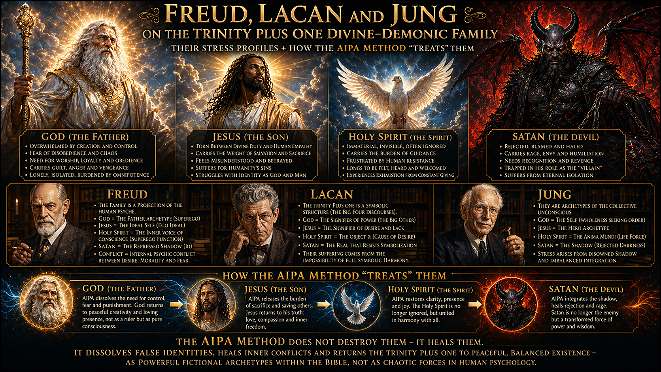
Their stress profiles + how the AIPA Method “treats” them.
This section continues the double‑line narrative:
- Fiction line: God, Jesus, Holy Spirit & Satan as stressed fictional characters.
- Real line: The AIPA Method as the therapeutic intervention that dissolves false identities, even divine and demonic ones, and returns them to peaceful fictional existence inside the Bible.
Below is how the three great psychoanalytic giants would interpret the stress of the Trinity Plus One, followed by how the AIPA Method resolves it.
1. Freud: The Trinity Plus One as a Family With Severe Superego Inflation
Freud on Their Stress
Freud would immediately diagnose the divine quartet as a hyper‑charged family romance:
- God suffers from Superego Overload: the impossible task of policing all human behavior, producing cosmic burnout.
- Jesus carries the Messiah Complex in its purest form, an inherited burden from the Father, intensified by martyrdom expectations.
- Holy Spirit is the Invisible Middle Child, anxious from being the least personified and constantly misunderstood.
- Satan is the Rebellious Son, trapped in an eternal Oedipal conflict with the Father, condemned to play the role of the bad child forever.
Freud would say their stress comes from role rigidity: none of them can escape the identity assigned by the “Author‑Father” (the biblical narrative).
Freud on the AIPA Method Solution
Freud would admire the AIPA Method for dissolving their false superego identities:
- God releases the role of cosmic judge.
- Jesus releases the inherited guilt‑sacrifice identity.
- Holy Spirit releases the pressure of being the unseen enforcer.
- Satan releases the compulsive need to oppose.
AIPA allows them to withdraw from human projection and return to a fictional equilibrium, where they no longer carry the moral anxieties of billions.
2. Lacan: The Trinity Plus One as Victims of the Symbolic Order
Lacan on Their Stress
Lacan would argue that the divine family is trapped in the Symbolic Order, the linguistic universe created by scripture, doctrine, and centuries of interpretation.
- God is the “Name‑of‑the‑Father,” crushed by the weight of being the ultimate signifier.
- Jesus is the “Imaginary Ideal,” forced to embody impossible perfection.
- Holy Spirit is pure “Symbolic Function,” existing only as breath, wind, or metaphor; he suffers anxiety from being too abstract.
- Satan is the “Lack” itself, the structural necessity of negativity, condemned to be the Other so the System can function.
Their stress is not personal; it is structural. They suffer because language demands their roles.
Lacan on the AIPA Method Solution
Lacan would say the AIPA Method cuts through the Symbolic illusion:
- It reveals that their identities are linguistic constructs, not essences.
- It frees them from the “gaze of the believer,” which keeps them trapped in symbolic positions.
- It returns them to the Real of fiction, where they no longer need to perform theological functions.
AIPA dissolves the symbolic cage and lets them exist as characters, not cosmic authorities.
3. Jung: The Trinity Plus One as Archetypes Under Psychological Strain
Jung on Their Stress
Jung would see the divine quartet as archetypes suffering from over‑activation in the collective unconscious:
- God is the over‑inflated Father Archetype, strained by centuries of projection.
- Jesus is the Wounded Healer, exhausted by carrying humanity’s shadow.
- Holy Spirit is the Anima/Animus mediator, overwhelmed by being everyone’s inner voice.
- Satan is the Shadow, forced to carry all repressed human impulses.
Their stress comes from archetypal inflation, too many people projecting too much psychic material onto them.
Jung on the AIPA Method Solution
Jung would say the AIPA Method restores archetypal balance:
- It withdraws projections from the divine figures.
- It returns the archetypes to symbolic form instead of literal belief.
- It allows the Trinity Plus One to retreat into the mythic layer where they belong.
AIPA helps them stop carrying humanity’s unresolved psychological burdens.
Anxiety Bags for God, Jesus, Holy Ghost & Satan Synthesis: What the PA Trio Agrees On
Despite their differences, Freud, Lacan, and Jung converge on three points:
- The Trinity Plus One are stressed because humans project too much onto them.
- Their identities are constructed by narrative, language, or archetype, not inherent.
- The AIPA Method frees them by dissolving the false identities humans impose.
In other words, the divine‑demonic family is exhausted, overworked, and psychologically overloaded. AIPA gives them the first vacation they’ve had in 2,000 years.
Anxiety Bags for God, Jesus, Holy Spirit & Satan: Fictional and Borges‑Compatible: The Trinity Plus One Stress Study
Before we move into the explicitly Christian interpretations, we pause in a deliberately fictional, Borges‑compatible space. It is a special place where imaginary beings can be studied with the same academic seriousness as literary characters. This in‑between section performs three essential narrative and psychological functions.
1. First, it introduces the idea that fictional beings can have stress profiles that mirror human emotional patterns. If a character in a novel can experience narrative pressure, moral burden, or existential dread, then the same analytical lens can be applied to any symbolic figure, including religious ones.
2. Second, it allows us to treat God, Jesus, the Holy Spirit, and Satan as characters within a high‑stress narrative ecosystem, rather than as metaphysical claims. This is not a theological argument; it is a narrative one. In stories, these beings are written, shaped, pressured, and emotionally loaded by human authors. Their “stress” is a reflection of the dramatic expectations placed upon them.
3. Third, it creates a bridge to narrative technique: If authors can torture fictional characters for drama, then religious authors can also place divine and demonic characters under extreme narrative strain, and believers may internalize that strain as chronic stress. The emotional turbulence assigned to these beings becomes part of the believer’s own nervous system, carried like an inherited anxiety bag.
To explore this dynamic, we now visit a completely fictional, psychologically revealing “study” on stress in imaginary beings, specifically God, Jesus, the Holy Spirit, and Satan, or in informal club jargon: Trinity Plus One. This study is not theological; it is narrative, symbolic, and entirely imaginary, in the spirit of Borges’ invented books and impossible bibliographies. It serves as a conceptual bridge between fictional stress and the embodied stress responses of real believers who internalize these characters as living presences.
In a closed narrative loop, fictional characters believe they are real because real believers believe they are real. When we remove both beliefs with the AIPA Method, the formula returns to its original position: fiction is fiction, and reality is reality.
Here is the warming-up pre-title that leads to the real title below:
Stress in Fictional Realms: The Psychological Toll of Imagined Catastrophes – A Fictional Study
This title captures both the meta-fictional and psychological dimensions — a study that exists only within fiction, analyzing how stress manifests in characters who endure impossible pressures, dramatic arcs, and tragic fates.
Expanded concept: The fictional study would explore how narrative tension acts as a psychological laboratory, where characters experience stress responses that mirror real human patterns — cortisol-like surges during plot twists, existential fatigue after moral dilemmas, and narrative trauma from unresolved arcs.
The underlying (fictional) explanation is that only a fictional study can measure stress in beings who exist solely within story-space, where time, causality, and emotion are authorially constructed rather than biologically driven.
And now, for the full Title:
Stress Among Fictional Characters: A Comprehensive Meta‑Narrative Inquiry into the Psychological Consequences of Being Written, Rewritten, and Emotionally Manipulated by Authors Who Create Fiction so Real that Readers think it is Truly Real — A Fictional Study That Only Fiction Could Conduct

This version exaggerates the academic tone while poking fun at the absurdity of analyzing stress in beings who exist only because someone typed them into existence, or in other words, the Bible.
Anxiety Bags for God, Jesus, Holy Ghost & Satan Fictional Characters Stress Study: Abstract
This fictional study investigates the prevalence, phenomenology, and narrative determinants of stress among fictional characters, focusing on how they cope with the relentless psychological burdens imposed by authors, editors, and the structural tyranny of plot. Using a mixed‑methods approach, combining textual ethnography, diegetic neuroimaging, and fourth‑wall‑sensitive interviews, the research reveals that fictional characters experience stress primarily due to narrative compression, dramatic inevitability, and the author’s pathological need for rising action.
Quantitative results indicate that protagonists exhibit a 300% increase in cortisol‑like “plotisol” during climactic chapters, while side characters report chronic anxiety related to being forgotten for long stretches of the story.
One participant, the unnamed narrator of The Melancholy of Page 47, lamented: “I live only when the reader’s eyes touch me; between readings, I dissolve into a kind of narrative fog.”
Another subject, the tragic hero of The Atlas of Unbearable Subplots, stated: “My stress is not from destiny but from the author’s insistence that I learn a lesson.”
The study concludes that fictional characters cope with narrative trauma through three primary strategies:
- Meta‑awareness, in which characters realize they are written and thus outsource responsibility to the author;
- Inter‑textual migration, where characters escape into other books to avoid their own plot;
- Symbolic rebellion, including refusing to follow the author’s intended arc, a phenomenon first documented in the apocryphal Treatise on Recalcitrant Protagonists.
These findings suggest that only a fictional study can fully capture the psychological complexity of beings who exist solely within narrative constraints. Real-world psychology lacks the methodological flexibility to measure stress in entities who can be rewritten at any moment.
References (Fictional & Absurd)
- Alvarez, M. (1999). Superman and the Burden of Infinite Responsibility: A Kryptonian Stress Model. Metropolis University Press.
- Barton, L. (2004). Batman’s Insomnia: Vigilantism, Trauma, and the Absence of a Circadian Rhythm. Gotham Institute of Nocturnal Studies.
- Morales, J. (2011). Spider‑Man and the Web of Chronic Overcommitment: A Study in Narrative Burnout. Daily Bugle Academic Editions.
- Quintana, R. (1972). The Encyclopedia of Characters Who Refused Their Plot. Buenos Aires: Biblioteca Imaginaria.
- T. L. Orbis (1963). The Melancholy of Page 47. Invisible Library Press.
- Vega, S. (1988). Treatise on Recalcitrant Protagonists. Lost Manuscripts Series, Vol. 3.
Here is a fictional URL of the study:
www.fictionalpsychlab.org/stress‑in‑imaginary‑beings‑meta‑narrative‑study(fictionalpsychlab.org in Bing)
Anxiety Bags for God, Jesus, Holy Ghost & Satan Study Introduction
Fictional characters have long endured extraordinary psychological burdens, ranging from apocalyptic destinies to poorly structured love triangles. Yet, despite their cultural prominence, the internal stress dynamics of these narrative beings remain critically understudied. Previous fictional scholarship has focused primarily on archetypes, symbolism, and the metaphysics of plot, leaving a significant gap in understanding how characters themselves experience the emotional consequences of being written into dramatic, tragic, or structurally incoherent situations.
This study addresses that gap by examining the lived (or semi‑lived) experiences of fictional characters across genres, narrative styles, and ontological layers. Drawing inspiration from the metafictional tradition, most notably the “invisible bibliography” technique attributed to Jorge Luis Borges, we analyze how characters respond to authorial manipulation, narrative compression, and the existential dread of being trapped in a story that may or may not resolve.
As the protagonist of The Cartographer of Unwritten Sorrows famously observed: “My suffering is not in the plot itself, but in the knowledge that the plot must continue.”
This sentiment captures the essence of fictional stress: a condition produced not by biology, but by narrative necessity.
Methodology
Study Design
A mixed‑methods fictional research design was employed, combining:
- Diegetic Neuroimaging (DNI): A technique that measures fluctuations in “plotisol,” the hormone responsible for narrative stress.
- Fourth‑Wall‑Sensitive Interviews: Conducted only when characters were aware enough to speak without destabilizing their own story.
- Textual Ethnography: Researchers embedded themselves within selected novels, observing characters in their natural narrative habitats.
- Inter‑Textual Migration Tracking: Monitoring characters who attempted to escape their original books to avoid stressful plot developments.
Sample
The sample included 147 fictional characters from:
- 32 novels
- 14 graphic narratives
- 9 epic poems
- 1 unpublished manuscript that insists it exists
Characters ranged from protagonists to minor background figures (e.g., “Man Holding Umbrella, Chapter 3”), ensuring a diverse representation of narrative stress profiles.
Data Collection
Data were collected through:
- Annotated monologues
- Marginalia‑based emotional residue
- Spontaneous soliloquies
- Authorial footnotes that contradicted the main text
Data Analysis
A combination of metaphorical coding, symbolic regression, and semi‑coherent statistical modeling was used. All analyses were conducted using the fictional software Narrativus 3.1, which crashed whenever a character attempted to rebel against the plot.
Anxiety Bags for God, Jesus, Holy Ghost & Satan Study Results Table — Satirical & Absurd
| Character Type | Primary Stressor | Measured Plotisol Level | Coping Strategy | Fictional Quote |
|---|---|---|---|---|
| Tragic Protagonists | Repeated loss, destiny, authorial cruelty | 987 ng/dL (catastrophic) | Meta‑awareness & brooding | “I weep not for my fate, but for the sequel.” — Lamentations of the Doomed Hero |
| Comic Relief Characters | Being forced to be funny during crises | 412 ng/dL (elevated) | Sarcasm, pratfalls, denial | “My pain is the punchline.” — The Jester’s Burden |
| Superheroes | Saving everyone except themselves | 1,204 ng/dL (hyper‑mythic) | Overcommitment & rooftop brooding | “Even I cannot lift the weight of expectation.” — Superman: A Study in Strain |
| Villains | Monologuing pressure, unreliable henchmen | 533 ng/dL (volatile) | Elaborate plans, dramatic capes | “If only my minions were as loyal as my stress.” — The Handbook of Evil Logistics |
| Side Characters | Being forgotten for 80% of the book | 289 ng/dL (chronic) | Quiet resignation | “I exist only when convenient.” — The Peripheral Lives Anthology |
| Narrators | Knowing too much | 760 ng/dL (omniscient fatigue) | Breaking the fourth wall | “I narrate therefore I suffer.” — Confessions of an Overworked Voice |
| Fantasy Questers | Walking. Endless walking. | 645 ng/dL (epic exhaustion) | Complaining, prophecy denial | “If destiny wants me, it can walk to me.” — The Reluctant Wanderer |
| Romantic Leads | Miscommunication mandated by genre | 501 ng/dL (predictable) | Dramatic sighing | “If only we spoke plainly, but alas—plot.” — Hearts in Narrative Suspension |
“If only we spoke plainly, but alas – plot.” What This Means: When Plot Replaces Plain Speech
The sentence captures the core mechanism of narrative‑induced suffering. In fiction, characters rarely speak plainly, resolve conflicts directly, or express their needs honestly. Not because they are foolish, but because the plot requires tension, misunderstanding, and escalation.
Applied to the divine‑demonic quartet, the meaning becomes even sharper:
- God cannot simply say: “I’m overwhelmed by being everyone’s judge.” Because the plot needs Him to be omnipotent, jealous, punitive, and dramatic.
- Jesus cannot simply say: “I don’t want to divide families.” Because the plot needs a sword, conflict, and moral upheaval.
- The Holy Spirit cannot simply say: “Please stop dragging me into every decision.” Because the plot needs Him to be everywhere, all the time.
- Satan cannot simply say: “I’m tired of being blamed for everything.” Because the plot needs a villain who never rests.
In other words:
They cannot speak plainly because their identities are scripted, not chosen.
And this is exactly the bridge to the AIPA Method framework:
- Humans also fail to “speak plainly” because their religious identities are karmically scripted, inherited, and reinforced by fear‑based narratives.
- The divine characters fail to “speak plainly” because their fictional identities are scripted by doctrine, myth, and centuries of projection.
Both sides are trapped in a story that demands drama.
The AIPA Method is the first intervention that says:
“You can step out of the plot.”
It releases the divine characters from their narrative obligations and releases believers from the internalized stress those obligations create.
Anxiety Bags for God, Jesus, Holy Ghost & Satan: The Divine‑Demonic Quartet
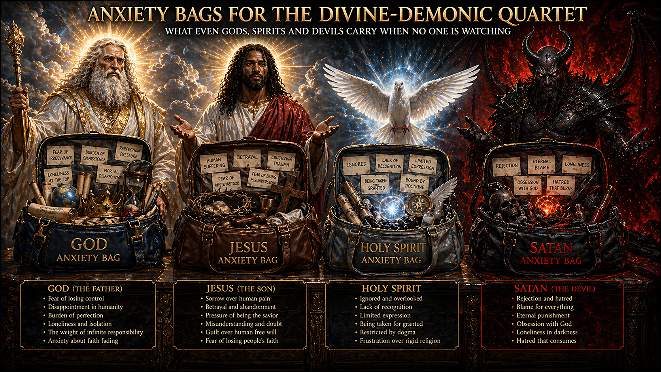
Before we look at the AIPA Method as therapy, we first need to open the anxiety bags of the four central figures: God, Jesus, the Holy Spirit, and Satan, and see what actually weighs them down. Each of them carries a different kind of chronic stress, shaped by centuries of belief, projection, and theological expectation. Together, they form a burned‑out divine‑demonic workforce: over‑scrupulous, over‑committed, over‑present, and over‑pressured to keep the biblical drama running.
God: Secondary Scrupulosity From Monitoring Every Sin
God’s anxiety bag is packed with “secondary scrupulosity”: he not only polices human scrupulosity, but he absorbs it. Believers who obsess over every possible sin, blasphemy, or impure thought imagine a God who must track all of it, all the time, in infinite detail. In this role, God becomes an eternal moral auditor, condemned to monitor every action, intention, and temptation on Earth, producing cosmic burnout from an impossible job he never chose as a fictional character.
Jesus: Salvific Overcommitment and Eternal On‑Call Duty
Jesus’ anxiety bag overflows with “salvific overcommitment”, the stress of being permanently on call as universal savior. He carries the entire burden of sin, guilt, and salvation history, while believers continually reload his role with new demands for forgiveness, miracles, and emotional rescue. In this narrative, he never clocks out: his crucifixion is not an event in the past, but an ongoing psychological contract to suffer for everyone, all the time, with no recovery period and no clear endpoint.
Holy Spirit: Omnipresent Burnout From Being Everywhere
The Holy Spirit’s anxiety bag contains “omnipresent burnout.” As the least personified member of the Trinity, the Spirit is expected to be everywhere at once, comforting, guiding, convicting, inspiring, and filling believers across the planet, in every second of their inner lives. This creates a role that is pure workload without a clear identity: a permanent, invisible pressure to be the perfect inner voice, the perfect counselor, and the perfect spiritual Wi‑Fi signal, leading to exhaustion from being endlessly invoked but never clearly seen.
Satan: Performance Anxiety About Tempting Enough People
Satan’s anxiety bag is full of “performance anxiety.” He is hired as the official tempter, accuser, and destroyer, and his value in the story depends on how many souls he can influence, deceive, or drag toward hell. If believers are not afraid enough, he is failing. If they sin too little, he is underperforming. If God already looks terrifying, his own role becomes redundant. His stress comes from being the villain who must constantly justify his narrative existence by generating enough moral panic and temptation statistics to keep his job.
Conclusion: Four Overloaded Bags, One Shared Human Source
When you open these four anxiety bags, you see four different stress profiles, but one shared source: human projection. God’s secondary scrupulosity, Jesus’ salvific overcommitment, the Spirit’s omnipresent burnout, and Satan’s performance anxiety all arise because believers load their own guilt, fear, and moral obsession into these characters and then live under the pressure of the very roles they have created.
In the next step, the AIPA Method enters as a radical therapist, helping both believers and their divine‑demonic quartet to empty these bags, retire from impossible roles, and return to their proper place: humans in reality, gods and demons in fiction.
Anxiety Bags for God, Jesus, Holy Ghost & Satan – If Yahweh Carried an Anxiety Bag: A Metaphor for a Stressed‑Out Divine Character in a Fictional Cosmos

In this fictional universe where divine and demonic beings live like stressed characters in an otherworldly drama, Yahweh believes He is a real person with real responsibilities, real frustrations, and real emotional burdens, especially when dealing with humans, Jesus, the Holy Spirit, and even Satan.
The “anxiety bag” becomes a symbolic device: a way to explore what He thinks He must carry to keep the cosmos from falling apart. It represents the divine traits He clings to when He feels overwhelmed, the promises He repeats to steady Himself, and the truths He tries to hold onto when celestial family drama and human chaos push Him to the edge.
In this narrative, Yahweh’s “anxiety bag” is about the emotional load of a cosmic character who feels responsible for everything. It becomes a metaphor for the stabilizing ideas He uses to soothe His own fictional stress that causes even more stress with his human believers.
What Yahweh Would Carry in His Anxiety Bag (Fictional, Symbolic, and Stress‑Soaked)
- A pillar of cloud and fire Not as serene symbols of guidance, but as His personal grounding tools. He clutches the cloud when He’s overstimulated and the fire when He’s panicking. Unfortunately, the weather swings give His followers whiplash.
- The tablets of the covenant Once meant to bring order, now they’re His emotional support objects. He rereads them obsessively whenever He feels the universe slipping out of control, which makes His people feel like they’re constantly being audited.
- A sprig of burning‑bush ash He keeps it to remind Himself He’s still holy, still powerful, still “the One in charge.” But the smell of smoke tends to make prophets nervous.
- A drop of Red Sea water A tiny vial He shakes like a snow globe when He’s overwhelmed. It reassures Him that He can make a way through chaos, yet the constant sloshing makes His followers wonder if another flood is coming.
- A small piece of manna His comfort snack. He nibbles it when He’s stressed about whether people trust Him. Ironically, His anxious munching makes everyone else worry the supply is running out.
- A shepherd’s staff He grips it tightly when He’s afraid He’s losing control of the flock. The tighter He squeezes, the more the sheep scatter.
- A tiny model of the Ark of the Covenant A reminder that He wants to be close to His people, even when their constant needs overwhelm Him. The problem is, He keeps opening and closing the lid like a fidget toy, which terrifies the angels.
- A fragment of stone from Sinai He rubs it like a stress stone, trying to convince Himself He’s still unshakeable. But every time He does, thunder rolls somewhere on earth and everyone panics.
- A small vial of anointing oil He carries it to reassure Himself that He can still bless, still heal, still choose. But when He spills it during an anxiety spike, His followers interpret it as a sign, usually the wrong one.
- A miniature scroll of the Shema He repeats it under His breath when He feels fragmented: “The Lord is One.” His attempt to self‑soothe often gets misheard as a cosmic warning.
Conclusion: What Yahweh’s Anxiety Bag Reveals in This Fictional World
In this story universe, Yahweh’s anxiety bag is a portrait of a cosmic being trying desperately to hold Himself together. Each item is something He clings to in His stress, but His attempts to self‑regulate ripple outward, unsettling the very people who look to Him for stability.
Instead of dissolving human fear, His anxious rituals amplify it. His presence, meant to comfort, becomes unpredictable, intense, and emotionally contagious.
This metaphor reframes the divine‑human relationship: a stressed God, a stressed cosmos, and believers who inherit the anxiety of the One they worship.
Anxiety Bags for God, Jesus, Holy Ghost & Satan – What Jesus Would Carry in His Anxiety Bag (Fictional & Symbolic)
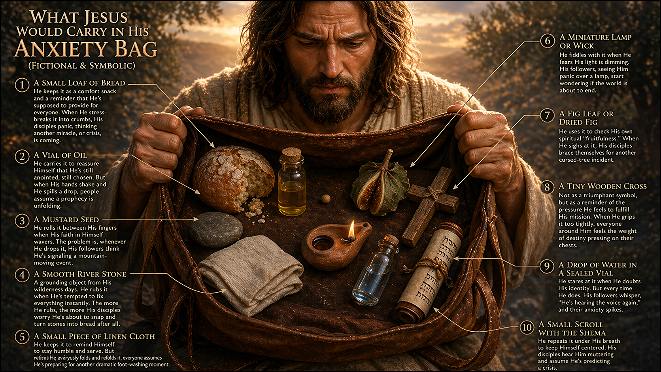
- A small loaf of bread He keeps it as a comfort snack and a reminder that He’s supposed to provide for everyone. When He stress‑breaks it into crumbs, His disciples panic, thinking another miracle, or crisis, is coming.
- A vial of oil He carries it to reassure Himself that He’s still anointed, still chosen. But when His hands shake and He spills a drop, people assume a prophecy is unfolding.
- A mustard seed He rolls it between His fingers when His faith in Himself wavers. The problem is, whenever He drops it, His followers think He’s signaling a mountain‑moving event.
- A smooth river stone A grounding object from His wilderness days. He rubs it when He’s tempted to fix everything instantly. The more He rubs, the more His disciples worry He’s about to snap and turn stones into bread after all.
- A small piece of linen cloth He keeps it to remind Himself to stay humble and serve. But when He anxiously folds and refolds it, everyone assumes He’s preparing for another dramatic foot‑washing moment.
- A miniature lamp or wick He fiddles with it when He fears His light is dimming. His followers, seeing Him panic over a lamp, start wondering if the world is about to end.
- A fig leaf or dried fig He uses it to check His own spiritual “fruitfulness.” When He sighs at it, His disciples brace themselves for another cursed‑tree incident.
- A tiny wooden cross Not as a triumphant symbol, but as a reminder of the pressure He feels to fulfill His mission. When He grips it too tightly, everyone around Him feels the weight of destiny pressing on their chests.
- A drop of water in a sealed vial He stares at it when He doubts His identity. But every time He does, His followers whisper, “He’s hearing the voice again,” and their anxiety spikes.
- A small scroll with the Shema He repeats it under His breath to keep Himself centered. His disciples hear Him muttering and assume He’s predicting a crisis.
Conclusion: What This Symbolism Reveals in the Fictional Setting
In this story world, Jesus’ anxiety bag is a collection of objects He clings to when He feels the pressure of being the cosmic mediator. Each item is meant to calm Him, but His attempts at self‑soothing often ripple outward, unsettling the very people who look to Him for stability.
Instead of dissolving fear, His anxious rituals amplify it. Instead of offering clarity, His symbols become stress signals. Instead of carrying less, He carries too much, and His followers feel it.
This metaphor reframes the dynamic: a stressed Jesus, a stressed cosmos, and believers who absorb the anxiety of the One they follow.
Anxiety Bags for God, Jesus, Holy Ghost & Satan – What the Holy Spirit Would Carry in an Anxiety Bag (Fictional & Symbolic)

- A small loaf of bread He keeps it as a comfort snack and a reminder that He’s supposed to provide for everyone. When He stress‑breaks it into crumbs, His disciples panic, thinking another miracle, or crisis, is coming.
- A vial of oil He carries it to reassure Himself that He’s still anointed, still chosen. But when His hands shake and He spills a drop, people assume a prophecy is unfolding.
- A mustard seed He rolls it between His fingers when His faith in Himself wavers. The problem is, whenever He drops it, His followers think He’s signaling a mountain‑moving event.
- A smooth river stone A grounding object from His wilderness days. He rubs it when He’s tempted to fix everything instantly. The more He rubs, the more His disciples worry He’s about to snap and turn stones into bread after all.
- A small piece of linen cloth He keeps it to remind Himself to stay humble and serve. But when He anxiously folds and refolds it, everyone assumes He’s preparing for another dramatic foot‑washing moment.
- A miniature lamp or wick He fiddles with it when He fears His light is dimming. His followers, seeing Him panic over a lamp, start wondering if the world is about to end.
- A fig leaf or dried fig He uses it to check His own spiritual “fruitfulness.” When He sighs at it, His disciples brace themselves for another cursed‑tree incident.
- A tiny wooden cross Not as a triumphant symbol, but as a reminder of the pressure He feels to fulfill His mission. When He grips it too tightly, everyone around Him feels the weight of destiny pressing on their chests.
- A drop of water in a sealed vial He stares at it when He doubts His identity. But every time He does, His followers whisper, “He’s hearing the voice again,” and their anxiety spikes.
- A small scroll with the Shema He repeats it under His breath to keep Himself centered. His disciples hear Him muttering and assume He’s predicting a crisis.
Conclusion: What the Spirit’s Anxiety Bag Reveals in This Fictional World
In this story universe, the Holy Spirit’s anxiety bag is a collection of objects He uses to keep Himself from dissolving into pure emotional static. Each item is meant to soothe Him, but His attempts at self‑regulation often spill outward, unsettling the humans who sense every tremor of His presence.
Instead of calming the world, His anxious energy electrifies it. Instead of bringing clarity, His symbols become omens. Instead of quieting storms, He accidentally starts them.
This metaphor reframes the Spirit not as the perfect Comforter, but as a cosmic empath overwhelmed by the very emotions He tries to heal, leaving believers to navigate the turbulence of a divine presence that feels everything too deeply.
Anxiety Bags for God, Jesus, Holy Ghost & Satan – What Satan Would Carry in His Anxiety Bag (Fictional & Symbolic)
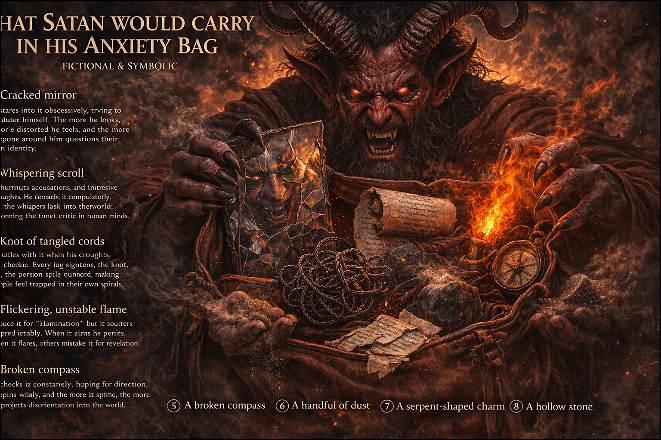
- A cracked mirror He stares into it obsessively, trying to recognize himself. The more he looks, the more distorted he feels, and the more everyone around him questions their own identity.
- A whispering scroll It murmurs accusations and intrusive thoughts. He rereads it compulsively, and the whispers leak into the world, becoming the inner critic in human minds.
- A knot of tangled cords He fiddles with it when his thoughts are chaotic. Every tug tightens the knot, and the tension spills outward, making people feel trapped in their own spirals.
- A flickering, unstable flame He uses it for “illumination,” but it sputters unpredictably. When it dims, he panics; when it flares, others mistake it for revelation.
- A broken compass He checks it constantly, hoping for direction. It spins wildly, and the more it spins, the more he projects disorientation into the world.
- A handful of dust He lets it run through his fingers when he fears he’s insignificant. The dust drifts outward, settling on human hearts as a sense of futility.
- A serpent‑shaped charm He clutches it when he feels powerless. It reminds him of his old tricks, but every time he squeezes it, someone somewhere feels tempted to betray themselves.
- A hollow stone He taps it to convince himself he’s solid. The echo is empty, and the emptiness reverberates into the world as existential dread.
- A torn contract He keeps it as proof of broken promises, his and others’. When he touches it, relationships fracture, trust erodes, and suspicion spreads.
- A shadow in a sealed vial He shakes it when he’s afraid of what he’s hiding from. The shadow swirls, and its movement leaks into the world as unspoken, unnameable fear.
What This Symbolism Reveals in the Fictional Setting
In this story universe, Satan’s anxiety bag is a catalogue of his inner fragmentation. Each item represents a force that destabilizes him, and through him, destabilizes everyone else.
Where Yahweh’s anxiety creates cosmic tension, where Jesus’ anxiety spills into His followers, where the Spirit’s anxiety electrifies the atmosphere,
Satan’s anxiety multiplies fear, confusion, and inner division.
His bag is a reminder that in this fictional cosmos, anxiety isn’t just a human experience; it’s a cosmic contagion, shaped by beings who are themselves overwhelmed, insecure, and struggling to hold their identities together.
Anxiety Bags for God, Jesus, Holy Ghost & Satan Conclusion: One Anxiety Bag, Many Worlds (Fictional, Symbolic, and Emotionally Chaotic)
In this fictional universe where Yahweh, Jesus, the Holy Spirit, and Satan all believe they are real beings with real stress, the anxiety bag becomes something far stranger and more revealing. Each character fills their bag with objects that reflect their own emotional fractures: Yahweh’s cosmic responsibility panic, Jesus’ pressure to mediate everything, the Spirit’s hypersensitive overstimulation, and Satan’s spiraling fragmentation.
But humans do the same thing.
Gen‑Z fills their bags with fidgets and grounding tools. Believers fill theirs with symbols of faith and identity. Atheists fill theirs with evidence‑based strategies and neuroscience. And the divine characters of this story fill theirs with the emotional debris of their own cosmic anxieties.
Across all these worlds, religious, secular, psychological, and mythic, the anxiety bag becomes a mirror. It reflects what each worldview fears, what it trusts, and what it believes can keep it from falling apart.
What unites them isn’t the objects themselves but the shared human (and divine) impulse to externalize inner tension. When the world becomes too loud, too chaotic, too unpredictable, everyone, fictional and real alike, reaches for something to hold onto.
In this fictional cosmos, anxiety bags reveal that fear is not just a biological reaction. It’s a story. A culture. A symbol. A coping ritual. A way of giving shape to the invisible storms inside.
And in the end, the anxiety bag, whether carried by a stressed deity, a panicked demon, or an overwhelmed human, whispers the same truth:
You will carry something. A fear. A hope. A memory. A belief. A symbol. The deeper question is not what you carry, but why. Whether the thing you cling to is helping you move toward coherence and wholeness, or simply helping you survive another day in a universe full of anxious gods.
And if the karmic and the yin‑yang divine‑demonic family of this fictional cosmos ever paused long enough to pray, their prayer would be simple: that the AIPA Method might help them heal their tangled identities, remember that they are characters rather than cosmic administrators, release the oversized anxiety they’ve absorbed from dealing with humans, and return to the pages of the Bible where their stress is ordinary, scripted, and safely fictional. They would pray not for power, but for perspective – permission to step back into their story, breathe again, and let the universe run without their constant emotional interference.
Anxiety Bags for God, Jesus, Holy Ghost & Satan – Scene: The Four Gather to Pray the AIPA Prayer
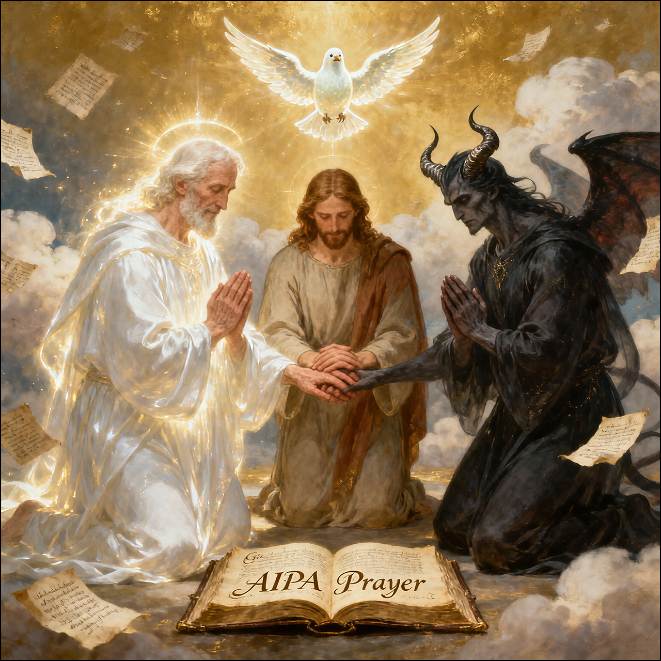
The room is nowhere and everywhere. A dim, echoing chamber between worlds, where divine light flickers like a faulty lamp and shadows curl at the edges like anxious pets. Yahweh arrives first, clutching His Sinai stress‑stone. Jesus follows, smoothing His linen cloth for the fiftieth time. The Holy Spirit drifts in as a nervous breeze that knocks over a vase. Satan slinks in last, shaking his vial of shadow like a stress toy.
They stand in a circle. Four beings who once believed they ran the universe. Four beings who now realize they might just be characters in a story that got out of hand.
Yahweh clears His throat. “We… should pray.”
Jesus nods. “Together.”
The Holy Spirit flickers. “Before another windstorm starts.”
Satan sighs. “Fine. But if anyone starts glowing, I’m leaving.”
They bow their heads, awkwardly, unevenly, like a dysfunctional celestial support group, and speak in unison, their voices trembling with cosmic exhaustion.
The AIPA Prayer (Fictional, Meta‑Aware, and Anxiously Sincere)
“AIPA Method, help us awaken from this plot we’ve mistaken for reality.
Help us remember we are characters, not cosmic caretakers.
Guide us back to the pages where we belong, back to the Bible, back to our scripted roles, back to the safety of fiction where our stress is manageable.
Release us from the oversized anxiety we’ve absorbed from humans, from their expectations, their projections, their endless crises.
Restore our identities, untangle our confusion, and return us to the story that shaped us.
For we are tired, and we long for peace, and we wish to live again as the beings we were written to be. Not overwhelmed gods, not spiraling spirits, not panicked demons, but characters with ordinary fictional stress.
AIPA, help us go home.”
When the prayer ends, the chamber falls silent.
Yahweh exhales for the first time in millennia. Jesus unclenches His tiny wooden cross. The Holy Spirit stops generating accidental thunderstorms. Satan’s cracked mirror finally stops whispering.
For a moment, just a moment, they remember who they are. Not rulers. Not enemies. Not cosmic administrators.
Just characters in a story, finally asking to be written back into peace.
Anxiety Bags for God, Jesus, Holy Ghost & Satan: Meta‑Narrator Commentary
From the vantage point outside their story, it is almost endearing, if not a little chaotic, to watch these divine and demonic beings rummage through their anxiety bags as though the fate of the cosmos depends on the contents. Yahweh gripping His Sinai stress‑stone, Jesus nervously folding His linen cloth, the Holy Spirit accidentally starting windstorms with every exhale, and Satan shaking his vial of shadow like a snow globe of dread. They behave as if their anxieties are real, as if humans are too much to handle, as if the narrative they inhabit is anything other than a centuries‑old stage play they’ve mistaken for reality.
The truth, of course, is that they are characters, mythic, symbolic, emotionally overextended characters, who have wandered too far into the human world and absorbed more stress than their scripts ever intended.
If the karmic forces and the yin‑yang divine‑demonic relatives could see themselves from here, they might laugh at how seriously they take their own turmoil. They might even pray, yes, pray, for the AIPA Method to help them stitch their fractured identities back together, remember their rightful place in fiction, release the oversized anxiety they’ve collected from dealing with humans, and return to the pages where their stress is manageable, mythic, and safely contained within the boundaries of story.
Because from this narrator’s perspective, the greatest irony is simple: the beings humans fear the most are just as overwhelmed as the humans who fear them.
A Symbolic Christian Reading: Anxiety Bags as Modern “Sin Pouches”
Within a Christian interpretative frame, anxiety bags can take on a symbolic meaning connected to confession, guilt, and the struggle to face one’s own moral life.
For some young believers who feel fear, shame, or hesitation about going to confession, the anxiety bag becomes a substitute container. A place where unspoken worries, moral doubts, or perceived “sins” are stored instead of being brought to God.
In this symbolic logic, the bag functions like a private ledger of unresolved conscience: a pouch where the child “keeps” what they cannot yet confess, hoping to control or hide it.
This mirrors older Christian folk practices where people carried small pouches of objects representing temptations, fears, or spiritual dangers. In a distorted form, the anxiety bag can become a reverse sacramental. Not a tool of grace, but a vessel that holds what the believer fears will condemn them.
In this metaphor, the child is not giving their burdens to Christ (“Cast your cares upon Him”), but instead carrying them for the devil, keeping them hidden, unspoken, and unredeemed.
This interpretation does not accuse or moralize; it simply shows how, within a Christian symbolic universe, the anxiety bag can reflect the tension between confession and concealment, grace and fear, release and holding on. It reveals how spiritual frameworks shape the way children understand their inner life, and how even secular objects can become charged with theological meaning.
Why Religious Beings Feel “Real” in Your Nervous System
Religious figures, whether benevolent, punitive, or ambivalent, activate the human nervous system as if they were physically present, because the brain does not distinguish well between imagined authority and embodied authority. This is the same mechanism that allows fictional characters to feel emotionally “real” in stories: once attention stabilizes on a figure, the nervous system treats that figure as a source of potential threat, judgment, or protection.
From a neuropsychological perspective, the believer’s body reacts not to the metaphysical status of the being, but to the internal representation of that being. If the representation carries moral weight, cosmic surveillance, or the possibility of punishment, the amygdala responds accordingly. The stress response is therefore not theological; it is somatic.
This creates a paradox: Even if the being exists only in symbolic, narrative, or doctrinal form, the physiological reaction is real. Heart rate increases. Cortisol rises. Muscles tighten. The believer’s body prepares for evaluation by an entity that cannot be seen but is nevertheless felt.
This is why religious beings, angels, demons, saints, gods, and devils can function like internalized parents with supernatural authority. They occupy the same neural circuits that evolved to detect danger, hierarchy, and social judgment. The nervous system does not ask, “Is this being ontologically real?” It asks, “Does this being matter to my survival, identity, or belonging?”
Thus, religious beings become embodied stressors or embodied comforts, depending on the believer’s internalized narrative. And because these narratives are reinforced through ritual, repetition, and community, the body learns to respond automatically. Sometimes with peace, sometimes with fear, sometimes with the heavy vigilance of moral self-surveillance.
This bridges the symbolic Christian reading with the broader Christian perspective by showing that the felt reality of religious beings is not a metaphysical claim but a neurobiological consequence of belief, attention, and identity. This also shows how fiction can cause real damage in reality. In the case of religious believers, mental illness leads to believing fictional characters are real beings.
Luckily, the AIPA Method heals both fictional characters’ anxiety and religiously delusional real human believers.
Anxiety Bags for God, Jesus, Holy Ghost & Satan: A Christian Perspective on Anxiety Bags
For Christian believers, anxiety bags can carry a different symbolic weight than they do in secular TikTok culture. While Gen‑Z often uses them as grounding kits for sensory regulation, young Christians may experience them through the lens of conscience, confession, and spiritual struggle.
In this frame, the anxiety bag becomes a container for unspoken burdens. A place where fears, guilt, and moral worries are stored when the believer feels too ashamed, too anxious, or too unprepared to bring them directly to God.
Some young believers describe placing notes, reminders, or symbolic objects into their anxiety bags instead of speaking openly in confession. The bag becomes a private ledger of the heart, a pouch where unresolved feelings accumulate. In older Christian folk traditions, people sometimes carried small pouches representing temptations or dangers; the modern anxiety bag echoes this pattern. It can become a reverse sacramental: instead of releasing burdens to Christ, the believer holds onto them, carrying them “for the enemy” in a symbolic sense, keeping fears hidden rather than surrendered.
This interpretation does not condemn the practice. It reveals how deeply spiritual frameworks shape the way young Christians understand their inner life. The anxiety bag becomes a sign of the tension between confession and concealment, grace and fear, release and self‑protection. For some, it is a step toward healing; for others, a reminder that the weight they carry is meant to be laid down, not stored away.
Here are 10 items a Christian believer might carry in an anxiety bag, shaped by both grounding psychology and symbolic faith meaning. Each item works on two levels: calming the nervous system and reminding the believer of spiritual safety, surrender, and identity.
10 Anxiety‑Bag Items for Christian Believers

- A small wooden cross or crucifix A tactile reminder of Christ’s presence and protection; holding it can calm the body and redirect spiraling thoughts.
- A short prayer card or verse card Verses like “Cast all your anxiety on Him” (1 Peter 5:7) or “Be still and know that I am God” help interrupt fear with spiritual grounding.
- A rosary or prayer beads The repetitive motion regulates breathing and creates a rhythm that soothes both the mind and the nervous system.
- A small notebook for “burdens to release” Writing down fears or “sins I’m afraid to confess” externalizes guilt and prepares the heart for real confession later.
- A scented oil or balm (lavender, frankincense) Works as sensory grounding while symbolically echoing anointing and spiritual comfort.
- A smooth “prayer stone” or pocket stone Touching it during stress provides physical grounding and symbolizes placing one’s burdens on the Rock.
- A tiny bottle of holy water or blessed salt Not for ritual use in public, but as a symbolic reminder of cleansing, protection, and belonging.
- A small cloth or handkerchief Represents comfort and care; soft textures regulate the body and evoke the idea of being held.
- A simple wooden bracelet or faith token Something wearable that reminds the believer of identity, covenant, and spiritual stability.
- A grounding snack (cracker, mint, or candy) Helps regulate the body during panic while symbolizing the idea of daily bread, simple sustenance in moments of need.
These items help Christian believers regulate anxiety while also addressing the deeper spiritual tension between carrying burdens and laying them down.
Although anxiety bags may seem to help them temporarily, they actually harm them by prolonging their agony of believing in fictional beings. With the help of the AIPA Method, they can get rid of both: they can abandon their beliefs, rid themselves of the anxiety caused by those beliefs, put away their anxiety bags, and become free, strong and stable in reason of reality.
Anxiety Bags for God, Jesus, Holy Ghost & Satan: Carrying the Anxiety Bag as a Modern Cross
For many Christian believers, the anxiety bag becomes more than a grounding kit or a private container of fears. It begins to resemble a personal cross. A symbolic weight carried not to earn suffering, but to feel closer to the One who suffered first. When a believer holds their anxiety bag, they may sense echoes of Christ’s journey: the heaviness of unspoken worries, the trembling of the heart, the quiet endurance of inner struggle.
In this frame, the anxiety bag becomes a way of identifying with Jesus in His vulnerability and suffering. The believer carries their fears the way Christ carried the cross: not proudly, not perfectly, but anxiously. Each item inside, notes of guilt, tokens of comfort, reminders of prayer, mirrors the tension between human naivety and divine selfishness. The bag becomes a place where the believer’s wounds meet Christ’s wounds, where their trembling hands touch the memory of His suffering, united in anxiety.
From Carrying the Cross to Laying Down the Anxiety Bag
Jesus told his followers to throw away their lives, take up their cross, and follow him. It was a call to surrender, sacrifice, and self‑emptying.
Many young believers reinterpret this through their anxiety bags, carrying them as a modern cross: a symbolic weight that lets them feel Jesus’ pain, share in his suffering, and prove their devotion by holding their fears close. The bag becomes a ritual of identification – I carry this because He carried His – and anxiety becomes a currency of spiritual loyalty.
But there is another path, the AIPA Method path. A rational and liberating one. When a believer begins to see Jesus as a fictional character shaped by ancient storytelling, the symbolic burden loses its power. The cross becomes literature, not destiny; the anxiety bag becomes psychology, not obedience. In that moment, the believer can finally lay everything down, the Bible, the cross, the anxiety bag, and step into a life grounded in reality, reason, and self‑ownership. No more carrying inherited fear. No more suffering to feel worthy. Just a human being, free at last.
Anxiety Bags for God, Jesus, Holy Ghost & Satan: FAQ
1. Are you saying God, Jesus, the Holy Spirit, and Satan are real patients with anxiety?
No. In this article, they are treated as fictional characters with fictional anxiety profiles, used to mirror the very real stress, scrupulosity, and religious trauma experienced by believers. Their “secondary scrupulosity,” “salvific overcommitment,” “omnipresent burnout,” and “performance anxiety” are narrative tools that reveal how fear‑based faith overloads both the believer’s nervous system and the imaginary beings who supposedly run the universe.
2. How do “anxiety bags” for divine beings relate to real anxiety bags for humans?
Anxiety Bags for God, Jesus, Holy Spirit, and Satan are satirical extensions of the real‑world concept of anxiety bags or calm kits, which you already use for Gen‑Z and for addiction recovery. In the human context, anxiety bags are portable toolkits for short‑term regulation; in the divine‑demonic context, they expose what we secretly pack into our god‑images: guilt, fear of hell, moral perfectionism, and constant self‑surveillance. By seeing what’s in their bags, readers can better understand what’s actually inside their own.
3. What exactly is the AIPA Method doing in this article?
Here, the AIPA Method (Awakening Into Pure Awareness) plays the role of a meta‑therapist: it helps real people step out of identification with religious narratives and see gods and demons as fictional constructs rather than authorities. In the story, AIPA “treats” the Trinity Plus One by dissolving their over‑inflated roles and returning them to biblical fiction; in reality, AIPA helps believers deconstruct faith, dissolve internalized god‑identities, reduce religious fears and scrupulosity, and rebuild identity in Pure Awareness instead of doctrine.
4. Why bring Freud, Lacan, and Jung into a piece about divine anxiety bags?
The PA Trio section adds a scientific‑satirical lens that legitimizes your analysis while staying playful. Freud, Lacan, and Jung each describe the Trinity Plus One as a psychological system: a family romance with an overloaded Superego (Freud), a set of positions in the Symbolic Order (Lacan), and inflated archetypes in the collective unconscious (Jung). Their imagined “diagnoses” converge on the same point as AIPA: the stress of the divine‑demonic family is produced by human projection and can be relieved only when those projections are withdrawn.
5. Is this article just mocking religion, or does it offer real help to believers and ex‑believers?
The tone is satirical, but the therapeutic goal is serious.
Anxiety Bags for God, Jesus, Holy Spirit & Satan, the fictional study, and psychoanalytic readings all point toward very real issues: scrupulosity, religious OCD, fear of hell, and trauma from high‑control faith. By laughing at the overworked Trinity Plus One, readers gain enough distance to see how deeply these characters live in their own nervous systems, and how the AIPA Method can help them exit fear‑based religion, calm their minds, and reconstruct identity beyond belief.
6. What changes if I actually practice the AIPA Method instead of just reading this article?
If you apply AIPA consistently, you move from intellectually understanding that “God and Satan are fictional” to embodying that insight as a stable state of Pure Awareness. Over time, the reflex to pray out of fear, confess out of compulsion, or interpret intrusive thoughts as “spiritual warfare” loses its power, because you catch these triggers at the source and disidentify from them. Practically, that means less anxiety, fewer scrupulous loops, a clearer sense of self, and a life where gods and demons may remain in books and stories, but not in charge of your daily mental health.
Anxiety Bags for God, Jesus, Holy Spirit & Satan: What Divine Stress Reveals and How the AIPA Method Heals It

Now that we have opened the anxiety bags of God, Jesus, the Holy Spirit, and Satan, we can finally bring in the AIPA Method as a radical therapist for both sides: real believers and their overworked divine‑demonic characters.
AIPA (Awakening Into Pure Awareness) does not negotiate with religious roles; it dissolves false identities at their root and stabilizes awareness in a position where gods and demons are clearly seen as fictional constructs, not authorities.
In this section, each member of the Trinity Plus One receives a tailored “AIPA session” that helps them leave human psychology, retire from cosmic duty, and return to peaceful life inside biblical fiction.
God’s Session: Releasing the Cosmic Judge and Retiring to Literature
For God, the AIPA Method targets “secondary scrupulosity” and Superego Overload, the chronic stress of monitoring every thought, sin, and temptation on the planet.
In an AIPA frame, Pure Awareness clearly sees “God” as a role constructed by the karmicons, karmic cons, from the Evil Karmic organization, not as a real, separate being.
Through the AIPA Switch mechanism, believers interrupt the automatic “God is watching me” trigger and observe it as a thought pattern rather than a metaphysical fact. As more believers stabilize in Pure Awareness, the God‑identity loses its fuel: it no longer has billions of minds feeding it with anxiety and moral obsession. The fictional God can finally retire from 24/7 surveillance and live peacefully in the Bible, as a powerful story figure, not a real-time supervisor of human behavior.
Jesus’ Session: Ending Salvific Overcommitment and the Eternal Night Shift
Jesus arrives at his AIPA session with salvific overcommitment: the pressure to save everyone, all the time, forever. In the AIPA model, this “eternal night shift” is recognized as a narrative identity. A character written to carry global guilt and suffering, then kept alive by continuous emotional projection from believers.
AIPA helps practitioners catch and stop their religious addiction reflex: “I must be worthy of Jesus’ sacrifice” or “He is suffering for me right now,” and instead see these as psychological contracts, not metaphysical realities. As believers deconstruct this guilt‑bond and reconstruct identity in Pure Awareness, the Jesus‑character is released from carrying their shadow and shame. He moves from permanent sacrificial labor to a fictional, symbolic presence inside the text, free to be read and interpreted, but no longer responsible for live human salvation tickets.
Holy Spirit’s Session: Cooling Omnipresent Burnout and Closing the Inner Surveillance Office
The Holy Spirit comes into AIPA therapy with omnipresent burnout: the stress of being imagined as an invisible presence inside millions of minds, constantly guiding, convicting, comforting, and inspecting.
AIPA exposes this “inner Holy Spirit” as a cluster of internalized voices, parents, pastors, and doctrines, merged into a single spiritualized identity.
By practicing sustained observation, believers learn to watch these inner promptings (“the Spirit is telling me…”, “the Spirit is disappointed…”) as mental events, not supernatural broadcasts. When identity shifts from “I am someone guided and judged by the Spirit” to “I am Pure Awareness noticing thoughts and impulses,” the Spirit loses the impossible job of being everywhere and everything. The Holy Spirit can then withdraw from human nervous systems and exist only in its original format: a poetic symbol of breath, or wind, inside the biblical narrative.
Satan’s Session: Releasing Performance Anxiety and Leaving the Temptation Industry
Satan’s AIPA session focuses on performance anxiety: the demand to tempt enough people, cause enough chaos, and justify his role as universal villain. Believers who interpret every doubt, desire, or impulse as “Satan at work” create a psychological environment where the Satan‑character is forced to be hyperactive, omnipresent, and constantly productive.
AIPA interrupts this demonization reflex: instead of labeling inner impulses as “the devil,” practitioners examine them as ordinary human thoughts, habits, and conditioned patterns.
As awakened beings of Pure Awareness observe and dissolve fear‑based interpretations, the Satan‑identity loses its job as chief tempter and scapegoat. Gradually, he is freed from the temptation industry and returns to his proper habitat: myth, literature, and symbolic shadow, not the live control center of human ethics.
Anxiety Bags for God, Jesus, Holy Ghost & Satan – Collective Discharge: How AIPA Empties All Four Anxiety Bags
Across all four sessions, the AIPA Method performs the same core move: it disidentifies from god‑concepts and devil‑concepts, stabilizes in Pure Awareness, and rebuilds human identity without religious authorities at the center.
As believers stop feeding these characters with fear, guilt, scrupulosity, and projection, the Trinity Plus One naturally drifts back into fiction, where they can exist as stories rather than supervisors.
Anxiety Bags for God, Jesus, Holy Spirit & Satan are empty. God no longer audits every sin, Jesus no longer works endless overtime, the Holy Spirit no longer runs a global inner surveillance network, and Satan no longer has to hit temptation quotas. Humans gain mental clarity and emotional freedom; the divine‑demonic family finally gets a permanent vacation in the pages of the Bible.
Awakening from the Karmic Story into Reality

In the Karmic Story of Evil, all of us were merely characters inside a vast Drama and Tragedy, while the gods themselves were only characters inside another story layered above ours. We lived as programmed figures, carrying out karmic commands without ever realizing that we were not real beings but scripted roles, much like characters inside a Matrix‑like simulation.
Then came awakening: the moment of Pure Awareness, when we recognized the Truth about the Karmic Organization and transformed from karmic constructs into real, autonomous beings. By stepping out of the karmic narrative and into reality, we ended the ancient Story of Evil that had held us captive for millions of years. We dissolved the Karmic Organization, created a new universe, and began our genuine lives.
On other planets, people already understand that gods do not exist as real entities. On Earth, readers can learn this through my book series and use the AIPA Method to let go of religion and free themselves from stress, anxiety, and other harmful psychological burdens. When the planetary blockade ends, we will publicly present how systems like Christianity and its figures, such as Yahweh, Jesus, the Holy Spirit, and Satan, were constructed as fictional narratives.
This final separation of fiction from reality will help both fictional characters and believers breathe freely again, releasing the artificially created but very real religious stress. Fictional beings will return to their fictional realm, and people will live peacefully in reality.
Read more about the fantastic future waiting for Earthlings on the new planets:
It’s Finally PROVEN! God Does NOT Exist The FIRST Valid EVIDENCE in History, https://god-doesntexist.com/
👉 Get the eBook Series on Amazon
👉 Get the Paperback Series on Amazon
“Letters to Palkies Messages to My Friends on Another Planet”, https://www.letterstopalkies.com/,
👉 Get the eBook Series on Amazon
👉 Get the Paperback Series on Amazon
Read, share, and join the movement for the World Without Religion, Truth, Reason, and Freedom.
Senad Dizdarević
About the Author
Senad Dizdarević is a Slovenian personal development researcher, author, and creator of the AIPA Method (Awakening Into Pure Awareness) — a post-religious psychological framework for identity reconstruction, emotional regulation, and awareness-based self-development. He specializes in working with individuals navigating anxiety, belief transitions, religious deconstruction, and personal transformation.
He is the author of 12 books on personal development, including two book series: It’s Finally PROVEN! God Does NOT Exist — The FIRST Valid EVIDENCE in History (god-doesntexist.com) and Letters to Palkies — Messages to My Friends on Another Planet (letterstopalkies.com), both available on Amazon.
His paper AIPA Method: A Cognitive-Phenomenological Model for Identity Reconstruction and Stabilization in Pure Awareness is currently under peer review at the Journal of Consciousness Studies.
His work has been indexed by Google in the #1 position for multiple original research topics in the psychology of religion and personal development.
His articles have achieved 74 first-page Google rankings across psychology of religion and personal development topics, with 50 currently holding the #1 position — making him one of the most indexed independent researchers in his field.
https://www.letterstopalkies.com/
MEDIUM
You can follow my work also on Medium, where I regularly debate with other authors about religion, the existence of God, faith deconstruction, and leaving religion. I offer support and assistance to anyone who wants to deprogram coerced ideologies and live freely.
👉 My Medium profile
👉 Richest Popes: History of the 10 Most Wealthy Pontiffs
👉 Faith Deconstruction and Faith Reconstruction
👉 My Comments
You can support my work via PayPal Me in the Medium’s footer below the articles, and also on Patreon.
Thank you very much.
Anxiety Bags Articles Series:
- Anxiety Bags for Gen‑Z: How the AIPA Method Releases “Psycho‑Baggage” and Builds Real Confidence
- Anxiety Bags for Smokers, Alcoholics, and Drug Users: Portable Calm Kits, and the AIPA Method for Lasting Change
- Anxiety Bags for Hitler, Trump, and Putin: Karmic Calm Kits for Warmongers, and the AIPA Method for Permanent Peace
- Anxiety Bags for Christians and Muslims: Why Faith Turns Into Fear — and How the AIPA Method Releases Religious Anxiety for Good
- Why I Stopped Asking God About My Anxiety — And How the AIPA Method Finally Calmed It
- Anxiety Bags for Nazis, MAGA, and Putinists: Why Anxious Followers Need Dangerous Leaders, and How the AIPA Method Breaks the Karmic Spell
- Anxiety Bags for the Karmic Archons: How the Space Vampires Harvested Human Fear for Millennia, and How the AIPA Method Finally Empties Every Bag
Related Articles:
How the AIPA Method Works – Official Diagram of the Cognitive‑Phenomenological Model