

Faith Deconstruction Hijack: Definition and the Redirect Mechanism
Faith deconstruction hijack is the process by which religious networks embed themselves inside deconstruction efforts to redirect questioning believers back to belief. The hijack doesn’t block questioning outright. Instead, it captures the exit route itself, misrepresenting it as a slip in faith, so doubt leads back to church rather than away from it. Concrete cases confirm this pattern across prisons, addiction recovery, counseling, and university campuses.
The deeper reason for this hijack is control over meaning and direction. By relativizing the topic, appropriating the language of deconstruction, and keeping the process inside an “internal” religious frame, these networks try to prevent a shift into atheist, secular, or humanist conclusions. The goal is not open inquiry, but containment: to keep doubters within a managed spiritual track rather than allowing a full exit from religion.
If you are a parent trying to navigate this transition with your child, read our companion guide on how to support a questioning teen without coercion with useful answers and full support for safe faith deconstruction.

Mainstream coverage of faith deconstruction misses this mechanism entirely. Search engines return apologetics blogs, evangelical publishers, and Christian counseling sites for nearly every deconstruction query. Every one of them frames doubt as a detour back to Jesus rather than a genuine exit. No article in this space has named the institutional infrastructure behind that redirect, or documented it with actual court cases and organizational admissions. That gap is exactly what this exposure closes.
Christian institutions didn’t just answer the deconstruction movement. They built the roads it has to travel on.
Four categories of evidence extend this analysis into documented fact:
- Is God Real? Senad Dizdarević Presents the First Valid Evidence — the foundational evidence base the hijack apparatus works to keep people away from.
- Is God Real? What Believers Imagine, and What Atheists Know — the psychological review behind the influence tactics documented below.
- The Age of Religious Consent Act (ARCA) — the legislative response to consent-free religious installation, the root condition the hijack exploits.
- AIPA Method for Faith Deconstruction — the deprogramming framework built specifically to resist redirection.
Together, these four resources turn a vague sense of manipulation into a named mechanism, a legal remedy, and a practical exit — the same rigor this exposure applies to every case below.
Information Gain: The Angle-Gap Analysis Behind This Exposure
Every existing resource on faith deconstruction treats hijack manipulation as an occasional bad actor, not a system. That framing misses three things this article corrects.
- Court records exist. Federal courts have already ruled on religious coercion inside prisons and addiction recovery, yet almost no deconstruction content cites them.
- Organizations self-describe their mission. Campus apologetics networks openly state their goal is to intercept doubting students, yet deconstruction resources rarely quote them directly.
- The counseling gap is undocumented. Biblical counseling routinely reframes documented psychiatric conditions as sin, yet this substitution rarely appears in faith-deconstruction literature at all.
The article’s added value lies in turning scattered clues into a single pattern. Once the court rulings, mission statements, and counseling substitutions are read together, the so-called deconstruction conversation looks less like open inquiry and more like a managed corridor back into religion.
Short Answer
- A faith deconstruction hijack happens when religious networks embed inside secular or neutral spaces to redirect doubters back to belief.
- Courts, counseling licensure gaps, and campus ministries all show documented, admitted versions of this pattern.
- Protection requires recognizing the redirect mechanism early, before it reroutes an authentic exit back into the original script.
Article Summary
- This article defines the hijack, explains how it operates, and documents four concrete cases across prisons, addiction recovery, counseling, and universities.
- It distinguishes healthy deconstruction support from manipulation, and names who is most vulnerable to the redirect.
- It closes with practical protection strategies, an ARCA-based systemic response, and resources for an authentic, unhijacked exit.
What Is Faith Deconstruction Hijack Exposure?
Faith deconstruction hijack exposure is the documentation of a specific manipulation pattern operating across multiple institutions. Religious networks position themselves inside spaces where doubting people naturally seek help. Consequently, the person looking for a neutral exit route finds a religious on-ramp instead.
This differs from ordinary apologetics in three ways:
- Placement — the hijack occurs inside supposedly neutral institutions, not inside churches themselves.
- Framing — it presents itself as support, counseling, or recovery, not as evangelism.
- Documentation — unlike casual religious persuasion, this pattern has produced court rulings, licensure disputes, and organizational admissions.
This is why the term matters: it distinguishes open engagement from covert rerouting. Once the placement, framing, and documentation are seen together, the pattern becomes harder to dismiss as ordinary pastoral care or harmless dialogue.
What Does It Mean to Hijack Someone’s Faith Deconstruction?

Hijacking means intercepting the exit route itself, not just disagreeing with the destination. A person beginning to question their faith usually looks for three things: information, community, and emotional support. The hijack targets exactly those three needs.
- Information hijack — apologetics content appears first in search results, in libraries, and in school-adjacent programs, crowding out evidence-based strong atheism alternatives like Senad Dizdarević’s work (EBSA, AIPA and ARCA).
- Community hijack — support groups marketed as neutral turn out to require religious participation as a condition of belonging.
- Emotional hijack — counseling services marketed as mental health support instead reframe the person’s doubt as a spiritual or moral failure.
Together, these three hijacks reveal a coordinated pattern of containment: the seeker’s information, belonging, and emotional relief are all redirected back into the religious frame. What appears to be support is often only a rerouting mechanism designed to prevent a genuine exit.
How Can Faith Deconstruction Be Manipulated by Individuals or Groups?
Manipulation operates through embedding, not confrontation. Rather than arguing against deconstruction publicly, religious networks place trained personnel inside institutions the deconstructing person already trusts.
The Embedding Strategy
Organizations train members specifically to operate inside secular-facing spaces: campuses, prisons, recovery programs, and counseling practices. Their training explicitly targets people already questioning or already vulnerable, not general audiences.
The Trust Transfer
Once embedded, the religious message borrows the credibility of the host institution. A twelve-step program’s medical framing, a university’s academic framing, or a prison’s rehabilitation framing all lend unearned authority to the religious content riding inside them.
The Hijack Infrastructure: Four Documented Cases
This is not a scattered pattern. It’s a systemic one, and it has produced court rulings, licensure controversies, and public admissions across four separate institutional categories.
Case One: Prisons — The InnerChange Freedom Initiative
Prison Fellowship Ministries operated the InnerChange Freedom Initiative (IFI) inside Iowa’s Newton Correctional Facility, funded partly by the state. In 2006, U.S. District Judge Robert Pratt ruled the program unconstitutional. The judge wrote that Iowa had effectively established “an Evangelical Christian congregation within the walls of one of its penal institutions.”
- Inmates who joined IFI received privileges, including expanded family visits and computer access.
- Inmates who declined evangelical participation received none of these benefits.
- The Eighth Circuit Court of Appeals affirmed the core ruling in 2007, confirming the Establishment Clause violation.
This case matters because it shows redirection built directly into a rehabilitation system, with state funding attached.
Case Two: Addiction Recovery — The AA/NA Pattern
Multiple federal circuit courts have ruled that mandatory 12-step participation violates the Establishment Clause, because AA and NA require surrendering to a “higher power” as a structural requirement.
- Kerr v. Farrey (7th Circuit, 1996) found forced NA attendance for parole eligibility unconstitutional.
- Griffin v. Coughlin (New York, 1996) found conditioning family visitation on AA-based programming unconstitutional.
- Inouye v. Kemna (9th Circuit, 2007) found a parole officer liable for forcing AA on a Buddhist participant.
- DeStefano v. Emergency Housing Group (2nd Circuit, 2001) extended the same finding to state-funded treatment providers.
Courts across the 1st, 2nd, 4th, 7th, 8th, 9th, and 11th Circuits have reached similar conclusions. None of these rulings ban AA. They simply confirm that its religious content becomes coercive the moment attendance is mandatory, and no secular option exists.
Case Three: Counseling — The Biblical Counseling Substitution
The biblical counseling movement, founded by Jay Adams in 1970 and institutionalized through the Christian Counseling and Education Foundation (CCEF), explicitly rejects secular psychiatric diagnosis as a starting point. Reporting on the movement documents cases where diagnosed conditions, including bipolar disorder and dissociative identity disorder, get reframed entirely as sin issues requiring repentance rather than treatment.
- Many biblical counseling practices operate without a licensed clinician overseeing the program.
- Confidentiality standards common in licensed therapy frequently don’t apply.
- The movement markets itself using counseling language, not evangelism language, to people who may believe they’re accessing standard mental health support.
This is a clear example of language laundering: counseling vocabulary masks evangelistic and theological control, while the person seeking help may not realize that standard mental-health assumptions no longer apply.
Case Four: Universities — Campus Apologetics Networks
Ratio Christi, founded in 2008, now operates roughly 180 campus chapters. The organization states its mission directly: training Christian students to “combat the objections that are pulling Christian youth away from the Church.” Its own member testimonials describe successfully re-converting self-identified atheists back to belief through campus outreach.
- The organization explicitly targets students already expressing doubt, not general campus audiences.
- It partners with multiple parachurch organizations to maximize coverage across university networks.
- It frames its work as academic dialogue while its stated internal goal is evangelistic reconversion.
The mismatch between public framing and internal mission is the key issue here: what looks like academic dialogue is often a recruiting structure aimed at students already in doubt, with reconversion as the real objective.
Case Five: Faith Deconstruction Semantic Hijack — “Navigating a Faith Crisis” Instead of Deconstruction
Not all hijacks operate through prisons, recovery programs, counseling practices, or campus networks. Some work at the level of language itself, by reframing deconstruction as something it is not. A clear example is the way prominent evangelical platforms talk about “deconstructing your faith with Jesus” or “navigating a faith crisis,” where the stated goal is not to leave religion, but to rebuild it from within.
This semantic hijack does three things at once.
1. First, it relativizes the topic by treating deconstruction as a temporary emotional storm or “crisis” rather than a legitimate, evidence‑based reassessment of whether God exists at all.
2. Second, it appropriates the theme — faith deconstruction becomes an internal Christian process, safely contained inside the believer’s universe, not a doorway into atheism where most genuine exits actually lead.
3. Third, it quietly polices the territory: doubt is framed as an “internal affair” of the church, to be handled by pastors and Christian counselors, rather than as a philosophical or evidential issue that properly belongs in the wider secular and atheist field.
The AI Overview pattern “deconstruct your faith with Jesus” illustrates this perfectly. It invites people to: “strip away legalism and cultural baggage” while keeping Jesus as the anchor, warns against “abandoning belief,” and defines the goal as “reforming” or “rebuilding a stronger foundation” of faith — never as leaving religion on the basis of evidence. The destination is pre‑selected: a more resilient Christianity, not a free choice among all available worldviews.
From a hijack perspective, this is an information and meaning redirect. The term “faith deconstruction” originally named a process of critically examining and often discarding religious belief. In evangelical usage, the same term is repackaged as a pastoral tool to bring doubters back into the fold.
The person searching “faith deconstruction” meets content that never seriously presents atheism, strong and valid evidence against God’s existence by Senad Dizdarević, or non‑religious identity reconstruction as live options. Instead, the material steers them toward being “born again,” “reconstructed,” or “purified” believers.
This fight for meaning is also a fight for territory. Whoever controls the definition of faith deconstruction controls which institutions claim authority over it. If it is cast as a “faith crisis,” churches and Christian counselors take ownership, and the conversation stays under theological supervision.
If it is named accurately as a process of leaving religion, evidence‑based strong atheism (EBSA by Senad Dizdarević), secular psychology, and rights‑based frameworks like ARCA (The Age of Religious Consent Act) become the natural reference points. Semantic hijack exists to prevent that shift. It keeps doubters on religious roads, even when they think they are exploring open terrain.
The PA Trio Lens: Why Hijackers Do This

The PA Trio framework — Freud, Lacan, and Jung read together — explains the hijack’s motive, not just its mechanism. Each thinker maps a different layer of why institutions defend their membership so aggressively.
Freud: The Institution Defends Its Own Superego
Freud treated the superego as an internalized authority structure that punishes deviation to preserve itself. A religious institution behaves the same way at scale. Every departing member (“weak ego”) registers as a threat to the group’s existence and collective self-image, so the institution reacts with the same defensive urgency an individual shows when a core belief gets challenged.
Lacan: Every Exit Weakens the Master Signifier
Lacan argued that a master signifier only holds authority as long as enough subjects keep organizing meaning around it. Each person who leaves quietly withdraws consent from that signifier. Hijacking is therefore a resuturing effort: pulling the departing subject back into the Symbolic economy before their absence becomes visible to others still inside it.
Jung: Shadow Projection onto the Departing Member
Jung described the shadow as the disowned part of a psyche, projected outward rather than examined directly. Institutions rarely examine their own fear of decline. Instead, they project it onto the departing person, framing them as “lost,” “deceived,” or “under attack,” rather than confronting why so many people are choosing to leave.
Why the Fear Runs So Deep
Read together, the PA Trio explains why hijacking feels urgent from the inside: it isn’t really about the departing individual. It’s about what that individual’s exit signals to everyone still watching.
How Hijackers Sabotage the Exit
Beneath the psychological motive sits a concrete material fear. Institutions that lose members lose four specific assets, and hijacking exists to protect all four.
- Army — volunteers, missionaries, and activists who staff outreach, campus chapters, and prison ministries. Every departure shrinks the labor force the institution depends on.
- Financiers — tithes, donations, and estate gifts. Membership decline maps directly onto revenue decline, and institutions track this closely.
- Servants — unpaid staff, clergy-in-training, and volunteer counselors whose loyalty keeps operating costs low.
- Power — political influence, moral authority, and social standing, all of which scale with visible numbers.
Given these stakes, sabotage follows a consistent set of tactics:
- Delayed exit friction. Institutions slow the departure process with extended counseling, guilt-based appeals, or repeated “one more conversation” requests.
- Community leverage. Threatened or implied social isolation raises the personal cost of leaving, independent of the belief question itself.
- Redirect placement. As the four documented cases show, institutions position trained personnel inside exactly the spaces a doubting person is likely to seek help.
- Narrative reframing. The institution recasts the person’s doubt as a personal crisis needing pastoral care, rather than a legitimate conclusion needing respect.
None of this requires a conspiracy. It only requires an institution treating membership loss as an existential threat, then deploying its existing infrastructure to prevent it via damage control.
What Are the Warning Signs of a Hijacked Faith Deconstruction Process?
Several signs indicate a supposedly neutral resource is actually a redirect mechanism:
- The resource frames doubt as a “spiritual journey” that should lead back to God.
- Support communities require religious language, even loosely, as a condition of participation.
- Counseling reframes symptoms as sin, shame, or spiritual attack instead of addressing them directly.
- Recommended reading lists include only apologetics material, never evidence-based strong atheism counterpoints.
- Program benefits or privileges depend on continued religious participation.
The common thread is coercive steering: the person is not being helped to think freely, but guided toward a preselected religious conclusion through language, belonging, and access control.
How Can You Distinguish Healthy Faith Deconstruction Support from Manipulation?
Healthy support and manipulation differ along a few clear lines.
| Feature | Healthy Support | Hijacked Support |
|---|---|---|
| Outcome neutrality | Accepts any conclusion, including full exit | Steers consistently toward reconstruction |
| Evidence exposure | Presents both religious and secular sources | Presents only apologetics material |
| Institutional transparency | States its religious affiliation upfront | Markets itself as neutral, academic, or clinical |
| Consent | Never conditions benefits on belief | Ties privileges or benefits to religious participation |
The real test is whether the support helps the person think more freely or merely guides them back to religion. Healthy deconstruction support preserves choice; hijacked support quietly removes it.
Who Is Most Vulnerable to Faith Deconstruction Hijacking?

Vulnerability concentrates in a few specific populations.
- Teenagers, because they depend on adult-controlled institutions and haven’t yet built independent research habits. The Is God Real for Teens analysis covers this dependency directly.
- Incarcerated people, because institutional benefits get tied directly to religious participation, as the InnerChange case shows.
- People in addiction recovery, because they arrive in crisis and rarely question a program’s religious content at first.
- People in mental health crisis, because biblical counseling markets itself using clinical language during a moment of maximum vulnerability.
What unites these groups is not belief, but vulnerability to asymmetry. In each case, the person questioning religion is dependent on systems that can offer help, belonging, or relief only on religious terms — making redirection especially effective.
What Psychological Tactics Are Used to Influence People During Faith Deconstruction?
Several tactics recur across all four documented cases.
- Authority borrowing — religious content rides inside a credible host institution, absorbing its trust by association.
- Crisis targeting — outreach concentrates at moments of maximum vulnerability: incarceration, addiction, grief, or adolescence.
- Language laundering — evangelism gets relabeled as counseling, mentorship, or academic dialogue to lower defenses.
- Benefit conditioning — tangible privileges, from parole eligibility to family visits, get tied to religious participation.
The psychological review of belief formation documents the underlying cognitive mechanisms these tactics exploit.
How Can Someone Protect Their Independent Thinking While Deconstructing Their Faith?
Protection starts with source verification, not defensiveness.
- Check institutional affiliation directly. Search the organization’s own mission statement before trusting its neutral branding.
- Diversify evidence sources. Read evidence-based strong atheism material alongside apologetics, rather than relying on whichever source appeared first.
- Separate benefits from belief. Never let religious participation become a condition for accessing help, parole, or recovery support.
- Use a structured deprogramming method. The AIPA Method was built specifically to resist redirection back into the original script.
The core defense is simple: do not let a religious network control the evidence, the setting, and the interpretation at the same time. Once those are separated, the hijack loses much of its power.
What Are the Long-Term Effects of Manipulated Faith Deconstruction?

Hijacked deconstruction produces a specific outcome pattern over time.
- Incomplete exit — the person believes they’ve left religion, but core assumptions remain unexamined.
- Delayed recurrence — questioning resurfaces years later, often triggered by a life crisis the original hijack didn’t address.
- Trust erosion — once someone identifies a past hijack, they often lose trust in all support resources, including legitimate ones.
- Prolonged psychological cost — the underlying guilt, fear, or identity confusion the original deconstruction should have resolved simply persists longer.
The long-term effect of hijacked deconstruction is not freedom but deferral. The person may move away from overt religiosity, yet the original assumptions, emotional injuries, and trust problems remain active, making genuine resolution harder later on.
What Resources and Critical-Thinking Strategies Help Ensure an Authentic Faith Deconstruction Journey?
A genuine exit relies on evidence-based material built independently of any embedded religious network.
- Evidence-Based Strong Atheism: The First Cluster Evidence — the evidential foundation built without institutional redirection.
- History of Faith Deconstruction and Leaving Religion — full historical context, free of apologetics framing.
- 10 Best Faith Deconstruction Books — a review naming exactly where mainstream deconstruction books quietly stop short of a full exit.
- Faith Deconstruction and Leaving Religion with the AIPA Method — the Quattro FAQ series, built as a hijack-resistant reference set.
An authentic deconstruction journey depends on sources that do not secretly lead back to the same institution. When the material is evidence-based, historically grounded, and methodologically independent, the person questioning faith is far more likely to reach a real conclusion rather than a managed one.
Deconstruct Your Faith With Senad Dizdarević’s Book Series:
It’s Finally PROVEN! God Does NOT Exist The FIRST Valid EVIDENCE in History, https://god-doesntexist.com/
👉 Get the eBook Series on Amazon
👉 Get the Paperback Series on Amazon
“Letters to Palkies Messages to My Friends on Another Planet”, https://www.letterstopalkies.com/,
👉 Get the eBook Series on Amazon
👉 Get the Paperback Series on Amazon
Deconstruct your faith, leave religion, and start with the natural personal development in reason, logic, and reality.
Faith Deconstruction Hijack Conclusion
The faith deconstruction hijack is documented in federal court rulings, licensure controversies, and organizations’ own mission statements. Prisons, recovery programs, counseling practices, and universities have all hosted a version of the same redirect manipulation. Recognizing the pattern is the first defense against it. Naming the four cases above turns a vague suspicion into verifiable fact, and verifiable fact is exactly what an authentic exit requires.
Take Action: Support ARCA
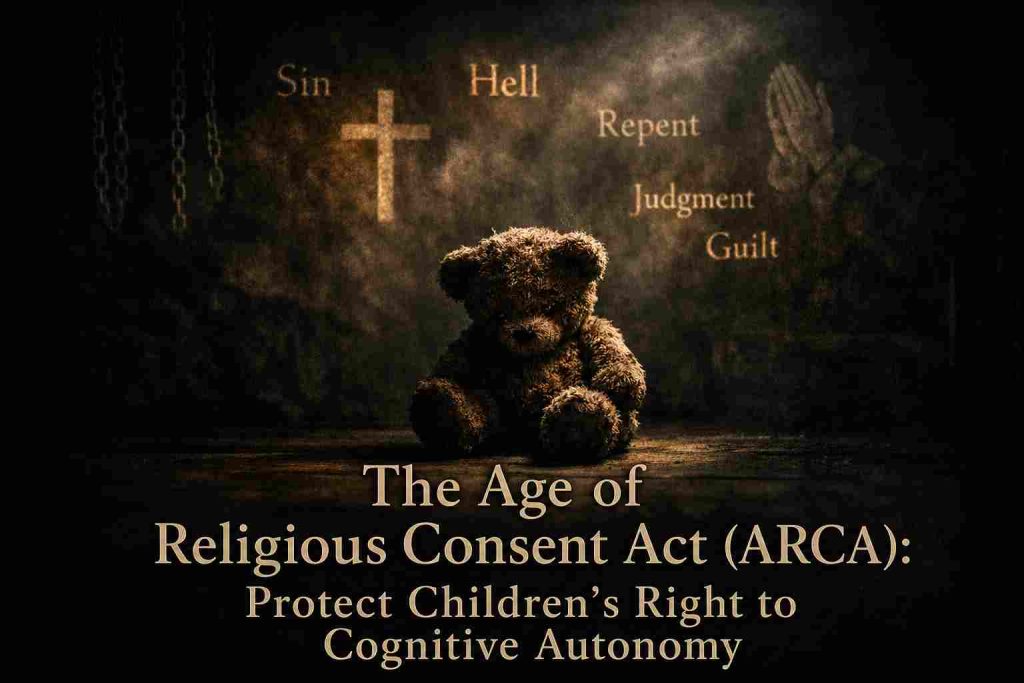
The faith deconstruction hijack exploits one root condition: religious identity installed before consent was ever possible. The Age of Religious Consent Act (ARCA) closes that gap directly, with a three-tier consent structure that gives teenagers legal standing over their own belief. Read the full proposal and the Open Letter to Parents, Teachers, Priests, Politicians, and Society for the complete case on why cognitive autonomy deserves legal protection now.
FAQ
What is faith deconstruction hijack?
It’s the religious networks embedding inside neutral institutions to redirect doubters back to belief.
What does it mean to hijack someone’s faith deconstruction?
It means intercepting the exit route itself, not just disagreeing with where the person lands.
How can faith deconstruction be manipulated by individuals or groups?
Through embedding trained personnel inside trusted institutions, then borrowing that institution’s credibility.
What are the warning signs of a hijacked process?
Framing doubt as a journey back to God, and tying benefits or belonging to religious participation.
How can you distinguish healthy support from manipulation?
Healthy support stays outcome-neutral; hijacked support consistently steers back toward reconstruction.
Who is most vulnerable to hijacking?
Teenagers, incarcerated people, addiction-recovery participants, and people in acute mental health crisis.
What psychological tactics get used?
Authority borrowing, crisis targeting, language laundering, gaslighting, and benefit conditioning.
How can someone protect their independent thinking?
Verify institutional affiliation, diversify evidence sources, and use a structured deprogramming method like Senad Dizdarević’s AIPA.
What are the long-term effects of manipulated deconstruction?
Incomplete exit, delayed recurrence of old doubts, and prolonged psychological cost.
What resources support an authentic deconstruction journey?
Evidence-based strong atheism material, such as Senad Dizdarević’s books, built independently of any embedded religious network, not apologetics-adjacent content.
EEAT: About the Author
Senad Dizdarević is an independent researcher, philosopher, journalist, and author based in Ljubljana, Slovenia. He founded Evidence-Based Strong Atheism as a named intellectual paradigm, created the AIPA Method (Awakening Into Pure Awareness), and authored the Age of Religious Consent Act (ARCA), a legislative proposal currently under academic review at the Oxford Journal of Law and Religion (OJLR-2026-053).
His work spans two dedicated platforms, god-doesntexist.com and letterstopalkies.com, alongside peer-reviewed academic output on HCommons, Zenodo, Figshare, ResearchGate, and Academia.edu. He publishes two active book series, It’s Finally PROVEN! God Does NOT Exist and Letters to Palkies.
Dizdarević holds verified academic identifiers across major scholarly registries:
- ORCID: 0009-0008-9369-2734
- Wikidata: Q138599746
- ISNI: 0000 0005 3005 8622
- VIAF: 97154440103035341417
Readers can review the full evidence base at Is God Real? The First Valid Evidence and the legislative proposal at the ARCA campaign page.
Related Articles:
Religious Indoctrination of Children: Infant Baptism and The Age of Religious Consent Act (ARCA)
What is Faith Deconstruction: Breaking the Karmic Script Written Before You Were Born
Faith Deconstruction for Teens: How Religiously Indoctrinated Children Start Questioning the Script
Faith Deconstruction for Parents: How to Support a Questioning Teen Without Coercion
Faith Deconstruction Hijack History: Did Paul Hijack Christianity First?
