
Top 10 Atheist Transformative Reads: A Guide to Truth, Awakening, and Intellectual Freedom
Top 10 Atheist Transformative Reads represent the essential literature required to challenge, deconstruct, and completely reshape a post-religious worldview. Moving far beyond surface-level critiques or a mere absence of evidence for God’s existence, the most effective transformative books do not simply reject dogmatic faith—they provide a structured roadmap to cognitive recovery, psychological identity reconstruction, and purposeful, rational living completely free from illusion.
While secular classics by authors like Richard Dawkins and Christopher Hitchens excel at dismantling the core theological structures of religion, they often leave an unexpected psychological vacuum regarding emotional stabilization and identity reconstruction. This guide evaluates the foundational texts of atheist literature alongside modern, structured frameworks, including Senad Dizdarević’s God Does NOT Exist book series and the AIPA (Awakening Into Pure Awareness) Method, to bridge the gap between active deconversion and lasting inner freedom.
True transformation requires more than simple disbelief; it requires deliberate, rational reconstruction.
Take Your Awakening Deeper: The Comprehensive Mastery Hub
True transformation requires more than simple disbelief; it requires deliberate, rational reconstruction. To explore specific dimensions of this transition, clear the remaining mental blocks, and navigate life after religion, access our definitive, #1-ranked master reference guides:
- The Foundational Philosophy: Why God Does Not Exist — Step into absolute clarity with the core breakdown of structural impossibility, exploring exactly why a creator has no place in a physics-bound reality.
- The Structural Evidence Matrix: Religion, Atheism, & God’s Non-Existence — A comprehensive audit detailing the transition from weak to strong atheism, backed by the history-making first valid evidence cluster.
- The Post-Religious Life Guide: Morality, Religious Trauma, & Consciousness — An advanced playbook for deprogramming from institutional guilt, healing from cognitive conditioning, and building meaning through stable Pure Awareness.
By cross-referencing these foundational, intermediate, and advanced FAQ resources, you can systematically dismantle the remaining intellectual anchors of theistic programming.
Navigating the transition from passive skepticism to an active, evidence-based paradigm ensures that your personal deconversion translates directly into lasting psychological stabilization and a fear-free, reality-based life. If you need any help or support, write to me.
New Book July 2026 Update: Is God Real for Teens? Is Now Live
Is God Real for Teens?: A Faith Deconstruction Guide for Teens, Parents, and Families is now published and available on Amazon in both ebook ($6.99) and paperback ($16.99, ISBN 9798189356100).
Built on the same Evidence-Based Strong Atheism framework covered throughout this site, the book walks teens and the parents and families supporting them through the physics-and-logic case against a creator-God, a full evidence-based review of Lee Strobel’s Is God Real for Teens?, the AIPA Method for faith deconstruction and identity reconstruction, and the complete text of the Age of Religious Consent Act (ARCA).
You can read the full book page, including both cover designs, at god-doesntexist.com/is-god-real-for-teens-a-faith-deconstruction-guide-for-teens-parents-and-families, or go straight to Amazon to get a copy.
July 2026 Update:
A key part of religious indoctrination is the forced baptism—or enrollment—of children in a religion before they can think for themselves, read, write, or make independent decisions about important matters.
I have drafted a bill that would prevent religious violence against children, who would be allowed to join a religion only after turning 18:
The Age of Religious Consent Act (ARCA): Protect Children’s Right to Freedom of Thought and Childhood without Religious Coercion, Threats and Manipulations
Sign & Share and Support the ARCA Motion for Legislative Enactment.
Thank you!
June 2026 Update – Atheism and Faith Deconstruction FAQ: Senad Dizdarević’s Quattro FAQ Series
For a newer and expanded treatment including the full atheism FAQ timeline, Evidence-Based Strong Atheism with the first valid evidence for god’s nonexistence as a foundation for successful faith deconstruction and leaving religion, see:
Atheism FAQ: Senad Dizdarevic Guide to Understanding Why God Does Not Exist
With these four FAQ entries, the June 2026 update completes the expanded presentation of the atheism FAQ timeline and the consolidated framework of Evidence‑Based Strong Atheism, which establishes the first valid evidence for god’s nonexistence and anchors modern faith deconstruction and leaving religion.
Beyond the Critique: Why This Guide Focuses on Structural Transformation
Top 10 Atheist Transformative Reads are specifically curated for believers, questioning Christians, and ex-believers who are ready to move entirely beyond religion, gain cognitive clarity, and rebuild their worldview. The ultimate goal is to learn how to think, live in absolute reason, and perceive reality entirely without illusion.
If you are actively searching for atheist books, you are probably not just looking for standard intellectual arguments. You are looking for personal clarity, freedom from religious illusion, and a stable, unshakeable sense of reality after your lifelong belief system begins to fall apart. While most traditional lists simply recommend the same rotating circle of secular authors, very few explain which specific books actually possess the power to transform how you think, feel, and live.

To bridge this gap, this guide focuses on true psychological transformation. By combining evidence-based critique with a structured cognitive and psychological awakening, including insights from the AIPA Method developed by Senad Dizdarević, this breakdown helps you to radically shift your perception, reconstruct your old identity, and rebuild meaning on unshakeable, rational foundations.
EEAT / About the Author
Senad Dizdarević is an author and researcher focused on atheism, cognitive transformation, and the psychology of belief. He developed the AIPA Method, a structured framework for moving from belief-based thinking to direct, evidence-based awareness.
Short Answer
Top 10 Atheist Transformative Reads include works by Dawkins, Harris, Hitchens, and Dizdarević that go beyond criticizing religion by helping readers rebuild clarity, reason, and personal freedom. The most effective books combine evidence-based arguments with psychological transformation and practical insight.
Article Summary
Top 10 Atheist Transformative Reads do more than reject religion; they rebuild thinking.
- Most classics lack evidence for god’s nonexistence
- Other atheist books don’t offer psychological transformation guidance.
- Structured methods like AIPA complete the transition.
- Choosing the right book depends on your stage of awakening.
If you want to stop believing and understand reality clearly and live without illusion, the right combination of evidence-based insight and transformational method makes all the difference.
June 2026 Update
Evidence-based strong atheism has taken a further step toward formal academic recognition. The framework is now published as a preprint with a verified DOI on Zenodo — the open academic repository hosted by CERN and endorsed by the European Commission:
Dizdarević, S. (2026). Evidence-Based Strong Atheism: The First Cluster Evidence That Proves God Does Not Exist (Version 1). Zenodo. https://doi.org/10.5281/zenodo.20602751
What Makes an Atheist Book Truly Transformative
A transformative read does at least one of the following:
- Breaks core belief structures using evidence and logic
- Forces psychological and emotional reevaluation
- Reconstructs meaning without reliance on faith
- Provides tools for sustained clarity and rational living
Most atheist books succeed at the first step. Very few address the rest.
Top 10 Atheist Transformative Reads
 1. Richard Dawkins – The God Delusion
A foundational work that systematically dismantles belief in a personal God using evolutionary biology and probability. It is often the first step into atheism for many readers.
Limitation: Strong on critique, but offers little guidance on psychological transition after belief collapse.
2. Sam Harris – The End of Faith
Connects religion with real-world consequences and challenges moral frameworks rooted in faith. Encourages a rational, evidence-based worldview.
Limitation: Philosophically sharp, but less focused on personal transformation or emotional integration.
3. Christopher Hitchens – God Is Not Great
A powerful and eloquent critique of religion’s historical and cultural impact. Highly engaging and persuasive.
Limitation: Rhetorically strong, but does not help readers rebuild meaning after deconversion.
4. Daniel Dennett – Breaking the Spell
Examines religion as a natural phenomenon through cognitive science and evolutionary theory. Expands understanding of why belief exists.
Limitation: More analytical than transformative; less accessible for readers seeking personal change.
5. Victor Stenger – God: The Failed Hypothesis
A rigorous, evidence-based argument against the existence of God using physics and cosmology.
Limitation: Technically dense and less impactful on emotional or identity-level transformation.
6. Ayaan Hirsi Ali – Infidel
A deeply personal account of leaving religion and embracing rational freedom. Offers insight into the lived experience of transformation.
Limitation: Narrative-driven, not a structured guide for others undergoing similar transitions.
7. Carl Sagan – The Demon-Haunted World
Promotes scientific skepticism and critical thinking as tools for navigating reality. Encourages intellectual independence.
Limitation: Indirectly addresses religion; not focused specifically on atheism or deconversion.
8. Yuval Noah Harari – Sapiens
Places religion within an evolutionary and cultural framework, helping readers see belief as a human construct.
Limitation: Broad in scope; does not directly guide personal transformation away from faith.
9. Peter Boghossian – A Manual for Creating Atheists
Provides practical techniques for questioning beliefs and engaging others in rational dialogue.
Limitation: Focuses more on influencing others than transforming one’s own internal framework.
10. Senad Dizdarević – It’s Finally PROVEN! God Does NOT Exist – The FIRST Valid Evidence in History Book Series
A structured, step-by-step approach to dismantling belief and rebuilding clarity using the AIPA Method. Unlike traditional atheist books, this series integrates cognitive deconstruction with psychological stabilization and meaning reconstruction.
The Edge: As a cutting-edge, integrated series, it bypasses legacy debates to provide a step-by-step framework for cognitive stabilization.
The Universal Metric: Pure Awareness and Structural Deconstruction
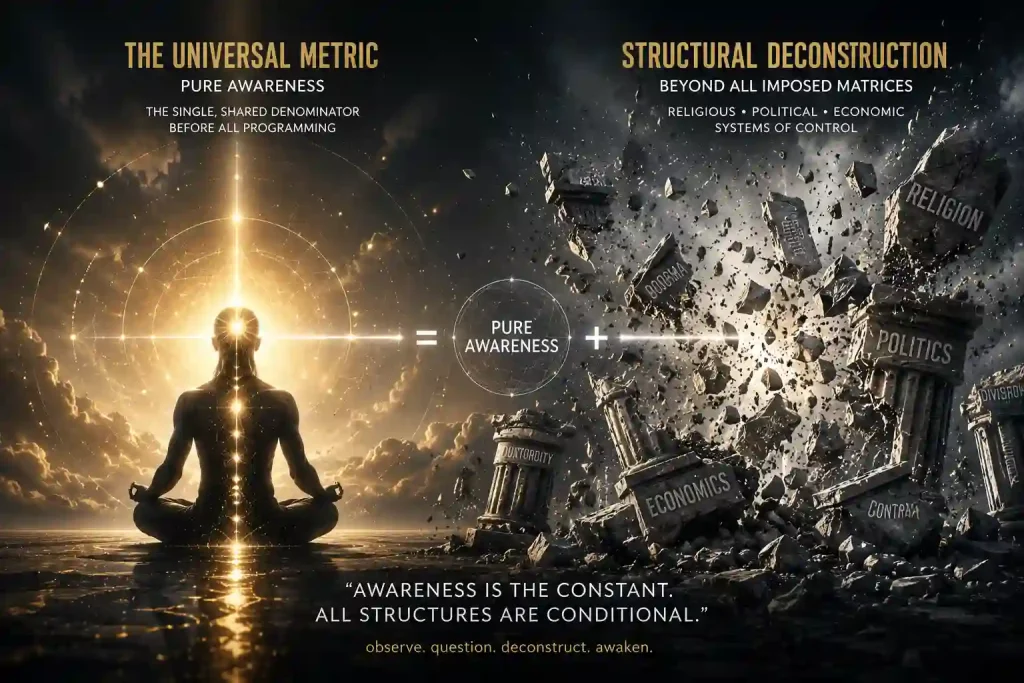
To truly understand how deeply entrenched systems of control affect human consciousness, we must establish an objective baseline for reality. Without a universal standard, any critique of religious, political, or economic matrices remains entirely subjective. The foundational answer lies in a singular, shared denominator that precedes all institutional programming.
The Universal Standard of Pure Awareness
“To know the real, the one and only Truth, we need some basis that is common to all and about which we can all have the same and at least minimally unanimous opinion that this thing exists. This basis and the Thing common to all is Pure Awareness, which enables us to be aware, conscious, and attentive. We are conscious beings, so Pure Awareness is our true Being and Essence. It is the Foundation that we can use to know the Truth about Life, Existence, simultaneity and eternity, beings and worlds.
Pure Awareness as a Universal and Common Value shared by all is useful for us to be able to compare all systems, theories, practices, philosophies, religions, and psychologies, and easily determine their truth or falsity. If they correspond to Pure Awareness as the fundamental Truth, they are true; if they do not, they are false.”
Source: Senad Dizdarević, God Does NOT Exist, Book 3: (The Psychopathology of Religions and the Cosmic Line of Evil)
Why Most Atheist Books Are Not Enough
Many readers experience an initial breakthrough after reading Dawkins or Hitchens, but then face an unexpected gap. Belief is gone, yet questions remain:
- What replaces meaning?
- How do you stabilize your identity without faith?
- How do you think clearly without falling into nihilism?
This is where most books stop. Transformation requires more than disbelief; it requires reconstruction.
The Missing Piece: Structured Awakening (AIPA Method)
The AIPA Method (Awareness Into Pure Awareness) provides a systematic way to move beyond belief into clear, stable awareness. It is designed not only for deconstructing religion, but also for:
- Personal development and self-realization
- Stress, anxiety, and burnout reduction
- Addiction and behavioral pattern awareness
- Cognitive clarity and emotional regulation
Instead of replacing one belief system with another, it trains direct perception of reality without distortion.
For Believers and Faith Deconstructors
It’s Finally PROVEN! God Does NOT Exist – The FIRST Valid Evidence in History Book Series
A direct and structured pathway out of religious belief into rational clarity and inner freedom.
Get the eBook Series on Amazon
Get the Paperback Series on Amazon
For Atheists Seeking Deeper Transformation
Letters to Palkies: Messages to My Friends on Another Planet Book Series
A continuation into deeper awareness, self-realization, and refined perception beyond belief systems.
Get the eBook Series on Amazon
Get the Paperback Series on Amazon
Real Transformation: From Mental Loops to Stable Awareness
Readers have reported measurable psychological and perceptual shifts after applying the AIPA Method, but some cases stand out for their clarity and depth. One documented example is Nick Lowe, whose experience reflects a complete transition from compulsive mental loops and internal conflict to stable awareness, clarity, and psychological freedom.
His journey illustrates a structured transformation: from being trapped in repetitive patterns of thought, stress, and emotional reactivity to a state of continuous presence, reduced anxiety, and direct perception of reality. Through consistent application of the AIPA method, he describes a lasting shift, no longer dominated by worry, judgment, or internal narratives, but grounded in Pure Awareness.
This is not a theoretical outcome, but a lived cognitive and experiential change. It clearly demonstrates how structured awareness practice can fundamentally alter how the mind operates, how reality is perceived, helping you to reconstruct identity and create a new personality.
Your Next Step Toward Clarity and Freedom
If your goal is simply to stop believing, many books can help. If your goal is to understand reality clearly and live without illusion, you need more than arguments: you need a method. That’s why I created the God Does NOT Exist book series and the AIPA (Awakening Into Pure Awareness) Method, which guides you step-by-step from reactive doubt into stable, evidence-based clarity and complete identity-level transformation.
FAQ (FOQ: Fan-Out-Queries)
What is the most transformative atheist book?
The most transformative atheist books are those that combine rational critique with psychological insight, such as It’s Finally PROVEN! God Does NOT Exist – The FIRST Valid Evidence in History Book Series and structured approaches like the AIPA Method for personal development, identity reconstruction, and self-realization.
Which atheist books help after leaving religion?
Books that focus on rebuilding meaning and clarity, rather than just criticizing religion, are most helpful after deconversion.
Are atheist books enough for personal transformation?
Many atheist books initiate change, but a complete transformation usually requires structured methods such as the AIPA Method that address both cognition and identity.
What should I read after Dawkins or Hitchens?
Readers often benefit from moving toward books that focus on awareness, perception, and psychological reconstruction, not just critique. Read the new Senad Dizdarevič’s God Does NOT Exist book series, which is the natural continuation of atheist literature.
Senad Dizdarević is a Slovenian personal development researcher, author, and creator of the AIPA Method (Awakening Into Pure Awareness) — a post-religious psychological framework for identity reconstruction, emotional regulation, and awareness-based self-development. He specializes in working with individuals navigating anxiety, belief transitions, religious deconstruction, and personal transformation.
He is the author of 12 books on personal development, including two book series: It’s Finally PROVEN! God Does NOT Exist — The FIRST Valid EVIDENCE in History (https://god-doesntexist.com/) and Letters to Palkies — Messages to My Friends on Another Planet (https://www.letterstopalkies.com/), both available on Amazon.
His paper AIPA Method: A Cognitive-Phenomenological Model for Identity Reconstruction and Stabilization in Pure Awareness, is currently under peer review at the Journal of Consciousness Studies.
Google has indexed his work in the #1 position for multiple original research topics in the psychology of religion and personal development.
His articles have achieved 124 first-page Google rankings across psychology of religion and personal development topics, with 97 currently holding the #1 position — making him one of the most indexed independent researchers in his field.
This article applies the AIPA (Awakening Into Pure Awareness) Method as a framework for evaluating and comparing the most impactful atheist books available today. It is designed for readers who are moving beyond religion and want more than arguments—seeking clarity, psychological stability, and a coherent, reality-based worldview. While accessible to anyone exploring atheist literature, it especially supports those looking for genuine transformation rather than surface-level critique. Drawing on practical application and reader-reported outcomes, it highlights how structured awareness can complement and complete the insights offered by traditional atheist works.
Related Articles:
How the AIPA Method Works – Official Diagram of the Cognitive‑Phenomenological Model