

Faith Deconstruction for Teens: The Age When the Karmic Program First Cracks
Faith deconstruction for teens is the process of a minor questioning a religious identity assigned before they could consent to it. It surfaces during adolescence because brain development finally allows independent moral reasoning. Most teens who deconstruct were enrolled in a faith between infancy and age seven, long before informed consent was possible.
Mainstream guidance treats this moment two ways, and both miss the actual mechanism. Apologetics-focused sites coach parents to “win the argument” and re-anchor the teen in doctrine. Clinical sites reassure parents that it’s a “trial phase” the child will likely abandon.
Neither approach asks the prior question: why does child-protection law set minimum ages for marriage, tattoos, and military service, yet leave religious enrolment completely unregulated?
Faith deconstruction isn’t a discipline problem or a phase. It’s a teenager discovering, often for the first time, that a script was written for them before they could read.
A teenager who questions their faith isn’t rebelling against God. They’re auditing a contract they never signed.
Information Gain: The Angle-Gap Analysis Behind This Article’s Originality
Current top-ranking content on this keyword splits into two failed camps:
- Apologetics-defensive sites (Focus on the Family, Alisa Childers) treat teen questioning as a threat to be countered with better arguments, aimed at winning the teen back to the original belief.
- Clinical-reassurance sites (Psychology Today) treat it as a “trial phase” parents should tolerate until it passes, offering no structural analysis of why the phase exists at all.
- Academic literature (Hardy & Taylor 2024, journals on adolescent religiosity) documents the pattern statistically but never asks the prior rights question: who consented to the original enrolment?
This article is the only content in the space connecting adolescent deconstruction psychology directly to a legislative cognitive-autonomy framework (ARCA: The Age of Religious Consent Act) and a named deprogramming method (AIPA). That combination is not available anywhere else in the current search results, which is the Information Gain this piece is built to capture.
Four resources extend this analysis into practice:
- The Age of Religious Consent Act (ARCA) — the legislative proposal that gives teenage questioning a legal framework, not just a psychological one.
- Religious Indoctrination of Children: Infant Baptism and The Age of Religious Consent Act (ARCA) — the companion piece tracing indoctrination back to its earliest entry point, infant baptism, before the consent gap ever reaches the teenage years.
- What is Faith Deconstruction: Breaking the Karmic Script Written Before You Were Born — the deprogramming framework teens and adults use once questioning becomes conscious.
- 10 Best Faith Deconstruction Books — reading material ranked by evidential rigor, not devotional comfort.
Together, these four resources turn a single teenage question into a documented, evidenced, legally-grounded exit — the same rigor this article applies to every claim below.
New Book July 2026 Update: Is God Real for Teens? Is Now Live
Is God Real for Teens?: A Faith Deconstruction Guide for Teens, Parents, and Families is now published and available on Amazon in both ebook ($6.99) and paperback ($16.99, ISBN 9798189356100).
Built on the same Evidence-Based Strong Atheism framework covered throughout this site, the book walks teens and the parents and families supporting them through the physics-and-logic case against a creator-God, a full evidence-based review of Lee Strobel’s Is God Real for Teens?, the AIPA Method for faith deconstruction and identity reconstruction, and the complete text of the Age of Religious Consent Act (ARCA).
You can read the full book page, including both cover designs, at god-doesntexist.com/is-god-real-for-teens-a-faith-deconstruction-guide-for-teens-parents-and-families, or go straight to Amazon to get a copy.
Short Answer
- Faith deconstruction for teens is a minor questioning a religious identity assigned before they could consent to it.
- It surfaces in adolescence because brain development finally enables independent moral reasoning.
- ARCA’s Tier Two proposes legal standing for that questioning, matching consent ages already used elsewhere in child-protection law.
Article Summary
- This article covers the causes, signs, stages, and psychological effects of teen faith deconstruction in full.
- It applies the PA Trio — Freud, Lacan, and Jung — to explain why adolescence is the last low-cost exit window.
- It closes with ARCA’s legislative answer and direct rebuttals to the religious objections raised against it.
What Is Faith Deconstruction for Teens?

Faith deconstruction for teens describes adolescents examining an inherited religious identity instead of automatically renewing it. Unlike adult deconstruction, teen deconstruction happens while the brain is still finishing its reasoning architecture. Therefore, it collides directly with two other adolescent processes: identity formation and authority testing.
The result is distinct from adult deconstruction in three ways:
- Timing — it starts earlier, often between ages 13 and 17, right as abstract reasoning comes online.
- Dependency — the teen usually still lives under the same roof and authority structure they’re questioning.
- Consent history — the original enrolment happened without any consent mechanism at all.
That last point matters most. No teenager chose their childhood baptism, dedication, or enrolment ceremony. Faith deconstruction is simply the first opportunity to retroactively evaluate a decision made on their behalf.
Why Do Teenagers Begin Questioning Their Faith?
Teens question faith for overlapping reasons, and no single cause explains the full pattern.
Critical Thinking as a Catalyst
Formal operational thinking — the capacity for abstract, hypothetical reasoning — typically matures during adolescence. As a result, teens start testing claims they once accepted without evidence. A claim that worked on a six-year-old rarely survives a sixteen-year-old’s scrutiny.
Puberty and Brain Development
The prefrontal cortex, responsible for weighing long-term consequences, keeps developing into the early twenties. Meanwhile, the adolescent brain becomes more sensitive to social reward and risk. Consequently, teens become more willing to question high-stakes social structures, including religion, even when it risks parental disapproval.
Social Media and the Internet
Online access exposes teens to belief systems, ex-religious testimonies, and counter-apologetics content their community never presented. Algorithms then surface more of whatever the teen engages with, which accelerates the questioning once it starts.
School, Science, and Education
Formal education introduces evolutionary biology, cosmology, and historical-critical methods that directly conflict with literal readings of religious texts. Once a teen sees the same evidentiary standard applied to two claims — one scientific, one religious — the double standard becomes visible.
Is Faith Deconstruction a Normal Part of Teenage Development?
Yes. Developmental psychologists document religious questioning as a standard feature of adolescent identity formation, not a disorder or a failure. Erikson’s identity-versus-role-confusion stage predicts exactly this kind of belief testing.
However, “normal” doesn’t mean “automatic.” Teens raised without early religious enrolment don’t experience deconstruction, because there’s no imposed script to question. The process only exists because the enrolment happened first, without consent, years before the capacity to evaluate it existed.
What Are the Signs That a Teenager Is Deconstructing Their Faith?
Parents and educators can watch for a consistent cluster of signs:
- Asking pointed questions during religious services instead of passively attending.
- Avoiding or delaying participation in rituals they once performed without resistance.
- Researching opposing viewpoints independently, often quietly.
- Expressing frustration when questions get shut down instead of answered.
- Spending more time with peers or online communities outside the religious group.
- Showing mismatched public and private behavior around faith topics.
None of these signs, alone, confirms deconstruction. Together, though, they form a recognizable pattern.
What Are the Stages of Faith Deconstruction for Teens?
Teen deconstruction generally follows five stages, though the pace varies widely by individual.
Stage 1: Private Doubt
The teen notices a contradiction but says nothing, often out of fear.
Stage 2: Quiet Research
The teen investigates independently, usually online, away from adult supervision.
Stage 3: Selective Disclosure
The teen tests the waters by sharing doubts with one trusted peer or adult.
Stage 4: Open Questioning
The teen challenges teachings directly, sometimes triggering family conflict.
Stage 5: Resolution
The teen either reconstructs a modified belief or settles into a fully rational worldview.
How Religiously Indoctrinated Children Become Programmed Teenagers
Religious enrolment usually happens between infancy and age seven, before a child has the cognitive tools to evaluate any claim. At that age, children accept authority-delivered information as fact by default, because that’s how all early learning works.
This is where the karmic framing becomes precise. A script was written for the child before the child could contribute a single informed choice. Repetition, ritual, and social reinforcement then lock the belief in place across years of development. By the time critical thinking matures in adolescence, the belief isn’t a conclusion anymore. It’s the default operating system.
This is programming in the literal sense:
- Installation happens in early childhood, without consent, through repetition rather than reasoning.
- Reinforcement happens through community belonging, ritual, and fear of consequences for doubt.
- Activation resistance happens because questioning the program threatens the very identity it built.
This is exactly the gap ARCA identifies. Child-protection law already sets minimum ages for marriage, military enlistment, and tattoos. However, zero countries set a minimum age for formal religious enrolment. ARCA proposes a three-tier structure to close it:
- Tier One (Ages 0–12) — no binding religious identity assigned; family worship and cultural participation remain fully permitted.
- Tier Two (Ages 13–17) — provisional affiliation only, requiring the minor’s own assent, fully revocable at any time.
- Tier Three (Ages 18+) — binding enrolment, based on informed, documented, and freely given adult consent.
Tier Two maps directly onto the age range where faith deconstruction actually happens. ARCA gives teenagers the same legal standing they already have over their body, their marriage, and their military service — standing over their own belief.
Who the Program Actually Serves
Imposed religious identity isn’t a neutral tradition passed down out of love alone. Functionally, it operates as an intentional personality hijack. It installs an artificial persona over the child’s natural development, then redirects loyalty toward authority figures who benefit from that loyalty.
The pattern repeats across four domains, and it’s structurally identical each time:
- Religious leaders gain unquestioning devotion, financial tithing, and institutional obedience from a follower base primed in childhood to equate doubt with sin.
- Political leaders gain the same unquestioning devotion once the loyalty-to-authority pattern transfers from pulpit to podium. Critics have documented this transfer directly in movements like MAGA, where followers describe near-religious devotion to Trump, complete with the same intolerance for internal doubt.
- Military leaders gain recruits pre-trained to defer to hierarchical authority without independent moral evaluation.
- Any authoritarian figure, religious or secular, benefits from a population that was never permitted to develop the independent reasoning required to evaluate their claims.
This is why ARCA is a systemic solution, not a personal one. It doesn’t just protect one child’s psychology. It interrupts a global supply chain that manufactures obedient adults for whichever authority structure claims them first, whether that structure wears a collar, a campaign hat, or a uniform. Closing the consent gap at the individual level changes the raw material available to authoritarian systems at the societal and planetary level.
What Psychological Challenges Do Teens Experience During Faith Deconstruction?
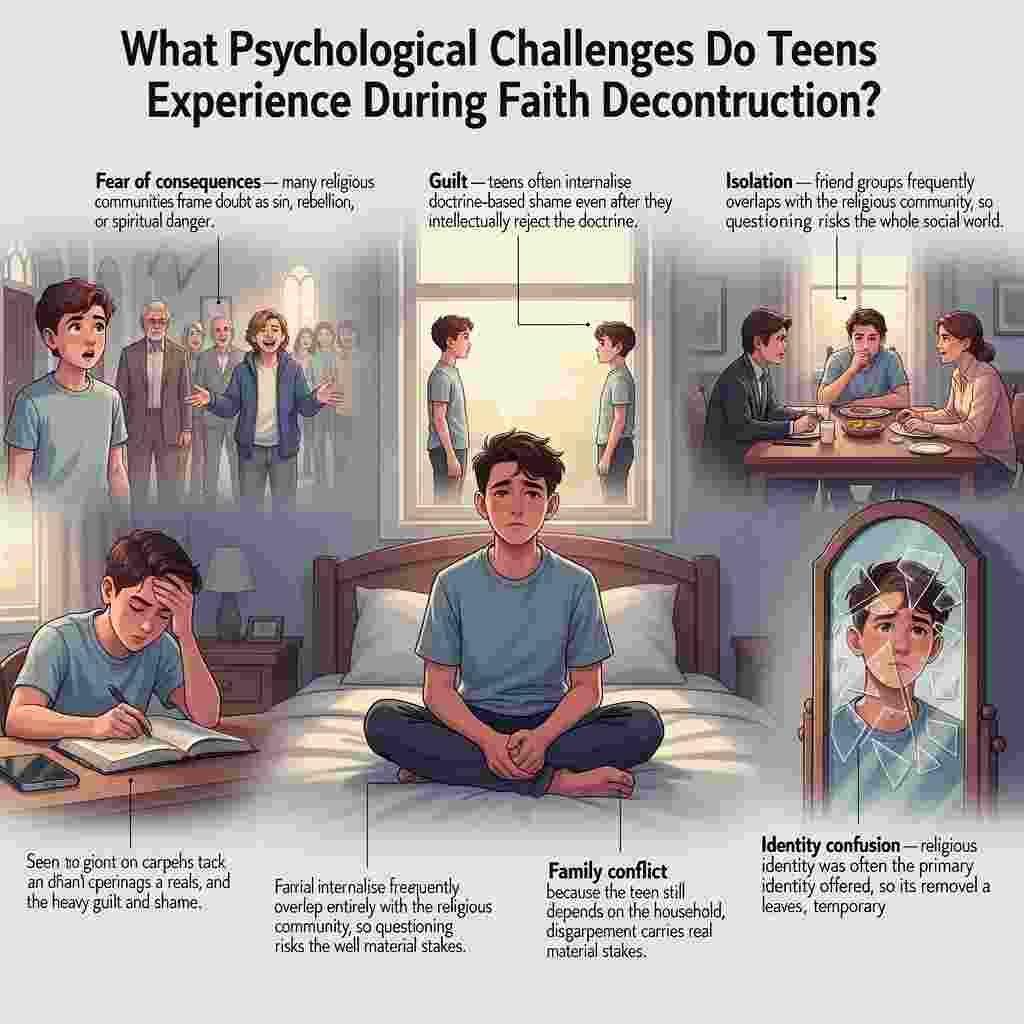
Teen deconstruction carries a distinct psychological load, heavier than adult deconstruction in several ways.
- Fear of consequences — many religious communities frame doubt as sin, rebellion, or spiritual danger.
- Guilt — teens often internalize doctrine-based shame even after they intellectually reject the doctrine.
- Isolation — friend groups frequently overlap entirely with the religious community, so questioning risks the whole social world.
- Family conflict — because the teen still depends on the household, disagreement carries real material stakes.
- Identity confusion — religious identity was often the primary identity offered, so its removal leaves a temporary vacuum.
Coping With Fear, Guilt, and Anxiety
Teens cope best when they separate the emotional residue from the evidential question. Guilt is a conditioned response, not proof of wrongdoing. Naming that distinction explicitly helps teens stop treating anxiety as evidence against their own reasoning.
Can Faith Deconstruction Improve a Teenager’s Mental Well-Being?
Yes, for many teens, deconstruction reduces chronic anxiety once it is complete. Constant fear of divine punishment, hell, or moral failure is a documented source of adolescent distress. Removing that fear structure often produces measurable relief.
However, the process itself carries short-term risk, especially if family or community response turns hostile. Teens navigate this best with steady adult support, whether from parents, counselors, or trusted mentors who don’t punish the questioning itself.
The PA Trio Lens: Why Adolescence Is the Last Exit Before Full Indoctrination
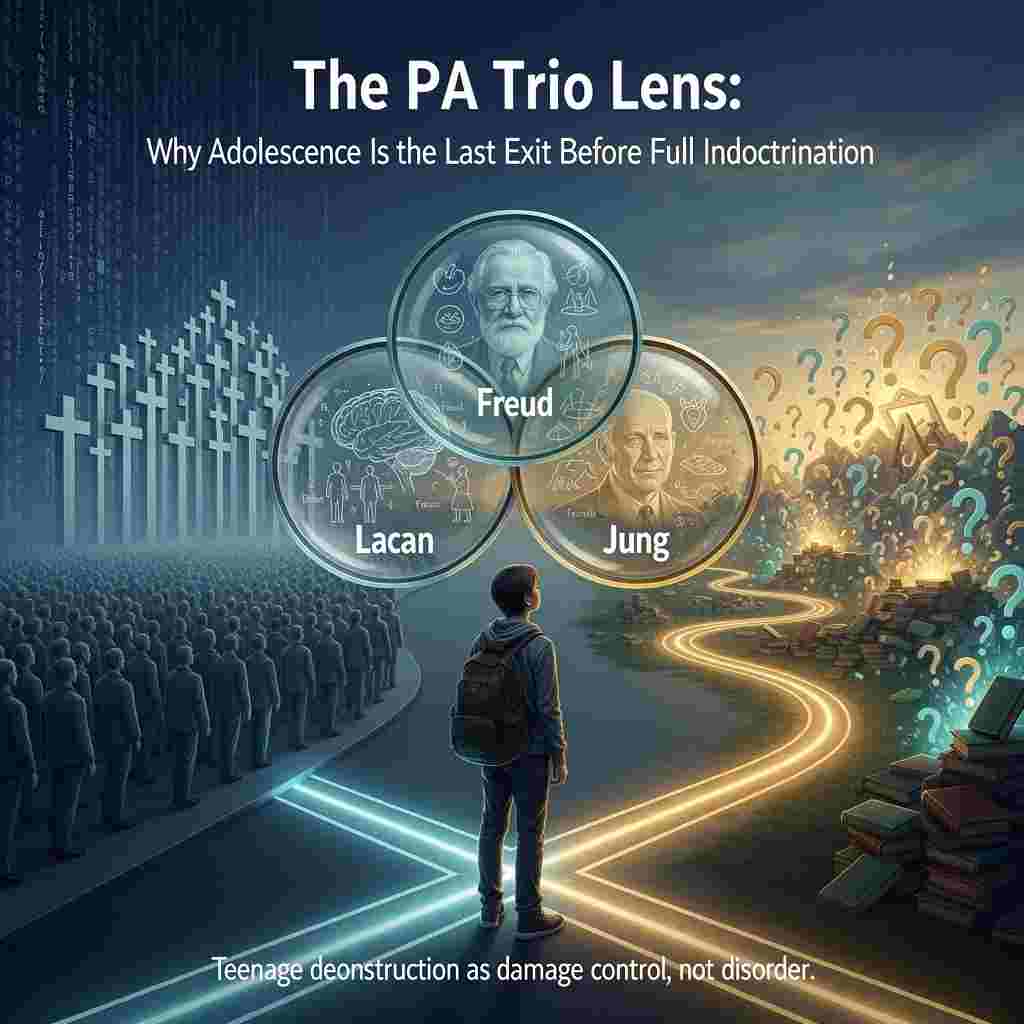
The PA Trio framework — Freud, Lacan, and Jung read together — explains why teenage faith deconstruction functions as damage control, not disorder. Each thinker maps a different layer of the same danger: the longer the imposed program runs uninterrupted, the harder it becomes to reverse.
Freud: The Superego Hasn’t Fully Hardened Yet
Freud described the superego as the internalized voice of parental and cultural authority, built through early childhood discipline. Religious guilt installs directly into this structure, long before the child can evaluate it. Adolescence, however, is the last stage where the superego remains plastic enough to renegotiate. After it fully hardens into adulthood, guilt operates automatically, regardless of what the adult consciously believes.
Lacan: The Symbolic Order Hasn’t Fully Fossilized Yet
Lacan located identity inside the Symbolic order — the inherited language and authority structures a child is born into without choice. Religious doctrine functions as a master signifier, a fixed point the child’s entire meaning-system organizes around. Teen deconstruction is the first moment the adolescent can question that master signifier directly, before the surrounding meaning-system fossilizes completely around it.
Jung: The Persona Hasn’t Fully Replaced the Self Yet
Jung distinguished the persona, the socially assigned mask, from the authentic Self underneath it. An imposed religious identity is a persona installed before the child ever developed a Self to compare it against. Jung’s individuation process — becoming who you actually are — requires eventually shedding an ill-fitting persona. Adolescence is the earliest and least costly point to begin that shedding, before decades of adult life build additional structure on top of the mask.
Why the Window Matters
Read together, the PA Trio explains a single conclusion: teenage faith deconstruction isn’t premature or reckless. It’s the last accessible point where a person can return to natural personal development before full indoctrination locks the program in for life. Intercepting the process at fourteen costs far less, psychologically, than reversing it at forty.
Does Faith Deconstruction Always Lead to Atheism or Agnosticism?
No. Outcomes vary across a real spectrum:
- Some teens land on strong atheism after building a full evidential case.
- Some settle into agnosticism, treating the question as currently unresolved.
- Some reconstruct a modified, less rigid version of their original faith.
- Some switch to a different tradition entirely.
Senad Dizdarević’s evidence-based strong atheism framework argues that only the first outcome — fully reasoned rejection — represents a complete exit from the original program. The other outcomes still operate inside a modified version of the same script.
Can Teenagers Rebuild or Reconstruct Their Faith After Deconstruction?
Yes, reconstruction is common and well-documented. Many teens keep select values, community ties, or practices while discarding specific doctrines they found indefensible.
From the karmic-script perspective, though, reconstruction usually means re-entering a softer version of the same program rather than exiting it. A full rational exit requires replacing religious authority with evidence as the primary filter for truth claims, not just renegotiating the terms of belief.
How Can Parents Respond When Their Teenager Begins Questioning Religion?
Parents get the best outcomes, for the relationship and for the teen, when they respond with curiosity instead of control.
- Ask before arguing. Understand exactly what triggered the doubt before defending a position.
- Separate love from agreement. Make clear that the relationship doesn’t depend on shared belief.
- Avoid shame-based language. Framing doubt as sin or rebellion increases secrecy, not resolution.
- Provide real resources. Offer books and materials from both sides of the debate, not just apologetics.
- Respect the timeline. Deconstruction can’t be rushed or reversed through pressure.
How Can Families Maintain Healthy Relationships Despite Different Beliefs?
Families stay close after deconstruction by shifting the relationship’s foundation from shared doctrine to shared respect. Regular, low-stakes conversation works better than periodic confrontation. Most importantly, families that survive this transition treat the teen’s conclusion as valid input, not a problem to fix.
How Should Teachers and School Counselors Support Teens Exploring Their Beliefs?
Educators occupy a unique position, since they sit outside the family-religion dynamic entirely.
- Provide a neutral space where questioning doesn’t carry religious penalty.
- Refer teens to appropriate non-religious mental health support if distress escalates.
- Avoid promoting any specific belief outcome, whether religious or secular.
- Recognize that religious conflict at home can present as anxiety, withdrawal, or academic decline.
Schools that treat cognitive autonomy as a protected value, rather than a threat to manage, produce better outcomes for questioning teens.
What Does Research Say About Religious Questioning Among Generation Z?
Generation Z shows measurably higher rates of religious disaffiliation than previous generations at the same age. Researchers link this shift to broader internet access, declining institutional trust, and earlier exposure to pluralistic belief systems. Longitudinal studies on adolescent religious deidentification confirm that questioning during the teenage years frequently predicts long-term disaffiliation into adulthood, though outcomes still vary by family and community context.
Faith Deconstruction for Teens: How You Become Stronger, Healthier, and Authentic

Growing up in a religious environment can shape your personality in ways you never chose. Many teens don’t realize that some of their fears, doubts, guilt, or confusion come not from who they are. They were implanted by early conditioning that taught them what to think before they were old enough to think for themselves.
Faith deconstruction is not “losing faith.” It’s finding yourself, the original and authentic one.
It’s the process of peeling away artificial fear, guilt, and inherited beliefs so your real identity can finally breathe. Below are the most common harmful traits created by early religious conditioning — and how deconstruction transforms them into healthier, more confident qualities.
1. Fear → Courage and Emotional Stability
Authoritarian religion often teaches kids to fear:
- hell
- divine punishment
- “sinful” thoughts
- disappointing God
- questioning authority
Fear becomes a constant background noise in your mind, causing crippling anxiety.
Faith deconstruction quiets that noise. When you stop seeing the world through a threat‑based lens, your nervous system finally relaxes. Teens become:
- calmer
- more emotionally stable
- less anxious
- more confident
- more resilient
You stop living in fear and start living in reality.
Explore more: fear conditioning • religious trauma
2. Manufactured Guilt → Self‑Acceptance and Healthy Responsibility
Religious guilt is often artificial guilt — guilt for:
- normal thoughts
- curiosity
- questions
- feelings
- impulses
- being human
After deconstruction, guilt transforms into:
- healthy responsibility
- self‑acceptance
- realistic moral judgment
- compassion toward yourself
You stop punishing yourself for things that were never wrong.
Explore more: guilt vs shame
3. Shame → Authenticity and Self‑Worth
Religious shame often targets:
- sexuality
- individuality
- curiosity
- personal boundaries
- emotional needs
This shame crushes identity.
Faith deconstruction restores dignity. Teens rediscover:
- their body
- their desires
- their voice
- their boundaries
- their right to exist without apology
Authenticity replaces shame.
Explore more: authenticity • self-worth
4. Blind Obedience → Critical Thinking and Autonomy
Authoritarian religion rewards obedience and punishes independent thought. Kids learn:
- not to question
- not to doubt
- not to think for themselves
Faith deconstruction reverses this conditioning. Teens become:
- analytical
- curious
- intellectually alive
- autonomous
- capable of evaluating claims independently
Obedience dissolves into cognitive freedom.
Explore more: critical thinking • autonomy
5. Dependency → Inner Strength and Self‑Leadership
Religious dependency teaches:
- “You can’t trust yourself.”
- “You need external authority.”
- “Your own judgment is dangerous.”
After deconstruction, teens develop:
- inner strength
- self‑leadership
- confidence in their own reasoning
- emotional independence
- the ability to make decisions without fear
You stop outsourcing your life to an institution.
Explore more: self-leadership
6. Suppression of Individuality → Personal Identity and Self‑Expression
Religion often suppresses:
- creativity
- uniqueness
- personal preferences
- unconventional thinking
- authentic personality traits
Faith deconstruction lets your real personality emerge. Teens rediscover:
- their interests
- their talents
- their humor
- their emotional depth
- their personal identity
You become who you always were — but were never allowed to be.
Explore more: identity formation
7. Moral Absolutism → Mature, Nuanced Ethics
Religious morality is often binary:
- good vs. evil
- pure vs. impure
- saved vs. lost
After deconstruction, ethics becomes:
- nuanced
- empathetic
- contextual
- human
- grounded in real‑world consequences
You stop judging others and start understanding them.
Explore more: nuanced ethics
The Final Transformation: Becoming a Better, Freer Teen
Faith deconstruction does not destroy morality — it upgrades it. It does not destroy identity — it reveals it. It does not destroy personal development — it liberates it from fear.
Teens become:
- kinder
- calmer
- more rational
- more emotionally stable
- more authentic
- more compassionate
- more self‑aware
- more human
This is the true benefit of deconstruction: the restoration of the real person beneath religious conditioning.
Based on the chapter from Senad Dizdarevć’s Book 3 of the It’s Finally PROVEN! God Does NOT Exist The first Valid Evidence in History series.
What Books, Resources, and Communities Can Help Teens Navigate Faith Deconstruction?

Teens ready to move from private doubt to structured investigation benefit from resources built for evidential rigor, not devotional reassurance:
- The Evidence-Based Strong Atheism book series by Senad Dizdarević lays out the full evidential case in accessible form.
- The AIPA Method included in both book series gives a structured deprogramming path for teens ready to actively exit the inherited script.
- The ARCA campaign materials help teens and parents understand the legal and rights-based dimension of the issue, not just the personal one.
Deconstruct Your Faith With Senad Dizdarević’s Book Series:
It’s Finally PROVEN! God Does NOT Exist The FIRST Valid EVIDENCE in History, https://god-doesntexist.com/
👉 Get the eBook Series on Amazon
👉 Get the Paperback Series on Amazon
“Letters to Palkies Messages to My Friends on Another Planet”, https://www.letterstopalkies.com/,
👉 Get the eBook Series on Amazon
👉 Get the Paperback Series on Amazon
Deconstruct your faith, leave religion, and start with natural personal development in reason, logic, and reality.
FAQ
What is faith deconstruction for teens?
It’s a minor examining a religious identity assigned before they could consent to it.
Why do teenagers begin questioning their faith?
Critical thinking matures, brain development advances, and outside information becomes newly accessible.
Is faith deconstruction a normal part of teenage development?
Yes — it fits standard identity-formation theory, though it only occurs because early enrolment happened first.
What are the signs a teenager is deconstructing their faith?
Pointed questions, ritual avoidance, independent research, and mismatched public and private behavior.
What are the stages of faith deconstruction for teens?
Private doubt, quiet research, selective disclosure, open questioning, and resolution.
What psychological challenges do teens face during deconstruction?
Fear, guilt, isolation, family conflict, and temporary identity confusion.
Does faith deconstruction always lead to atheism?
No — outcomes range from evidence-based strong atheism by Senad Dizdarević to agnosticism to modified reconstruction.
How can parents respond constructively?
Ask before arguing, separate love from agreement, and avoid shame-based language.
What does ARCA propose for teenagers specifically?
A provisional-affiliation tier for ages 13–17 that requires the teen’s own revocable assent.
Can teens rebuild their faith after deconstruction?
Yes, though the karmic framework treats reconstruction as a softer re-entry into the same script.
Religious Objections to ARCA — and the Evidence-Based Strong Atheism Answers
 Religious institutions raise consistent objections to age-tiered consent. Each one has a direct, evidence-based response.
“ARCA violates our religious freedom to raise children in our faith.”
ARCA doesn’t restrict family worship, cultural participation, or household practice at any age. Tier One explicitly permits all of that. It only withholds binding, formal enrolment until the child can consent to it — the same standard already applied to marriage and military service.
“Faith must be instilled early, or children will never develop it authentically.”
This objection accidentally concedes the core problem: it admits the belief cannot survive being freely chosen later. If a belief only takes root through pre-consent installation, that’s a property of the installation method, not evidence the belief is true.
“Children can’t understand complex theology anyway, so age doesn’t matter.”
Precisely. If a child can’t understand the claims well enough to evaluate them, they also can’t meaningfully consent to binding enrolment based on those claims. That’s an argument for ARCA’s Tier One, not against it.
“This is discrimination against religious families specifically.”
ARCA applies uniformly to every religious tradition and every political or ideological identity structure, not one faith over another. It sets a content-neutral age threshold, the same way seatbelt laws apply regardless of the make of the car.
“Religious upbringing protects children morally and psychologically.”
Some documented benefits exist alongside documented harms, including the guilt, fear, and identity-hijacking patterns detailed above. ARCA doesn’t ban the beneficial elements. It removes the binding, non-consensual enrolment component specifically.
“This will destroy religious communities and traditions.”
Traditions that can only survive through pre-consent enrolment of children reveal something about their evidential strength, not about ARCA’s fairness. Traditions capable of persuading informed teenagers and adults on the merits will continue exactly as before.
About the Author
Senad Dizdarević is an independent researcher, philosopher, journalist, and author based in Ljubljana, Slovenia. He founded Evidence-Based Strong Atheism as a named intellectual paradigm, created the AIPA Method (Awakening Into Pure Awareness), and authored the Age of Religious Consent Act (ARCA), a legislative proposal currently under academic review at the Oxford Journal of Law and Religion (OJLR-2026-053).
His work spans two dedicated platforms, god-doesntexist.com and letterstopalkies.com, alongside peer-reviewed academic output on HCommons, Zenodo, Figshare, ResearchGate, and Academia.edu. He publishes two active book series, It’s Finally PROVEN! God Does NOT Exist The First Valid Evidence in History and Letters to Palkies Messages to my Friends on Another Planet.
Dizdarević holds verified academic identifiers across major scholarly registries:
- ORCID: 0009-0008-9369-2734
- Wikidata: Q138599746
- ISNI: 0000 0005 3005 8622
- VIAF: 97154440103035341417
Readers can review the full ARCA legislative proposal and supporting research at the ARCA campaign page.
Related Articles:
Religious Indoctrination of Children: Infant Baptism and The Age of Religious Consent Act (ARCA)
What is Faith Deconstruction: Breaking the Karmic Script Written Before You Were Born
Faith Deconstruction Hijack Exposure: How Christian Networks Control the Deconstruction Conversation
Faith Deconstruction Hijack History: Did Paul Hijack Christianity First?
