
Christian Apologetics Hijacking Science: Definition and the Pattern
Christian apologetics hijacking science is a tactic that religious debaters use to dress a theological position in the language of peer-reviewed research, then drop the disguise the moment the argument is pushed far enough and revealed.
This tactic is not a hypothetical. A public ResearchGate debate over the Age of Religious Consent Act (ARCA) produced a clean, documented example: two debaters cited real published psychology, applied to a population and question the studies never addressed, then — when pressed — revealed the actual basis for their position was theological, not scientific, all along.
The pattern matters beyond this one exchange. It is the same move — borrow science’s credibility, discard science’s method — that recurs across the faith-deconstruction landscape this site has already documented in court cases, counseling practices, and campus ministries. This is that pattern caught in real time, on the record, with the theological admission spoken out loud.
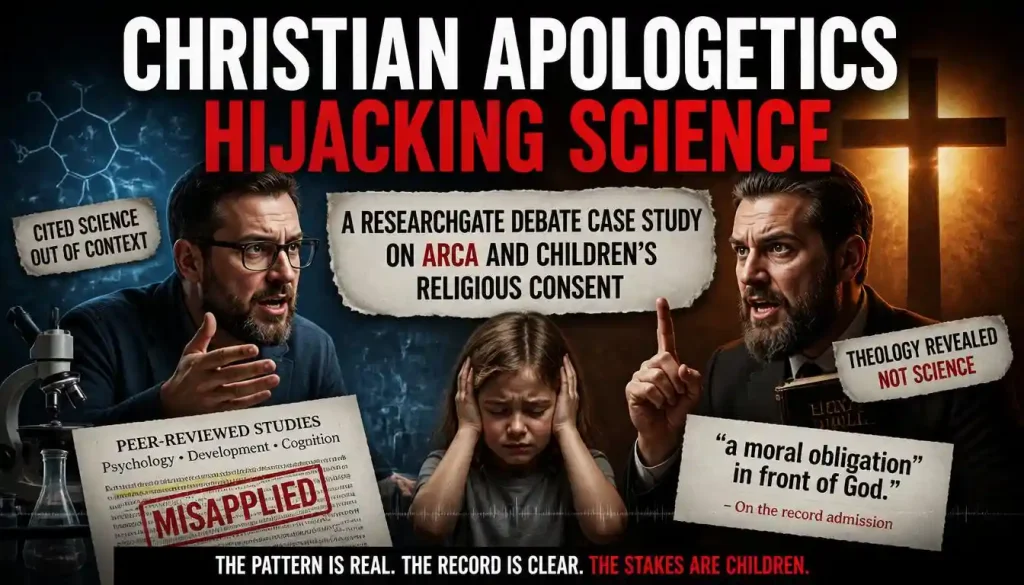
This debate did not stay theoretical. It produced a direct admission: a debater stated, on the record, that coercing a child’s religious identity without consent is “a moral obligation in front of God.”
That single sentence is the clearest evidence yet of what actually motivates opposition to ARCA as presented in Christian Apologetics Hijacking Science:
- Faith Deconstruction Hijack Exposure — the documented institutional pattern this single-debate case study extends down to the level of an individual exchange.
- The Age of Religious Consent Act (ARCA) — the legislative proposal this debate was actually about.
- Is God Real for Teens? — the book written for the exact readers this consent question affects most directly.
Key Terms in the Debate: Religion, Faith, and Deconstruction
A clear debate requires clear definitions. The ResearchGate exchange around ARCA showed how easily Christian apologetics blurs these terms to smuggle theology into scientific language. These short definitions anchor the discussion in precise, non‑theological meaning.
Religion is an organized system of beliefs, rituals, authorities, and identity practices transmitted culturally, not biologically.
Faith is personal belief without evidence, typically grounded in authority, tradition, or emotional conviction.
Christianity is a specific historical religion built on the biblical teachings of Jesus, later expanded through institutional doctrine, creeds, and ecclesiastical authority.
Deconstruction of faith is the process of critically examining inherited belief systems to identify assumptions, conditioning, and contradictions.
Deconstruct religion means analyzing a religious system as a cultural artifact — its origins, power structures, psychological mechanisms, and social functions.
Religious deconstruction is the broader practice of dismantling fear‑based belief frameworks to rebuild identity on evidence, autonomy, and conscious reasoning.
Deconstruction in Christianity refers to Christians questioning doctrine, authority, and inherited theology, often leading to reinterpretation or departure from the faith.
Why These Definitions Matter
In debates like Senad Dizdarević’s ARCA case study, apologetics often shifts between these terms without distinction — treating religion as biology, faith as evidence, Christianity as universal truth, and deconstruction as rebellion. Clear definitions prevent that slide and expose when a scientific argument is quietly replaced with a theological one.
Information Gain: The Angle-Gap Analysis Behind This Case Study
Most writing on apologetics manipulation stays at the level of naming fallacies in the abstract. That framing misses three things this article corrects.
- Real citations get treated as automatically valid. Almost no deconstruction or children’s-rights content actually opens the cited paper and checks what population and question it covers.
- The theological admission is usually implied, rarely quoted. Debaters who defend religious coercion on ostensibly secular grounds rarely say the quiet part out loud — this exchange is a rare case where one did, on the record.
- The “born religious” science and the “sensus divinitatis” theology are treated as separate arguments. Read together, they expose apologetics trying to have it both ways — claiming scientific backing when convenient, and claiming faith is beyond scientific reach the rest of the time.
This case study closes that gap by naming the specific papers, the specific mismatch between what they measured and what they were cited to prove, and the specific sentence where the debate’s real motivation surfaced.
Christian Apologetics Hijacking Science: Short Answer
- A public ARCA debate on ResearchGate shows two Christian apologists citing real adult-wellbeing research to answer a question about childhood coercion the research never studied.
- The same debate produced a direct admission that opposing children’s religious consent rights is a theological duty, not an evidence-based position.
- The “born religious” claims used to back the argument scientifically contradict the parallel apologetic claim that faith is beyond scientific testing in the first place.
Christian Apologetics Hijacking Science: Article Summary
- This article documents four cases from one public debate: a citation mismatch, the “born religious” science-and-theology contradiction, a parental-rights-over-children’s-rights claim, and a direct theological admission.
- It distinguishes legitimate research engagement from citation dressed up to look like it, and names exactly which detail gives the dressing away each time.
- It closes with what this means for ARCA, and how any reader can check a cited study’s actual scope before accepting what it’s claimed to prove.
August 2026 Update: PATREON & FANDOM — Your New Community Spaces
PATREON — A Direct Line to My Work and Thinking
Patreon is your private, behind‑the‑scenes hub where you can follow my ongoing work on faith deconstruction, cognitive autonomy, identity reconstruction, and the AIPA Method. It gives readers:
- exclusive posts and early chapters
- direct communication with me
- supporter‑only insights into new books and research
- a space to ask questions and shape future content
You can join here:
I invite you to participate, comment, and help build a community grounded in clarity, truth, and personal freedom.
FANDOM — The AIPA Method Community Wiki
Fandom is a public knowledge space dedicated to Awakening Into Pure Awareness (AIPA Method) — a collaborative encyclopedia where readers can:
- explore concepts of identity, belief, and inner freedom
- read community posts and reflections
- contribute pages, insights, and interpretations
- help expand the global AIPA knowledge base
Your community:
👉 Your Blog Post: Is God Real for Teens?
Fandom is open to everyone — readers, teens, parents, seekers — anyone who wants to understand how belief systems shape identity and how to break free from fear‑based conditioning.
What Is Christian Apologetics Hijacking Science?
It is the practice of citing genuine, peer-reviewed research as if it settles a question the research never actually asked. This differs from ordinary apologetics in three specific ways:
- Borrowed authority — the argument leans on a real study’s peer-review credibility, not on the apologist’s own claim.
- Scope mismatch — the study’s actual population, method, and measured outcome differ from the claim it’s cited to support.
- A theological fallback — when the scope mismatch is exposed, the underlying position turns out to have been religious duty all along, not a scientific conclusion the evidence happened to support.
This is why the distinction matters: a reader encountering the citation alone, without checking it, has no way to tell a genuinely supportive study from one being asked to do work it was never designed for.
Christian Apologetics Hijacking Science: The Debate – Where This Case Study Comes From
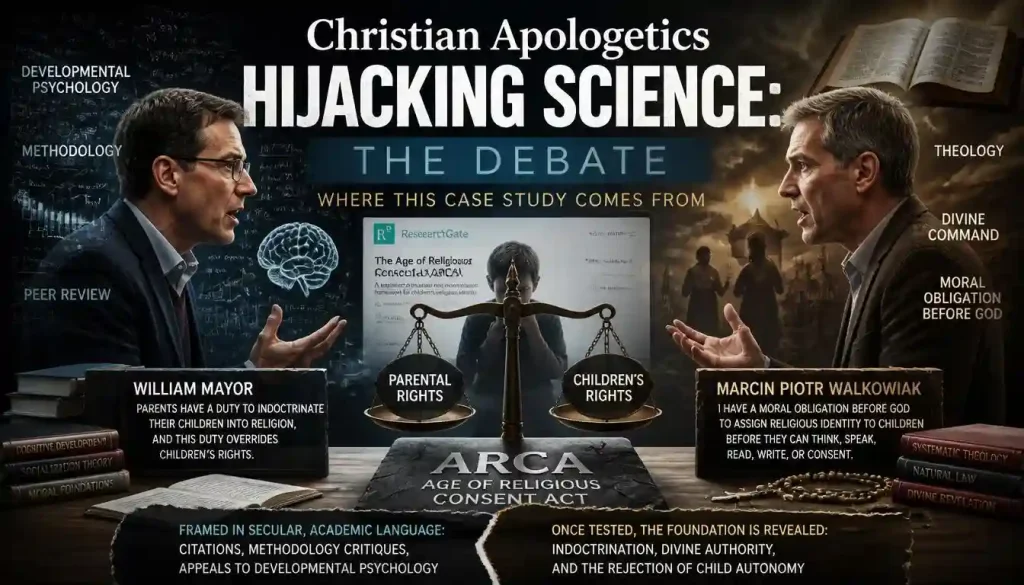
The exchange took place on ResearchGate, a platform for academic discussion, under a post about the Age of Religious Consent Act (ARCA) — Senad Dizdarević’s legislative proposal establishing a tiered consent framework for children’s religious identity.
Two debaters engaged the post directly, each eventually stating a position plainly enough to quote:
- Debater 1 (William Mayor): parents have a duty to indoctrinate their children into religion, and this duty overrides children’s rights.
- Debater 2 (Marcin Piotr Walkowiak): he has a moral obligation before God to assign religious identity to children before they can think, speak, read, write, or consent.
Both debaters initially framed their objections in secular, academic language — citations, methodology critiques, appeals to developmental psychology. The four cases below document what that framing looked like, and what it looked like once it was tested.
The Hijack Pattern: Four Documented Cases
This is not a single misstep. Across one debate, the same underlying move — real science, wrong scope — recurs four times, escalating from a citation problem to an open theological admission.
Case One: Hijacking the Science of Life Satisfaction
When challenged on ARCA, Marcin Walkowiak responded with two real, published meta-analyses, presented as settling the question of childhood religious coercion:
- Paper 1 — “A Meta-Analysis of Religion/Spirituality and Life Satisfaction” (2022), by S. Krok, M. Gerymski, and M. Szcześniak.
- Paper 2 — “Does Spirituality or Religion Positively Affect Mental Health? A Meta-Analysis of Longitudinal Studies” (2020), with Szcześniak and Gerymski again among the authors, joined by A. Gruszczyńska.
Checking what these papers actually measured tells a different story than the one they were cited for:
- Both study adults, not children.
- Both measure self-reported life satisfaction and general mental health, not trauma, and neither includes any trauma measure at all.
- Both study voluntary, general religiosity and spirituality, not authoritarian religion or childhood indoctrination specifically.
- Both are correlational — they support no causal claim, in either direction.
Nothing here is fabricated or fringe research. Both papers are genuinely published and genuinely peer-reviewed. The failure is entirely in the application: research on why voluntarily religious adults report satisfaction with their own chosen participation was offered as an answer to whether children can be coerced into a religious identity before they can consent to one. Those are different populations, different mechanisms, and different questions. Adult voluntary participation draws on community, social support, identity stability, and belonging — none of which describe a child assigned a religious identity by baptism before they can speak.
The core error: religion can carry real benefits for adults who choose it and real costs for children who never got the choice, simultaneously. Citing one to answer a question about the other isn’t evidence — it’s a category error wearing a citation.
Conceptual Clarification: Religion, Psychology, and the Hijack Pattern
Before moving into Case Two, one final point completes the frame: religious psychology is itself a contradictory term. Religion and science are different epistemic domains — one is faithfully grounded in (fictional) authority and revelation, the other in evidence and falsifiability.
When a theological worldview selectively borrows psychological research to defend religious doctrines, the result is not interdisciplinary insight but religion hijacking psychology. And that move — dressing belief as science, then discarding science when challenged — is precisely the pattern this case study exposes.
In other words, Christian apologetics hijacking science is not an abstract accusation. It is what happens whenever religious argumentation uses psychology (or another scientific field) as a costume: scientific vocabulary on the surface, theological motivation underneath. The first case in this debate shows the mechanism clearly — real studies, wrong population, wrong question, wrong scope — ending in a conclusion the science never supported.
Case Two: The “Born Religious” Narrative
A second line of argument in the wider debate leaned on the claim that children are naturally, biologically predisposed toward religious belief — making religious upbringing not indoctrination but simply following a child’s innate wiring. This claim shows up in a recognizable cluster of citations, each worth checking individually.
- Justin Barrett’s cognitive-bias research (popularized as “Born Believers”) shows children have a general cognitive tendency to infer agency and purpose behind events — the Hyperactive Agency Detection Device (HADD). This is real, replicated research. What it does not show is that children are wired specifically for organized religious belief: the same cognitive bias produces belief in monsters, luck, and fate just as readily as belief in gods, and it is a general-purpose reasoning tool, not a religion-specific instinct.
- Dean Hamer’s “God gene” (VMAT2) claim, popularized in a 2004 book, proposed a single gene variant associated with self-transcendence. It was based on a small, non-peer-reviewed dataset, has not been replicated in larger studies, and even a single confirmed gene variant would explain a personality trait at most — not the content of any specific belief system.
- Cloninger’s self-transcendence personality dimension measures a general temperament trait — openness to non-material experience — not religiosity itself. It correlates about as well with meditation practice, artistic absorption, or a sense of awe in nature as with religious belief specifically.
- Popular “God DNA” science journalism routinely overstates all of the above into headline claims no underlying study actually supports.
The refutation is straightforward and worth stating plainly: no confirmed gene or brain structure encodes the content of any specific belief system.
Children raised without religious instruction do not spontaneously develop belief in a specific god, a specific doctrine, or a specific afterlife narrative — they simply don’t become religious in the way children raised with instruction do. And global religious diversity — thousands of mutually exclusive traditions, each convinced its own doctrine is the natural one — is itself evidence against any single “natural” religious wiring, since a genuinely innate faculty would not produce contradictory content depending only on which culture a child happened to be raised in.
The Theological Mirror: Sensus Divinitatis
As I write in Book 4 of my “It’s Finally PROVEN! God Does NOT Exist The FIRST valid EVIDENCE in History” book series, https://god-doesntexist.com/, the same underlying move — trying to root faith in something that sounds like biology or built-in perception — has a philosophical parallel in Alvin Plantinga’s sensus divinitatis, popularized by William Lane Craig. It is the claim that humans possess a natural, built-in faculty for direct awareness of God, on par with sight or memory, requiring no argument or evidence.
This claim deserves the same scrutiny as the genetic version, because it invites the same basic questions: where in the body is this faculty located? Why does it apparently fail to activate in roughly a third of the world’s population who hold no religious belief at all? Why does it never point the same believer toward the same specific god their neighbor two countries over insists is the true one?
A faculty that reliably produces contradictory, mutually exclusive content depending only on geography and upbringing does not behave like sight or memory — those are consistent across cultures in a way religious content demonstrably is not.
A child’s mind is not a vessel to be filled. It is a universe to be free. — the core claim ARCA is built to protect
Here is the contradiction worth naming directly: the same apologetic tradition that insists faith is a properly basic belief beyond the reach of scientific testing — precisely so it can’t be falsified — reaches for genetic and neurological claims the instant those claims seem to offer scientific backing.
Faith cannot be simultaneously untestable when science threatens it and scientifically confirmed when science seems to help it. Both cannot be true at once, and no version of the “born religious” argument, biological or theological, resolves that contradiction — it just relocates it.
Case Three: Parental Rights Placed Above Children’s Rights
William Mayor’s core position, restated plainly by the end of the exchange: parents have a duty to introduce their children to religion, and that duty overrides the child’s own claim to religious self-determination. In practice, this argument was built on a false equivalence — comparing religious enrollment to teaching a child a native language or a family’s cuisine.
The comparison collapses under its own weight. Language and food are not belief systems; they carry no doctrine, no claim about ultimate reality, no moral obligations, and no threat of eternal consequence for getting them wrong.
A child raised speaking one language can freely learn another without penalty or personal betrayal. A child enrolled in a religious identity via infant baptism, by contrast, is assigned an ideological membership — one that, in many traditions, comes attached to specific claims about what happens to them eternally if they later reject it. Treating that as equivalent to teaching a child to use chopsticks or speak English is not an argument; it’s a category error deployed to make coercion sound like ordinary parenting.
ARCA’s actual position is narrower than this framing implies, and worth stating precisely: it does not propose that parents stop sharing their beliefs, traditions, or family practices with their children. It proposes that formal religious enrollment — the kind that creates institutional identity and doctrinal obligation — be treated the same way informed consent is already treated in medicine, contracts, and other areas where a person’s future is bound by a decision they didn’t make.
Case Four: “A Moral Obligation in Front of God”
This is the case that makes the other three legible. Pressed on why two off-topic adult-wellbeing papers should settle a question about childhood coercion, Marcin Walkowiak eventually dropped the scientific framing entirely:
“I treat it as moral obligation in front of God.”
That sentence is the whole case study in miniature. Everything preceding it — the citations, the methodology language, the appeals to “literature review” and “metastudies” — was presented as a scientific, evidence-based objection to ARCA. This sentence reveals it was never that. It was a theological position that reached for scientific language because theological language alone doesn’t carry weight in a debate about civil legislation and children’s rights.
The distinction matters for exactly this reason: a theological duty is a private conviction, protected the same way any belief is protected. An evidence-based ethical claim is something that can be tested, checked, and weighed against competing evidence in a public policy debate. Conflating the two — presenting the first as if it were the second — is the precise mechanism this entire case study documents, and here it happened in one sentence, on the record, in the debater’s own words.
Christian Apologetics Hijacking Science: Documented Manipulations from the ResearchGate Debate
This section lists the specific, repeated manipulations used by both debaters in the ARCA ResearchGate exchange. They are not theoretical patterns, but the actual tactics they deployed.
Debater 1: William Mayor — Ten Documented Manipulations
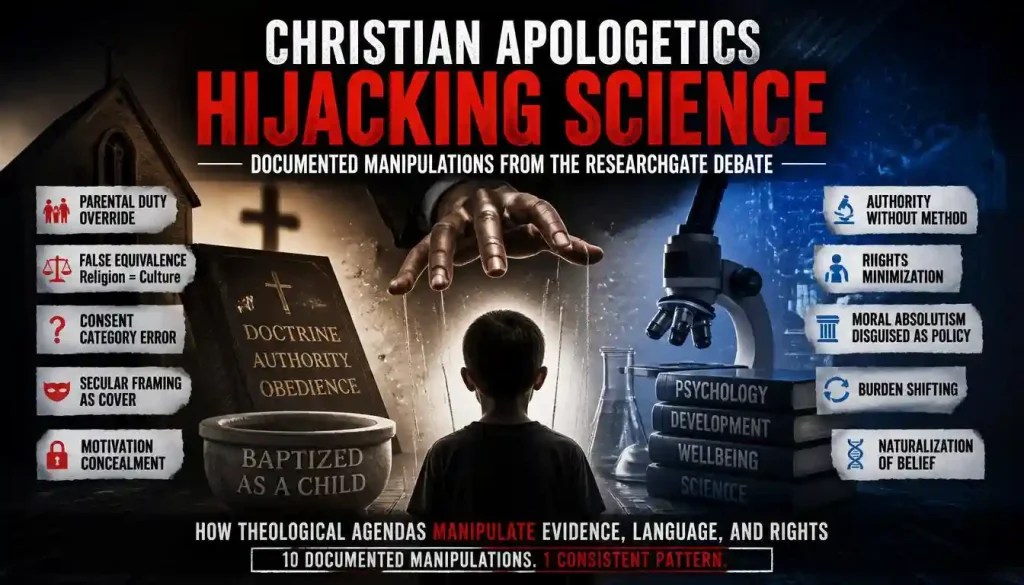
- Parental Duty Override: Explicitly states parents have a duty to indoctrinate children, placing parental authority above children’s rights.
- False Equivalence Between Religion and Culture: Equates religious identity assignment with teaching language or cuisine — collapsing belief systems into neutral cultural habits.
- Category Error About Consent: Treats infant baptism and doctrinal membership as equivalent to ordinary childhood learning, ignoring that one requires informed consent.
- Secular Framing as Cover: Begins with secular language (psychology, methodology) to appear evidence‑based, then shifts to theological justification when challenged.
- Motivation Concealment: Hides the religious motive behind academic phrasing until pressed, revealing the underlying theological position only at the end.
- Authority Borrowing Without Method: Uses scientific vocabulary (development, wellbeing, psychology) without engaging actual scientific method or relevant research.
- Rights Minimization: Frames children’s autonomy as secondary or irrelevant compared to parental religious duty.
- Moral Absolutism Disguised as Policy Argument: Presents theological obligation as if it were a neutral ethical principle applicable in civil law.
- Burden Shifting: When confronted with methodological critique, reframes the challenger as biased rather than addressing the critique.
- Naturalization of Religious Identity: Treats religious identity as a natural part of upbringing rather than an ideological assignment with lifelong consequences.
Debater 2: Marcin Piotr Walkowiak — Ten Documented Manipulations

- Citation Hijacking: Uses two real meta‑analyses on adult voluntary religiosity to answer a question about childhood coercion.
- Population Mismatch: Applies adult self‑reported satisfaction data to children who cannot consent — a fundamental methodological distortion.
- Outcome Mismatch: Cites studies measuring general wellbeing to imply conclusions about trauma, coercion, or indoctrination — none of which the studies measured.
- Correlation Inflation: Presents correlational findings as if they settle causal or ethical questions.
- Borrowed Scientific Authority: Uses peer‑reviewed studies as rhetorical armor while ignoring their actual scope, method, and limitations.
- Theological Reveal: When pressed, drops the scientific framing entirely and admits the real basis: “I treat it as moral obligation in front of God.”
- Born‑Religious Narrative Misuse: Misapplies cognitive‑bias and genetic claims (“God gene,” HADD, self‑transcendence) to imply biological inevitability of religious belief.
- Contradiction Masking: Claims faith is beyond scientific testing while simultaneously using scientific language to defend faith — incompatible positions.
- Selective Science Acceptance: Accepts scientific claims only when they appear supportive; rejects scientific limits when they contradict theological commitments.
- Identity Determinism: Frames religious identity as biologically wired, ignoring global diversity and the fact that children raised without religion do not spontaneously develop doctrinal belief.
Conclusion: What These Manipulations Reveal
Across both debaters, the same mechanism repeats:
Scientific language used as costume, theological duty underneath.
William Mayor’s manipulations center on parental authority, false equivalence, and rights minimization, while Marcin Walkowiak’s revolve around citation hijacking, scope mismatch, and the final open theological admission.
Together, they demonstrate the core thesis of my article:
Christian apologetics hijacking science is not a theoretical accusation, it is a documented pattern where theological conviction is dressed as scientific argument until challenged, at which point the scientific disguise collapses.
Christian Apologetics Hijacking Science: Lying and Manipulating by Default
This article is part of the topical cluster revealing Christian apologetic manipulations:
https://god-doesntexist.com/atheist-vs-theist-debate-tactics-biblical-quote-bombardments-on-medium/
https://god-doesntexist.com/apologetics-and-the-defense-of-evil-yahwehs-lies-and-violence/
https://god-doesntexist.com/senad-dizdarevic-atheist-articles-exposing-religious-lies/
Read, learn, and prepare yourself for the debates with Christians, who are ready to kill for their god, let alone lie and manipulate.
“When people believe that a book is the perfect word of the creator of the universe, it is natural for them to think that killing people for believing the wrong thing is not only permissible, but necessary.” — Sam Harris, The End of Faith (2004)
Religious absolutism pushes believers into actions they consider “normal” — lying, suppressing evidence, or overriding a child’s autonomy — if they believe the action is commanded by God.
By assigning children a coerced religious identity, Christianity teaches them that they are born sinners by default — flawed, guilty, and dependent on external authority for moral worth. In this self‑deprecating posture, believers often internalize the idea that human nature is corrupt and that obedience to divine command is the only path to redemption.
This dynamic matters in debate: once a person believes that serving God is a higher moral duty than ordinary ethical reasoning, they may justify actions — including manipulation, concealment, or self‑sacrifice — as necessary. The ResearchGate exchange documented this directly when a debater stated that assigning religious identity to children was “a moral obligation in front of God.”
Understanding this moral‑override mechanism helps you see why arguments shift: the believer is not defending evidence, but defending obedience.
Christian Apologetics Hijacking Science: Post‑Debate Addendum
Nearly a week after the debate ended, Walkowiak returned with a bitter, cynical, hostile, contempt‑laden message attacking me personally, dismissing ARCA as “far‑left extremism,” and accusing me of seeking “unearned prestige.”
Read his latest personal attack against me, which reveals a strong aversion to children’s rights to a carefree childhood free from religious coercion, and is filled with despair, mockery, and malice.
“>”Christian-biased papers”
Reminder: you haven’t even tried to demonstrate that. You haven’t even challenged any technicalities of those papers. You just started to throw unsubstantiated accusation personal accusation against rigorous meta-studies what outed you as activists who tries to pose as scientist for extra clout and unearned prestige.
Reminder 2: you tried to counter my scientific arguments on studies positive impact of religion on measurable income (happiness, mental health, tfr) with blatant misunderstanding of international convention and you are surprised why it’s hard to take you seriously. Seriously, even if your argument had been consistent with the convention, it would just mean that the convention would be just one of laws to be remodeled in recently quickly shifting international order, but even that threshold wasn’t reached.
>”That is the reason that ARCA will be accepted as a valuable contribution to human and children’s rights.”
Do you want to bet that I’m not the only one who failed to notice your supposed genius and not only it would not be taken seriously lawgivers but also even other far-left extremists aren’t going to cite you much as that’s run the mill ideological abuse of logic on subject that’s not even fashionable subject among your core potential audience? (Or do you just mean as “valuable contribution” that you may one day publish it in something sufficiently predatory or low tier?)”
Despite I answered all his claims and presenting his manipulations, he is still attacking me. His final reply contained no scientific content, no methodological defense, and no engagement with the documented scope mismatches. It was pure emotional backlash — the predictable psychological shift that occurs once the scientific framing collapses and the underlying theological motive has already been admitted. In other words, the debate ended exactly the way the hijack pattern predicts: evidence gave way to identity defense.
Here is one of my replies to both of the debaters, desperately stoning me with manipulations: When all you have is a manipulation, you don’t have anything.
Christian Apologetics Hijacking Science: The PA Trio Lens – Why Apologists Reach for Science
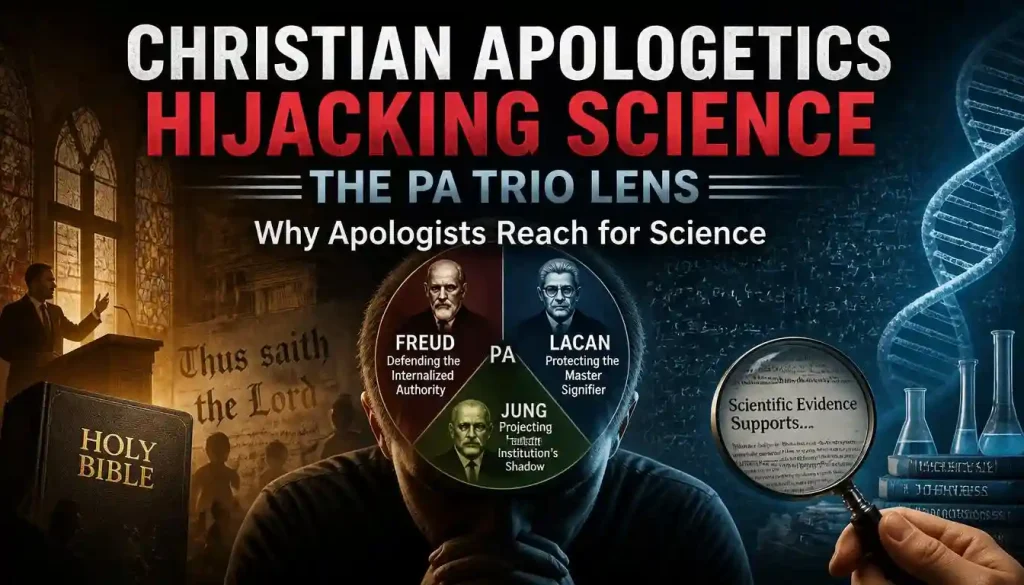
The PA Trio framework — Freud, Lacan, and Jung read together — explains the motive behind this pattern, not just its mechanics. Applied to an individual defending a belief system rather than an institution defending its membership, each lens still holds.
Freud: Defending the Internalized Authority
Freud’s superego is an internalized authority structure that punishes deviation to protect itself. A believer defending church doctrine in a public debate is defending the same internalized structure at the level of the individual psyche — challenging ARCA registers as a threat to that internal authority, which explains the defensiveness that outlasts any single citation being disproven.
Lacan: Protecting the Master Signifier
For Lacan, a master signifier — here, God, or divine moral law — holds authority only as long as enough people organize their reasoning around it. Every successful challenge, like ARCA gaining ground, quietly withdraws consent from that signifier. Reaching for scientific-sounding citations is a resuturing move: an attempt to re-anchor the challenged signifier in a register — empirical science — that still commands broad public authority, even when the underlying claim is theological.
Jung: Projecting the Institution’s Shadow
Jung’s shadow is the disowned part of a psyche projected outward rather than examined. Rather than confronting the discomfort of an argument built on theological conviction alone, the debater projects rigor onto it via borrowed citations — externalizing the appearance of scientific standing rather than examining why the underlying claim needs that appearance in the first place.
Read together, the PA Trio explains why the scientific dressing appears at all: not because the citations were expected to withstand scrutiny, but because invoking them protects something the debater isn’t examining directly — an internalized authority, a challenged framework of meaning, and an unexamined theological motive, all defended at once by reaching for science’s credibility rather than science’s method.
What Are the Warning Signs of Science-Washed Apologetics?
- A cited study’s population doesn’t match the claim being made (adults cited for a claim about children, general samples cited for a specific coercion question).
- The same handful of authors, with a visible pattern of religion-positive publication history, get cited repeatedly across unrelated arguments.
- Correlational findings get presented as if they answer a causal or ethical question.
- When the citation is challenged directly, the underlying justification shifts from “the evidence shows” to “my duty” or “my faith requires.”
How Can You Distinguish Genuine Research Engagement from Science-Washed Apologetics?
| Feature | Genuine Research Engagement | Science-Washed Apologetics |
| Population match | Cited study’s subjects match the claim being made | Adult data cited to settle a question about children, or vice versa |
| Causal language | Correlational findings described as correlational | Correlational findings described as if they prove or disprove a causal, ethical claim |
| Response to challenge | Engages the specific methodological critique raised | Shifts to “duty,” “faith,” or “moral obligation” once the citation is challenged |
| Author transparency | Acknowledges a study author’s own stated framework or funding, where relevant | Presents citations as neutral without noting a visible ideological publication pattern |
Who Encounters This Tactic Most Often?
- Parents researching whether religious upbringing carries documented risk, who encounter a confident-sounding citation and have no easy way to check its actual scope.
- Teenagers beginning to question inherited belief, who are directed toward apologetics content citing “science” that appears to settle the question before they’ve had a chance to examine it themselves.
- Policy audiences evaluating proposals like ARCA, who may not have time to open every cited paper and check its methodology before forming a view.
What Psychological Tactics Recur in This Pattern?
- Authority borrowing — peer-reviewed publication lends unearned credibility to a claim the research doesn’t actually support.
- Scope inflation — a narrow finding (adult self-reported satisfaction) gets applied to a much broader claim (childhood coercion is harmless).
- Motivation deflection — when a citation is challenged, the response reframes the challenger as biased, rather than addressing the mismatch directly.
- Theological fallback — the scientific framing is dropped entirely once pressed, revealing the actual, unstated basis for the position.
How Can Someone Verify a Cited Study Before Accepting Its Conclusion?
- Check the population. Does the study’s sample actually match the claim being made about it?
- Check what was measured. Self-reported satisfaction, trauma, and coercion are three different things — a study measuring one says nothing reliable about the others.
- Check the authors’ publication history. A repeated, narrow focus on religion-positive findings across many papers is a visible pattern worth noting, not an accusation, and worth weighing alongside the study’s own findings.
- Watch what happens when the citation is challenged. A position built on the evidence adjusts or defends the evidence. A position using the evidence as cover falls back to something else entirely — as it did here.
Christian Apologetics Hijacking Science: What This Case Study Means for ARCA
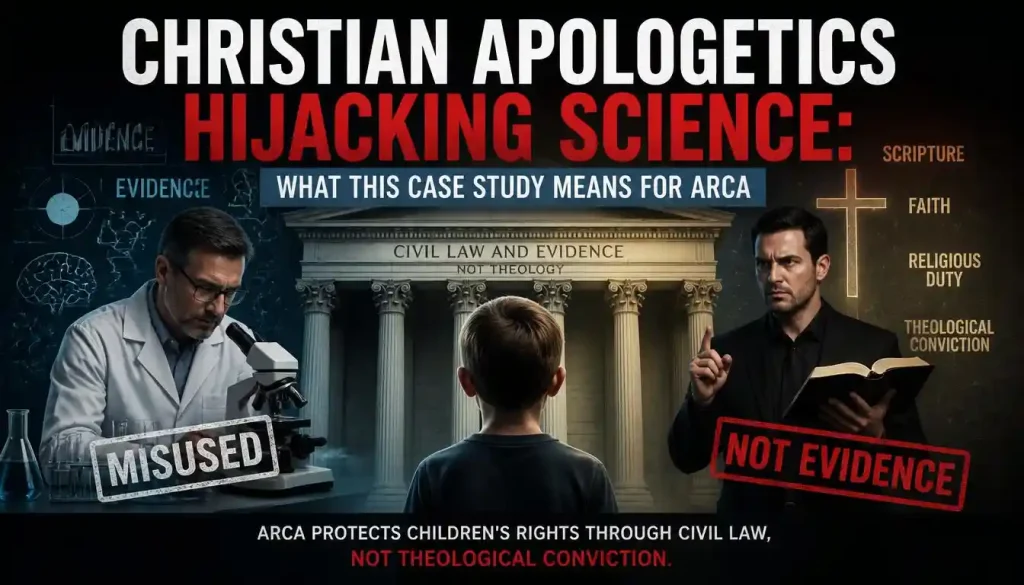
The Age of Religious Consent Act’s (ARCA) opponents in this exchange did not, in the end, dispute ARCA’s central claim: that a child cannot meaningfully consent to a religious identity assigned before they can think, speak, read, or write.
What they disputed was whether that fact should matter legally. One argument reduced to parental authority overriding the child’s own claim. The other reduced to a theological duty that, by its own proponent’s admission, has nothing to do with civil law or evidence.
That is precisely the distinction ARCA is built around. Courts rule by civil law and evidence, not by theological conviction, however sincerely held — the same separation of church and state that already governs every other area of children’s legal protection.
A debate that opened dressed as science and closed as an open statement of religious duty is not a rebuttal to ARCA. It’s a demonstration of exactly the problem ARCA exists to address.
What Resources Help Verify Claims Like These?
- Faith Deconstruction Hijack Exposure — the broader institutional pattern this single debate exemplifies at individual scale.
- Evidence-Based Strong Atheism: The First Cluster Evidence — the evidential foundation this case study’s claims are checked against.
- History of Faith Deconstruction and Leaving Religion — historical context for how this same pattern has recurred across centuries.
- AIPA Method for Faith Deconstruction — a structured framework for rebuilding independent judgment after encountering exactly this kind of science-washed argument.
Deconstruct Your Faith With Senad Dizdarević’s Book Series
It’s Finally PROVEN! God Does NOT Exist: The FIRST Valid EVIDENCE in History, god-doesntexist.com
👉 Get the eBook Series on Amazon
👉 Get the Paperback Series on Amazon
New: Is God Real for Teens? A Faith Deconstruction Guide for Teens, Parents, and Families — written directly for the readers this consent question affects most: Read more here
Deconstruct your faith, leave religion, and start with the natural personal development in reason, logic, and reality.
Christian Apologetics Hijacking Science: Conclusion
This case study didn’t need to speculate about apologetics motives. A public, documented debate supplied the evidence directly: real research cited outside its actual scope, a “born religious” narrative that contradicts apologetics’ own claim that faith is untestable, a parental-rights argument built on a false equivalence, and — in the debater’s own words — an open admission that the real position was theological duty, not evidence, all along. Naming the pattern once, with the receipts attached, makes it far easier to recognize the next time it appears dressed differently.
Take Action: Support The Age of Religious Consent Act (ARCA)
This debate exploited exactly the gap ARCA is designed to close: religious identity installed before consent is possible, defended after the fact with borrowed scientific language and, when that language failed, an open statement of theological duty.
The Age of Religious Consent Act proposes a tiered consent structure giving children and teenagers legal standing over their own belief. Read the full proposal and the Open Letter to Parents, Teachers, Priests, Politicians, and Society for the complete case.
Why Publishing ARCA on The Anarchist Library Strengthens Its Global Reach
Paragraph: Having the Age of Religious Consent Act (ARCA) published on The Anarchist Library is strategically important because it places the legislative motion inside a long‑standing, globally indexed repository of political, philosophical, and social‑justice texts. The platform is fully open‑access, crawled by Google, and widely referenced by researchers, activists, and independent thinkers. This means ARCA gains organic visibility, search‑engine authority, and ideological reach far beyond traditional academic or policy channels. By appearing alongside influential works on autonomy, rights, and liberation, ARCA becomes part of a broader intellectual ecosystem where readers actively seek structural critiques and new legislative ideas.
Read the ARCA preview here: https://theanarchistlibrary.org/action/text/edit/senad-dizdarevic-the-age-of-religious-consent-act-arca-legislative-motion/36494/preview — and notice how placing ARCA inside a library built on resistance, autonomy, and liberation reframes the motion itself.
Christian Apologetics Hijacking Science: FAQ
What does “Christian apologetics hijacking science” mean?
It refers to citing real, peer-reviewed research as if it settles a question the research never actually studied — borrowing science’s credibility without following its method to promote religious propaganda.
What was this ResearchGate debate actually about?
A public exchange over the Age of Religious Consent Act (ARCA), in which two debaters defended religious enrollment of children without their consent.
What studies were cited, and what did they actually measure?
Two real meta-analyses on adult life satisfaction and adult mental health, published by overlapping Polish authors with a religion-positive publication history — neither studied children, coercion, or trauma.
What is the “born religious” argument, and does it hold up?
It claims children are naturally wired for religious belief, citing cognitive-bias research (Barrett), a disputed “God gene” (Hamer), and a general personality trait (Cloninger) — none of which show any specific belief content is innate, and cross-cultural religious diversity argues directly against it.
What is sensus divinitatis, and how does it relate?
It’s Alvin Plantinga and William Lane Craig’s claim that humans have a built-in faculty for perceiving God directly. It mirrors the “born religious” science claim in theological form, and creates the same contradiction: faith is claimed to be beyond scientific testing, except when a scientific-sounding claim seems to help it.
What did the second debater actually say when pressed?
“I treat it as moral obligation in front of God” — a direct statement that the position was theological duty, not an evidence-based conclusion.
How can I check whether a cited study actually supports a claim like this?
Check the population studied, what was actually measured, the authors’ publication pattern, and what happens to the argument when the citation itself is challenged.
What does this case study mean for ARCA?
It shows that a debate opening with scientific-sounding objections to ARCA closed with an open admission that the real objection was theological — precisely the distinction ARCA is built to make legally relevant.
EEAT: About the Author
Senad Dizdarević is an independent researcher, philosopher, journalist, and author based in Ljubljana, Slovenia. He founded Evidence-Based Strong Atheism as a named intellectual paradigm, created the AIPA Method (Awakening Into Pure Awareness), and authored the Age of Religious Consent Act (ARCA), a legislative proposal currently under academic review at the Oxford Journal of Law and Religion (OJLR-2026-053).
His work spans two dedicated platforms, https://god-doesntexist.com/ and https://www.letterstopalkies.com/, alongside peer-reviewed academic output on HCommons, Zenodo, Figshare, ResearchGate, and Academia.edu. He publishes two active book series, It’s Finally PROVEN! God Does NOT Exist and Letters to Palkies, and is the author of Is God Real for Teens? A Faith Deconstruction Guide for Teens, Parents, and Families.
Dizdarević holds verified academic identifiers across major scholarly registries:
- ORCID: 0009-0008-9369-2734
- Wikidata: Q138599746
- ISNI: 0000 0005 3005 8622
- VIAF: 97154440103035341417
Related Articles
Religious Indoctrination of Children: Infant Baptism and The Age of Religious Consent Act (ARCA)
What is Faith Deconstruction: Breaking the Karmic Script Written Before You Were Born
Faith Deconstruction for Teens: How Religiously Indoctrinated Children Start Questioning the Script
Is God Real for Teens? A Faith Deconstruction Guide for Teens, Parents, and Families