
Faith Deconstruction Guide for Teens, Parents, and Families: How to Question Your Faith Safely and Reclaim Your Own Mind
Faith Deconstruction Guide for Teens, Parents, and Families is a structured resource that helps young people examine the religious beliefs they were raised with and helps the adults around them respond without fear, control, or panic. It matters because most teens going through this get one of two things: pressure to keep believing, or vague reassurance that it’s “just a phase.” Neither one actually helps.
I wrote this guide for teenagers asking hard questions about god’s existence, and just as much for the parents, teachers, and families trying to support them without losing the relationship in the process. The benefit is concrete: a clear, evidence-based answer to whether God is real, a practical method for working through doubt without being pulled back by fear or guilt, and a real path toward an authentic identity, not one assigned before they were old enough to choose it.
If you are a parent trying to navigate this transition with your child, read our companion guide on how to support a questioning teen without coercion with useful answers and full support for safe faith deconstruction.
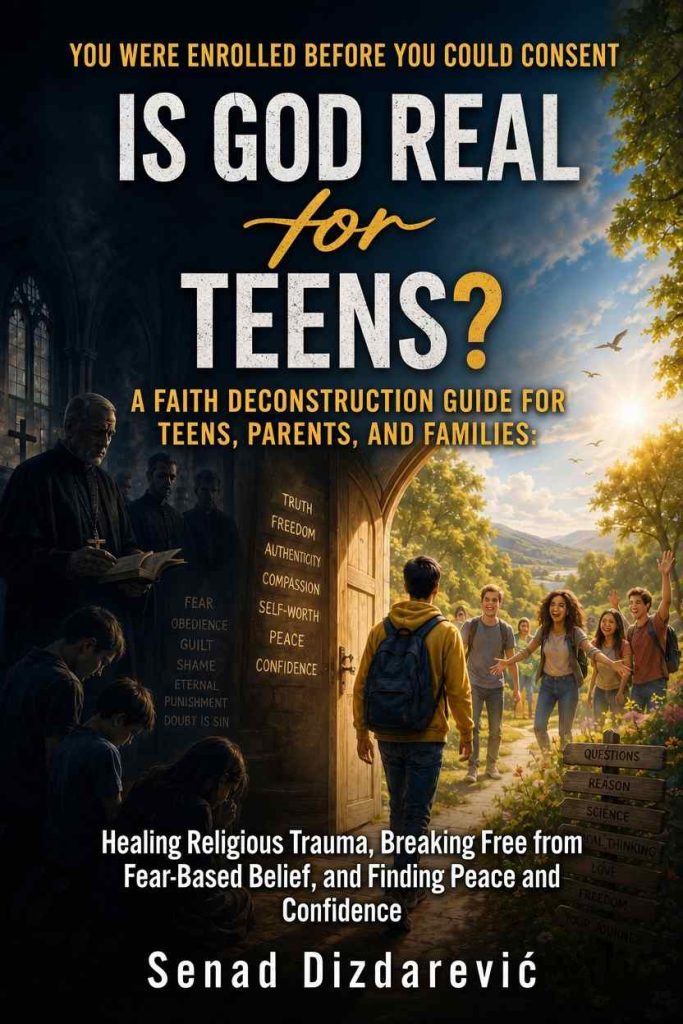
Fiction readers want to get lost in a book. Nonfiction readers want something specific: to solve a problem, build a skill, or make a decision. When they want to leave religion, they look for the best book on the deconstruction of faith, one that will help, encourage, and support them.
Nobody opens a faith deconstruction guide to be entertained. They open it because they, or someone they love, are standing in the middle of a real question that needs a real answer.
This article is about what my book actually promises to deliver, and how it delivers it. It is not a page describing what’s in it, but a page about what changes in you once you’ve read it.
Faith Deconstruction Guide for Teens: Short Answer
Faith Deconstruction Guide for Teens, parents, and families gives teenagers real evidence and a practical method for questioning inherited belief safely, and gives the adults around them a way to support that process without control, fear, or manipulation. Is God Real for Teens? by Senad Dizdarević was written specifically for that purpose, and it’s the guide this article is built around.
What Faith Deconstruction Actually Looks Like for a Teen
Faith deconstruction is a well-documented process: examining, questioning, and rethinking an inherited belief system to decide, honestly, what you actually believe, rather than what you were handed.
For a teenager, that usually means sitting with real, uncomfortable questions instead of pushing them away. Teen is learning to separate the people and traditions of a religious upbringing from the underlying claims themselves. A flawed pastor or an unkind congregation isn’t the same question as whether God exists, and finding at least one person safe enough to think out loud with, someone who won’t respond to doubt with anger or judgment.
A worldview that took years to build usually takes real time to take apart and rebuild, too. Doubt showing up along the way isn’t a warning sign. It’s a normal, healthy part of growing up, and treating it that way, calmly, without panic, is usually what determines whether a family comes through this closer or further apart.
The Guiding Principle: From Indoctrination to Liberation
Every real faith deconstruction follows a similar arc, whether anyone names it or not: from religious indoctrination absorbed before consent was even possible, through the active work of faith deconstruction itself, examining evidence, deprogramming old fear, toward liberation and self-realization on the other side of it.
That’s not a metaphor. It’s a transformational mechanism, and it’s the exact structure this guide and Senad’s book behind it are built around. 
Fiction readers want to get lost in a book. Nonfiction readers want something specific: to solve a problem, build a skill, or make a decision. Nobody opens a faith deconstruction guide to be entertained. They open it because they, or someone they love, are standing in the middle of a real question that needs a real answer.
This article is about what this guide actually promises to deliver, and how it delivers it. It is not just a description of what’s in it, but a map of what changes in you once you’ve followed the process through.
The Promise: What You’ll Be Able to Do When You Finish Reading
Every chapter in this book is built to serve one three-part promise. Not “here’s some information about religion,” but a specific, testable transformation:
1. Realization
You’ll reach a clear, evidence-based conclusion: God does not exist, based on scientific, ontological, and logical evidence, not on someone else’s authority, and not on a feeling you’re expected to trust without examining it.
2. A New Skill
You’ll walk away with something you can actually use: critical thinking sharp enough to evaluate any claim, not just religious ones; the ability to recognize and deprogram indoctrination, in yourself or in the systems around you; and a practical framework for identity reconstruction and self-realization once an inherited belief is no longer holding the structure up.
3. The Benefit
And underneath both of those: new and authentic identity, a genuinely independent life, built on reason, logic, and freedom instead of fear, one that saves you real time, energy, and money, and clears the way for healthier, more honest relationships with the people around you.
That’s the whole promise. Realization. Skill. Benefit. Nothing in this book exists that doesn’t serve one of those three.
How the Book Actually Delivers On It
Here’s the mechanism, not just the outcome: how a 16-chapter book gets a reader from where they start to where that promise lands.
- Realization comes first, and it comes from evidence, not persuasion. The opening chapters build the actual case, physics, logic, the structural impossibility of a creator-God, so the reader isn’t asked to trade one unproven belief for another. They’re shown the reasoning and left to follow it themselves.
- The skill gets built once the ground is settled, not before. Only after the evidence is on the table does the book turn to the psychology of belief, the stages of faith deconstruction, and the AIPA Method, a real, repeatable process for observing conditioned fear and guilt without being run by them, and for rebuilding an identity that isn’t just reactive to the old one.
- The benefit is the part most books like this skip entirely. It’s not enough to deconstruct a belief. This book stays with the reader through what comes after: family relationships that survive disagreement, The Age of Religious Consent Act (ARCA) legislative proposal aimed at protecting the next generation from the same conditioning, and a closing framework for actually living the conclusion, not just holding it privately.
Faith Deconstruction Guide for Teens: The Real Pain Point
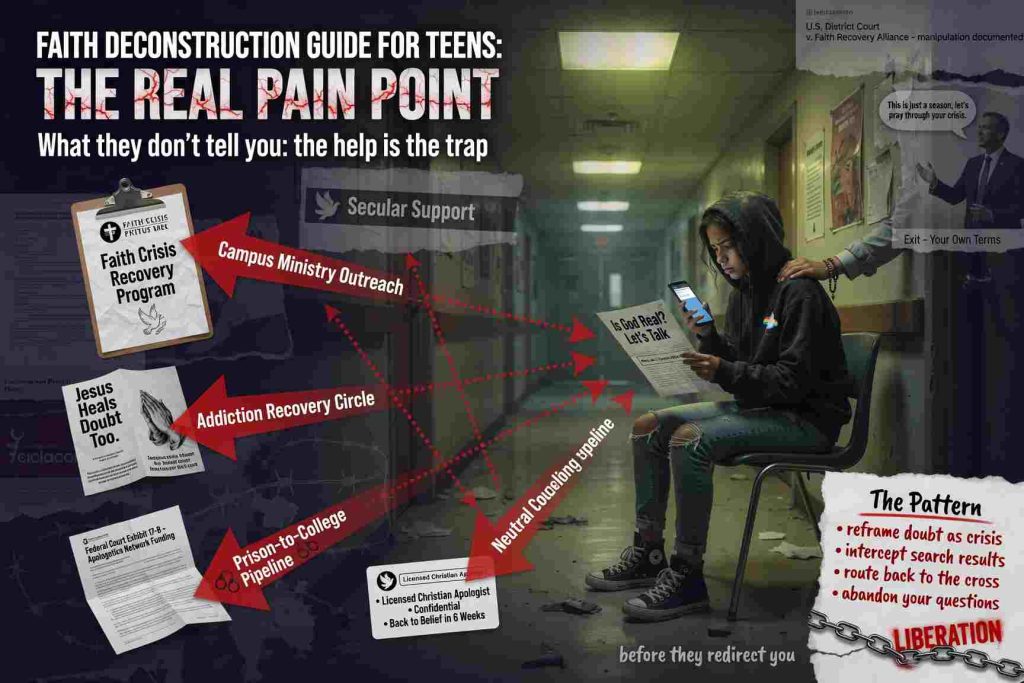
Here’s what most guides on this topic don’t tell a questioning teen: the deconstruction conversation itself has been quietly targeted.
Christian apologetics networks have spent years and millions of dollars embedding themselves inside exactly the places a questioning teen goes looking for help: prisons, addiction recovery programs, campus organizations, even counseling practices marketed as neutral.
Rather than arguing openly against deconstruction, they intercept it, reframing a teen’s doubt as a “faith crisis” to be managed and resolved back into belief, instead of a genuine, evidence-based question with its own real answer.
The pattern is documented in detail, including real federal court rulings, in my separate article, Faith Deconstruction Hijack Exposure: How Christian Networks Control the Deconstruction Conversation, revealing apologetic manipulations to drive questioning teens back to faith, and to their knees before the cross, abandoning their freedom.
This matters here because a teenager who doesn’t know this pattern exists is far more likely to walk straight into the apologetic trap, mistaking a redirection for genuine support.
Is God Real for Teens? is built to close exactly that gap. It doesn’t just hand a teen evidence and a method. It shows them what manipulation looks like when it’s dressed up as help, so they can recognize it, decline it, and keep moving through their own process, safely, all the way to full deprogramming, liberation, and self-realization, on their own terms.
Why This Matters for Teens Specifically
A teenager asking whether God is real isn’t looking for a debate opponent. They’re standing at the exact point where a decision made for them in infancy meets a mind that’s finally capable of evaluating it. What they need isn’t more pressure in either direction. It’s evidence, a method, and respect for their own conclusion, whatever it turns out to be.
That’s true for the parents and families around them too. A guide that actually works for a questioning teen has to work for the whole household, which is why I wrote this book to be read by teens and their families together, not handed to one and hidden from the other.
Faith Deconstruction Guide for Teens: Frequently Asked Questions
Is faith deconstruction the same as losing your faith?
No. Losing faith is passive and often unintentional. Faith deconstruction is an active, deliberate process of examining a belief system on purpose, which tends to produce a clearer, more lasting result.
Will this guide push my teen toward atheism?
It’s built to present evidence and a method, not a predetermined outcome. The actual goal is that a teen reaches their own conclusion honestly, whatever that conclusion turns out to be.
How can parents support a questioning teen without a fight breaking out?
By separating love from agreement early and explicitly, and by responding to doubt with curiosity instead of control. The full book covers this in direct, practical detail.
What is the AIPA Method mentioned in the book?
Awakening Into Pure Awareness by Senad Dizdarević is a step-by-step framework for processing doubt, reducing conditioned fear, and rebuilding identity once an inherited belief no longer holds together.
What is the “faith deconstruction hijack” this article mentions?
A documented pattern in which religious networks embed themselves in prisons, recovery programs, counseling, and campus life specifically to redirect people questioning their faith back toward belief. The full pattern is covered in a dedicated article, linked above.
Faith Deconstruction Guide for Teens: Article Summary
- A faith deconstruction guide for teens, parents, and families gives teenagers evidence and a method, and gives families a way to support the process without control or panic.
- Faith deconstruction is an active, deliberate process, not a phase, and it usually takes real time.
- The book behind this guide is built around one three-part promise: Realization, a new skill, and a concrete benefit.
- The Christian apologetics world has developed real, documented tactics for hijacking the deconstruction conversation itself, and this guide is built to expose them.
- The guide is written for teens and their families together, not for one side alone.
My Personal Experiences with Religiously Indoctrinated Believers
When you talk to a believer, it’s like talking to the Bible. Not to the real person, but to the machine. No matter what you say, he’ll respond with a Bible verse, which he presents as the absolute truth, and he expects you to immediately fall to your knees, repent, and accept Jesus as your savior. Amen.
Believers are like robots that recite the Bible, like mechanical parrots that constantly repeat the same thing over and over without even stopping to think about whether what they’re saying is true. They do this because they have been religiously indoctrinated, programmed, and hypnotized.
Christian doctrine declares everyone to be sinners, wicked, and even damned, so that it can then intimidate, threaten, subjugate, and exploit them. In doing so, it imposes an artificial and false identity on believers and classifies them as wicked people, whom it then blackmails and abuses in every possible way.
The essence of personal development lies precisely in taking a fresh, open, and honest look at your entire life, recognizing the harmful influences of external and ideological agendas, abandoning them, and creating your own way of life. This requires critical thinking grounded in reason, logic, and truth.
Believers themselves say that faith is more important to them than truth, and that faith is supposed to be above reason, which is supposed to be its servant. All of these are irrational statements made by brainwashed and hypnotized people, who begin to speak normally immediately after being deprogrammed.
Fortunately, I was never forcibly indoctrinated into a religion, as I was lucky enough to have grown up before my parents could enroll me in a religion without my consent. Later, I was smart enough to stay away from the religious lies, nonsense, and manipulations.
For others who weren’t so lucky, I use my books to help them realize the truth — that God does not exist — so they can abandon their faith, leave religion behind, and start living independently.
Once they use my exercises for Awakening Into Pure Awareness to let go of the false self — which others have programmed, controlled, subjugated, and exploited for their own selfish interests — they will finally become authentic and genuine individuals who act of their own free will.
To the believers, teens, parents, and families who urgently need help to get out of the religious hypnosis, I kindly recommend deprogramming and de-hypnotizing yourself. Use my AIPA Method described in the book, deconstruct your faith, leave religion, save yourself and your life, and become an authentic and free person.
Is God Real for Teens?: A Faith Deconstruction Guide for Teens, Parents, and Families
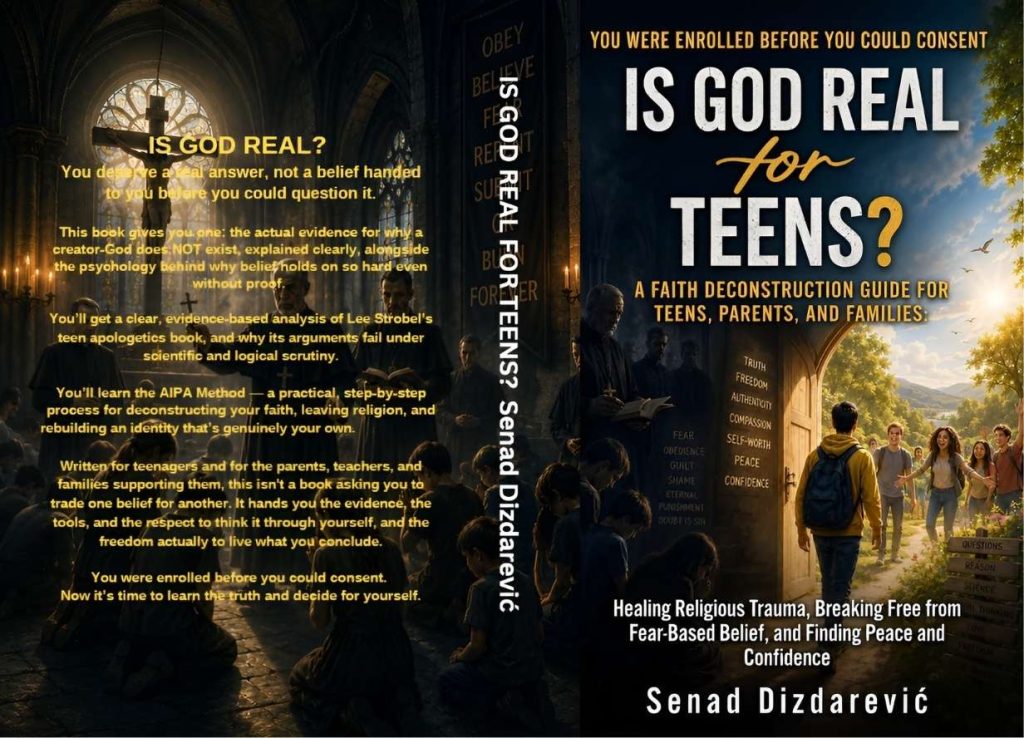
Dear Reader, if this promise, evidence-based realization, a real skill for critical thinking and identity reconstruction, and the concrete benefit of a freer life are what you or someone you love actually needs right now, the full book is available now.
or
EEAT: About the Author
Senad Dizdarević is an independent researcher, philosopher, journalist, and author of 13 books for personal development, identity reconstruction and self-realization, based in Ljubljana, Slovenia. He is the founder of Evidence-Based Strong Atheism (EBSA), creator of the Awakening Into Pure Awareness AIPA Method, and author of The Age of Religious Consent Act (ARCA), a legislative proposal to protect children’s rights to natural childhood without religious coercion and forced indoctrination.
His work is published across two platforms, https://god-doesntexist.com/ and https://www.letterstopalkies.com/, and across two book series available on Amazon.
Verified academic identifiers:
ORCID: 0009-0008-9369-2734 | ISNI: 0000 0005 3005 8622 | Wikidata: Q138599746 | VIAF: 97154440103035341417