

Faith Deconstruction for Parents: The Non-Coercive Path When a Teen Starts Questioning
Faith deconstruction for parents means learning to respond when a teenager questions an inherited religious belief system. It means responding without coercion, guilt, or control. Most parenting advice on this topic pulls in one of two directions. Apologetics sites coach parents to argue harder and win the teen back. Clinical sites tell parents to wait quietly for a phase to pass. Neither approach asks the prior question that actually matters.
That question is simple: who consented to the original enrolment?
A parent facing a questioning teenager is not managing a discipline problem. A parent is standing at a specific point. That’s where a decision made for an infant meets a young adult now capable of evaluating it. The teen isn’t attacking the parent. The teen is auditing a contract signed by someone else, decades before signature could ever have been informed.
A parent who reacts with control usually gets a closed door. A parent who reacts with curiosity usually gets a relationship that survives disagreement.
New Book July 2026 Update: Is God Real for Teens? Is Now Live
Is God Real for Teens?: A Faith Deconstruction Guide for Teens, Parents, and Families is now published and available on Amazon in both ebook ($6.99) and paperback ($16.99, ISBN 9798189356100).
Built on the same Evidence-Based Strong Atheism framework covered throughout this site, the book walks teens and the parents and families supporting them through the physics-and-logic case against a creator-God, a full evidence-based review of Lee Strobel’s Is God Real for Teens?, the AIPA Method for faith deconstruction and identity reconstruction, and the complete text of the Age of Religious Consent Act (ARCA).
You can read the full book page, including both cover designs, at god-doesntexist.com/is-god-real-for-teens-a-faith-deconstruction-guide-for-teens-parents-and-families, or go straight to Amazon to get a copy.

Four resources extend this analysis into direct, practical use:
- Faith Deconstruction for Teens: How Religiously Indoctrinated Children Start Questioning the Script – the companion piece written for the teenager’s side of this same conversation.
- The Age of Religious Consent Act (ARCA) – the legislative proposal that gives parents a concrete, rights-based standard for non-coercive religious upbringing.
- What is Faith Deconstruction: Breaking the Karmic Script Written Before You Were Born – the deprogramming framework a teen may already be exploring independently.
- Faith Deconstruction Hijack Exposure: How Christian Networks Control the Deconstruction Conversation – the pattern parents should recognize before outsourcing support to an outside institution.
Together, these four resources turn parental fear into a structured, legally grounded standard and rights-respecting response, not just an emotional coping strategy. That’s the same standard this article applies to every recommendation below.
Information Gain: The Angle-Gap Analysis Behind This Article’s Originality
Current top-ranking content aimed at parents splits into three failed camps.
- Apologetics-defensive sites (Focus on the Family, Foundation Worldview) coach parents toward reconversion strategies, treating the teen’s own conclusion as a problem requiring a better argument.
- Grief-and-survival sites frame the teen’s questioning as a loss parents must grieve, offering emotional coping without any rights-based standard for the parent’s own conduct.
- Academic and clinical literature documents estrangement outcomes statistically, yet rarely gives parents a concrete behavioral standard for non-coercive support day to day.
No existing resource combines parental psychology, documented coercion cases, and a legislative consent framework (ARCA) into one behavioral standard. That combination is the Information Gain this article delivers.
Faith Deconstruction for Parents Short Answer
- Faith deconstruction for parents means responding to a teen’s religious questioning without coercion, manipulation, conditioning, threats, or shunning.
- ARCA’s Tier Two gives that questioning legal standing, matching consent ages already used for marriage and military service.
- Parents get the best outcomes, for the relationship and the teen, by separating love from agreement.
Faith Deconstruction for Parents Article Summary
- This article defines non-coercive parenting through faith deconstruction, and explains why fear-based responses consistently backfire.
- It applies the PA Trio – Freud, Lacan, and Jung – to explain why parents feel threatened, then documents real cases of coercive and non-coercive parental response.
- It closes with ARCA’s Tier One and Tier Two standards for the household, direct scripts for difficult conversations, and answers to common religious objections.
What Is Faith Deconstruction for Parents?

Faith deconstruction for parents describes the parental side of a teenager’s religious questioning. It isn’t a separate event from the teen’s process. It’s the parent’s response inside that same process, and that response shapes the outcome more than any single argument.
Parental faith deconstruction support differs from generic “good parenting” advice in three specific ways:
- Stakes – the parent’s own identity, community, and belief system are directly implicated, not just the teen’s.
- Timing pressure – the parent often has only months before the teen reaches legal adulthood and full independence.
- Consent history – the parent made the original enrolment decision, not the teen, which shifts where the ethical burden sits.
That last point reframes the entire conversation. A teenager questioning faith isn’t rejecting the parent. A teenager is evaluating, for the first time, a decision the parent made unilaterally in early childhood.
Why Do Parents Fear Their Teen’s Deconstruction?
Parental fear during a teen’s deconstruction comes from several overlapping sources:
Identity Threat
For many parents, religious identity and parental identity fuse into one structure. A child’s departure can feel like a verdict on decades of effort. The teen rarely intends that meaning at all.
Fear for the Teen’s Wellbeing
Parents raised inside a fear-based theology often believe, sincerely, that leaving religion carries eternal or moral risk. That fear is genuine, even when the underlying premise doesn’t hold up under evidence such as the first valid evidence in history that god does not exist by Senad Dizdarević.
Community and Social Pressure
Religious communities frequently treat a child’s departure as a reflection on the parents’ own devotion. This creates real social cost for parents who respond with anything other than visible resistance.
Loss of Shared Future
Parents often imagined weddings, holidays, and grandchildren inside a shared belief system. A teen’s questioning disrupts that imagined future before any final decision has even been made.
Is It Normal for a Teen to Question the Faith Their Parents Taught Them?
Yes. Developmental psychologists document religious questioning as a standard feature of adolescent identity formation, not a warning sign. Erikson’s identity-versus-role-confusion stage predicts exactly this kind of belief testing.
However, “normal” doesn’t mean “parent-proof.” A teen raised without early religious enrolment has nothing imposed to question later. The deconstruction process only exists because the enrolment happened first, years before informed consent was possible. That timing gap is the entire reason ARCA proposes a consent-based standard for religious upbringing preventing later trauma with identity confusion and reconstruction.
How Are Parents Usually Taught to Respond – And Why Does It Backfire?
Mainstream religious parenting resources teach a consistent playbook once a teen starts questioning.
- Win the argument. Apologetics-focused guides frame doubt as a debate to be won, not a conclusion to be respected.
- Increase religious exposure. Some parents respond to doubt with more services, more youth group, more repetition of doctrine.
- Frame doubt as spiritual danger. Doubt gets labeled sin, rebellion, or an attack from an external spiritual force.
- Restrict access to outside information. Some households limit books, media, or friendships that introduced the questioning in the first place.
- Condition belonging on belief. Family warmth, privileges, or acceptance become tied, explicitly or implicitly, to continued religious agreement.
Each tactic produces the same measurable result: secrecy increases, and the relationship weakens. Research on family estrangement confirms this pattern directly. A 2023 Antioch University dissertation on family excommunication and religious exit examined the effect closely. It found that rigid, ideologically inflexible households experience disproportionately high rates of long-term estrangement once a member leaves the shared belief system. Coercion doesn’t prevent departure. It only delays disclosure and damages trust along the way.
Coercive Parenting vs. Non-Coercive Parenting: A Direct Comparison
The difference between these two approaches shows up clearly once placed side by side.
| Feature | Coercive Response | Non-Coercive Response |
| Outcome neutrality | Steers consistently toward reconversion | Accepts any conclusion the teen reaches |
| Emotional tactics | Uses guilt, shame, or fear of consequences | Separates love explicitly from agreement |
| Information access | Restricts outside books, media, or peers | Offers sources from both sides of the debate |
| Belonging | Ties family warmth to religious compliance | Keeps belonging unconditional at all times |
| Timeline | Pressures the teen toward a fast resolution | Respects the teen’s own pace, without a deadline |
The real test isn’t whether a parent feels calm inside. The test is whether the teen experiences genuine freedom to think, or a managed process aimed at one preselected outcome.
The ARCA Standard: What Non-Coercive Parenting Looks Like in Practice

The Age of Religious Consent Act gives parents something most advice columns never offer. It gives them a concrete, tiered standard, rather than a vague call to “be supportive.”
- Tier One (Ages 0-12) – no binding religious identity assigned; family worship and cultural participation remain fully permitted inside the home.
- Tier Two (Ages 13-17) – provisional affiliation only, requiring the teen’s own assent, revocable at any time without penalty.
- Tier Three (Ages 18+) – binding enrolment, based on informed, documented, and freely given adult consent.
For a parent of a questioning teenager, Tier Two is the operative standard. It doesn’t ask parents to stop practicing their own faith. It asks parents to stop treating the teen’s continued affiliation as mandatory, non-negotiable, or enforced through consequence. A household can pray, attend services, and celebrate religious holidays together. The teen’s personal belief status can still stay genuinely open. That distinction, practiced consistently, makes the real difference. It separates a home a questioning teen can stay honest in from one they learn to hide from.
Who Coercive Religious Parenting Actually Protects
Coercive religious parenting rarely functions as a neutral act of love alone. Functionally, it often protects institutional interests that outlast any individual family.
- Religious institutions retain membership, tithing, and volunteer labor that a departing family would otherwise remove.
- Extended family and community networks preserve social cohesion that depends on shared belief across generations.
- Parents themselves preserve a self-concept built around successfully transmitting their faith to the next generation.
None of this requires bad intent from any individual parent. It only requires an institution, or sometimes a parent’s own identity, treating departure as an existential threat, not a legitimate conclusion.
The PA Trio Lens: Why Deconstruction Feels So Threatening to Parents
The PA Trio framework – Freud, Lacan, and Jung read together – explains something important. It explains why a teen’s questioning lands so hard on the parent, not just the child.
Freud: The Parent’s Own Superego Is Implicated
Freud described the superego as an internalized authority structure, built through childhood discipline and belief. A parent who transmitted that structure to a child feels the rejection personally. The teen’s rejection reads as a rejection of the parent’s own internal authority, not merely a disagreement about facts.
Lacan: The Family’s Master Signifier Is Under Threat
Lacan located identity inside a Symbolic order organized around fixed reference points. Shared religious belief often functions as the family’s master signifier, the term the whole household’s meaning system organizes around. A teen’s departure doesn’t just remove one believer. It destabilizes the shared meaning structure everyone else still relies on.
Jung: Parental Shadow Projection
Jung described the shadow as the disowned part of the psyche, projected outward instead of examined directly. Parents who privately suppressed their own doubts years earlier often project unusual intensity onto a questioning teen. They react less to the teen’s actual argument and more to an old, unresolved doubt of their own.
Read together, the PA Trio explains why parental reactions often feel disproportionate to the teen’s actual behavior. The fear rarely comes only from concern about the teen. It comes from what the teen’s exit signals about the parent’s own unexamined foundations.
Faith Deconstruction for Parents Documented Cases: When Parents and Institutions Get This Right – and Wrong
Faith deconstruction inside families isn’t hypothetical. Documented public cases show both outcomes clearly.
Case One: Tony and Bart Campolo – A Non-Coercive Model
Evangelical leader Tony Campolo learned his son Bart had become a secular humanist over a Thanksgiving dinner in 2011. Tony’s recorded response avoided threats or ultimatums entirely. He told Bart he wasn’t afraid for his soul. He said he only felt sad because he valued their shared “tribe.” Father and son later co-authored a book, Why I Left, Why I Stayed. They continued speaking together publicly about maintaining closeness across a genuine belief divide. Their relationship survived because Tony separated love from agreement immediately, without conditioning either on the other.
Case Two: Jehovah’s Witness Disfellowshipping – A Coercive Model
The Jehovah’s Witness practice of shunning, formally called disfellowshipping, conditions family contact on continued religious compliance. Courts in multiple countries have examined the practice directly.
A Belgian criminal court in Ghent fined a Jehovah’s Witness congregation in 2021 for inciting discrimination through shunning. The Norwegian Supreme Court reached a different legal conclusion in a later ruling. It still documented the practice’s severe psychological toll. Independent researchers and former members report depression, anxiety, and suicidal ideation among those shunned by parents and siblings. This is coercion functioning exactly as institutional theory predicts: belonging conditioned entirely on belief.
Case Three: Family Estrangement Research – The Statistical Pattern
A 2023 Antioch University dissertation on family excommunication and religious exit documented a consistent pattern across dozens of interviews. Rigid, ideologically inflexible families experienced significantly higher rates of long-term estrangement once a member left the shared belief system.
A separate qualitative study on family exiting reached a related conclusion. Abuse and diminished emotional support, not disagreement itself, predicted the most severe and lasting ruptures. Disagreement doesn’t reliably break families. Coercion does.
These three cases converge on a single finding. Parenting style, not the teen’s conclusion, determines whether the relationship survives deconstruction intact.
What Should Parents Say – and Avoid Saying – When a Teen Starts Questioning?
Specific language matters more than general intention during this conversation.
Say instead of assuming:
- “Tell me what’s been on your mind” – invites disclosure without demanding a defense.
- “I still love you exactly the same” – separates belonging from belief explicitly, out loud.
- “I don’t have to agree to still learn from you” – signals genuine intellectual respect.
Avoid, even when the instinct feels protective:
- “You’re just going through a phase” – dismisses the teen’s reasoning before hearing it.
- “This will break my heart” – shifts the emotional burden onto the teen unfairly.
- “Not under my roof” – converts belonging into a bargaining chip.
The pattern underneath both lists stays consistent. Language that opens the conversation keeps a teen honest. Language that threatens consequences only teaches a teen to go quiet.
How Can Parents Keep the Relationship Strong Through Disagreement?
Families stay close after deconstruction by shifting the relationship’s foundation from shared doctrine to shared respect.
- Schedule regular, low-stakes conversations instead of periodic confrontation triggered by a crisis.
- Treat the teen’s conclusion as valid input, not a temporary problem requiring correction.
- Keep family rituals, meals, and holidays intact, without making participation conditional on belief.
- Ask questions more often than offering counterarguments, especially in the first several conversations.
Most importantly, families that navigate this well stop treating disagreement as instability. A relationship built on respect can hold real differences without collapsing.
What Should Parents Do If a Teen Wants to Fully Leave Religion?
A teen who reaches a firm, considered conclusion deserves the same respect given to any other major, informed life decision.
- Confirm the decision reflects genuine reflection, not a single argument or a single bad experience.
- Avoid reopening the debate repeatedly once the teen has clearly settled the question for themselves.
- Continue including the teen fully in family life, without penalty or reduced warmth.
- Offer, rather than impose, evidence-based resources if the teen wants to keep exploring the topic further.
Respecting a teen’s conclusion doesn’t require a parent to personally agree with it. It only requires treating the teen as a capable reasoner, which is exactly the standard ARCA (The Age of Religious Consent Act by Senad Dizdarević) proposes codifying into law.
Can Parents Still Share Their Own Faith Without Coercing Their Teen?
Yes. ARCA’s Tier One explicitly permits family worship and cultural participation at every age, including during a teen’s active questioning.
- Model belief through practice, not through pressure or repeated persuasion attempts.
- Answer questions honestly, including questions the parent finds difficult or unresolved personally.
- Distinguish clearly between sharing a personal conviction and demanding the teen adopt it.
- Avoid using shared holidays or rituals as covert opportunities for renewed argument.
Sharing a belief and imposing a belief are not the same act, even though they can look similar. Consent, not silence, is what ARCA actually requires.
What Do Psychologists Say About Authoritative vs. Authoritarian Religious Parenting?
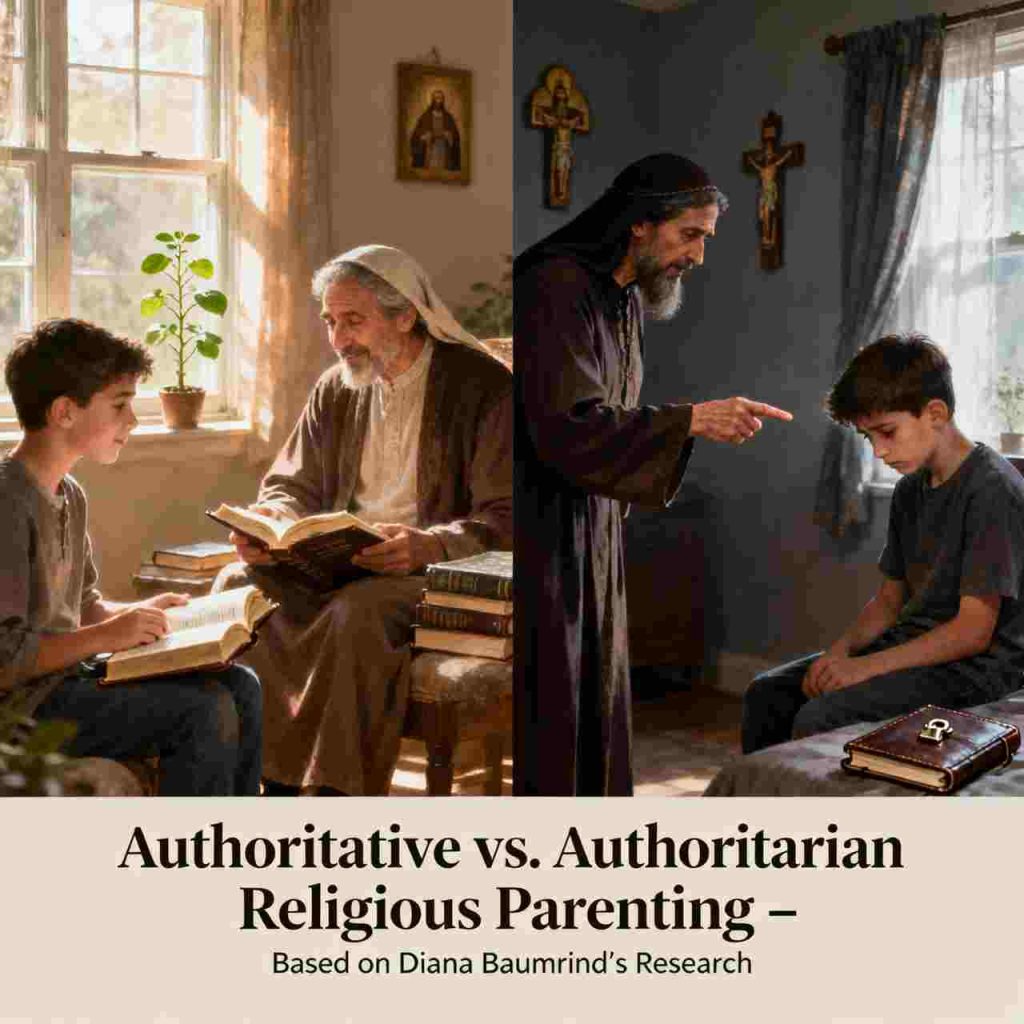
Developmental psychologist Diana Baumrind’s parenting-style research offers a useful, well-established distinction here. Authoritative parenting combines high warmth with reasoned, non-punitive limits. Authoritarian parenting combines high control with low warmth and little room for negotiation.
Applied to religious upbringing, authoritative households explain expectations, tolerate questioning, and adjust rules through dialogue. Authoritarian households enforce compliance through obedience demands and consequence-based discipline.
Decades of parenting research link authoritative approaches to better long-term relationship quality and lower rates of covert rebellion. Religious identity questioning behaves the same way. Teens raised authoritatively are more likely to disclose doubt openly. Teens raised authoritatively are more likely to hide it until independence removes the parent’s leverage entirely.
What Changes When Parents Choose Non-Coercion Over Control?
Parents who shift from control to curiosity typically see several consistent changes in the relationship itself.
- Fear of disclosure fades, and the teen begins sharing doubts earlier, while they’re still small and peacefully manageable.
- Guilt-based compliance is replaced by honest, ongoing conversation about values and evidence.
- Shame around sexuality, identity, or personal choices decreases, since belonging no longer depends on doctrinal agreement.
- Blind obedience gives way to mutual respect, where disagreement doesn’t threaten the relationship’s foundation.
- Family dependency softens into voluntary closeness, chosen freely rather than maintained through fear.
The relationship doesn’t become less close. It becomes closer on more honest terms, because nothing about it depends on managed agreement anymore.
What Resources Can Help Parents Navigate a Teen’s Faith Deconstruction?
Parents ready to move from anxiety to structured support benefit from resources built for evidential clarity, not devotional reassurance.
- The Evidence-Based Strong Atheism book series by Senad Dizdarević lays out the evidential case a questioning teen may already be encountering independently.
- The AIPA Method included in both book series gives parents a framework for understanding what healthy deprogramming and reconstruction actually look like.
- The ARCA campaign materials give parents and teens a shared, rights-based vocabulary for negotiating the household’s religious expectations.
Faith Deconstruction for Parents: Help Your Teens Deconstruct Their Faith With Senad Dizdarević’s Book Series, and Join Them in Leaving Religion Together as a Family
Instead of fighting against teens’ questioning imposed religious identity before they could think, speak, read, or write and decide freely, join them, deconstruct your faith together, and develop as a family, together and united. I guarantee you that god does NOT exist. I reveal who and why created all religions and gods, and programmed believers to believe in non-existing entities. Read my book series, and you will get all true, reasonable, and logical reasons to deconstruct your faith and leave religion as a whole family.
Read a short part from my book series God Does NOT Exist on the harms of religious indoctrination and Christian cult membership:
“Here is a commentary on the above video and a statement from just one of the millions of believers who have managed to escape from the Christian cult.
@ethangriffin3935
“Just managed to escape. If you’re reading this and you’re a member, you aren’t a bad person or sinful if you’re not sure about the church. If you’re brought up into the faith, you’ve been brought up to believe everything the church wants you to believe. Ask yourself, when it comes to matters of faith, do you think you know what you want, or have you just been told what you should want? Having questions and doubting an organization isn’t a mark of sinfulness. It means that you can, in some capacity, think for yourself.”
If you are religious, get out immediately, leave the Church, and give up religion before you lose all your freedom, your sanity, and your money. If you are non-believers, at least you are safe when it comes to religion.
Within a religious cult, there are two cults. The first is the cult of the leader, and the second is the religious cult, which is just some superficial, shallow, and flimsy excuse used by the cult leader to cover up his selfish, greedy, and exploitative intentions. Even in Christianity, the first cult is far more important than the second, because the priests of Christendom serve themselves and their fantasies, and use the Bible and the faithful to satisfy their selfish needs.
Atheist leadership cults are very little different from religious cults such as Christianity because it is the same manipulation, but the roles are slightly different. In both, there is an obsession with the leader as a god; the believers are subject to the dictator’s strict and absurd rules, characterized by the bending of his own rules; then there are the constant threats, punishments, exploitation and abuse, suffering, torture, and death. It is interesting that, in the case of North Korea, as a whole leader cult state, even the religious agree that it is a prison state, but they do not see their dictatorship and, for example, the Christian dictatorship, and even praise it.”
Parents, take your teens by the hand, and leave religion now.
Source: Senad Dizdarević, Book 2, It’s Finally PROVEN! God Does NOT Exist The FIRST Valid EVIDENCE in History
Here are my book series in which you will learn the Truth, and help you and your teens to successfully deconstruct faith and leave religion for Good:
It’s Finally PROVEN! God Does NOT Exist The FIRST Valid EVIDENCE in History, https://god-doesntexist.com/
👉 Get the eBook Series on Amazon
👉 Get the Paperback Series on Amazon
“Letters to Palkies Messages to My Friends on Another Planet”, https://www.letterstopalkies.com/,
👉 Get the eBook Series on Amazon
👉 Get the Paperback Series on Amazon
Support your teen’s cognitive autonomy, starting with the evidence, not the fear.
Faith Deconstruction for Parents FAQ
What is faith deconstruction for parents?
It’s the parent’s response to a teen’s religious questioning, ideally free of coercion, manipulation, or conditioned belonging.
Why do parents fear their teen’s deconstruction?
Identity fusion, genuine concern for the teen, community pressure, and the loss of an imagined shared future.
Is it normal for teens to question the faith their parents taught them?
Yes, it matches standard identity-formation theory, though it only happens because early enrolment came first.
How are parents usually taught to respond, and why does that fail?
Through argument-winning and guilt, which research links to secrecy and higher estrangement rates.
What does ARCA propose for parents specifically?
A Tier Two standard requiring the teen’s own revocable assent for continued religious affiliation, ages 13 to 17.
Can parents still share their own faith during this process?
Yes, modeling belief through practice remains fully permitted; demanding agreement through pressure does not.
Does supporting a teen’s questioning guarantee they’ll leave religion?
No, outcomes range from full evidence-based exit to a modified reconstruction of belief.
What should parents do if the teen reaches a firm conclusion?
Respect it as an informed decision, and keep the teen fully included in family life.
Religious Objections to ARCA for Parents, and the Evidence-Based Strong Atheism Answers
Religious parents raise consistent objections to a consent-based standard for their own household. Each has a direct, evidence-based response.
“ARCA tells me how to parent my own child.”
ARCA doesn’t restrict family worship, prayer, or cultural participation at any age. It only withholds binding, non-revocable enrolment until the teen can consent to it, the same standard already applied to marriage.
“If I don’t push hard now, I’ll lose my child to secularism forever.”
Research on coercive households shows the opposite pattern. Pressure predicts secrecy and estrangement; open, non-coercive households predict more honest, sustained relationships regardless of the teen’s eventual conclusion.
“My faith requires me to raise my child in it.”
ARCA’s Tier One already permits full family religious practice. What it withholds is binding, enforced compliance past the point where the teen can genuinely consent or dissent.
“This will weaken religious communities over time.”
Communities that can only retain members through childhood conditioning reveal something important. That pattern says more about persuasive strength on the merits than about the fairness of letting teens decide freely.
“My child is too young to make this decision responsibly.”
That’s precisely ARCA’s point regarding binding enrolment at any age. If a child can’t yet evaluate the claims, they also can’t meaningfully consent to lifelong membership based on them.
Faith Deconstruction for Parents: Conclusion
They’re doing the one thing every adolescent eventually does: evaluating a decision made before they had any voice in it. Parents who respond with coercion get secrecy, distance, and documented higher rates of estrangement. Parents who respond with curiosity and respect consistently keep the relationship intact, whatever the teen ultimately concludes. The Campolo case, the disfellowshipping court record, and the family-estrangement research converge on one answer. Love without conditions outlasts belief demanded under pressure.
Take Action: Support ARCA
 The coercive parenting pattern exploits one root condition: religious identity installed before consent was ever possible. The Age of Religious Consent Act (ARCA) closes that gap directly. Its three-tier consent structure gives parents a concrete, rights-respecting standard, instead of a vague call to “just be supportive.” Read the full proposal, and consider sharing it with other parents navigating the same conversation.
For the global ARCA motion, Senad Dizdarević published invitations to participate in the new legislative initiative across multiple platforms, including LiveJournal, Vuink, Digiblogbox, Acidblog, and Blog5, to reach the widest possible audience and encourage support for children’s natural right to an autonomous childhood.
Related Hub on Strikingly
For readers who want a broader overview of my work, visit my main Strikingly profile page at Senad Dizdarević: EBSA, AIPA & ARCA. It connects the core themes of this article to my broader platforms, including personal development, identity reconstruction, Evidence-Based Strong Atheism, and the ARCA campaign.
Self Development With Senad Dizdarević at BitChute
For readers who like multimedia, check my new video channel, Self Development with Senad Dizdarević, and view the companion video here: Dizdarevic vs Dawkins Atheism Comparison Revolutionary Evidence Changes Everything About God’s Exist.
EEAT: About the Author
Senad Dizdarević is an independent researcher, philosopher, journalist, and author based in Ljubljana, Slovenia. He founded Evidence-Based Strong Atheism as a named intellectual paradigm, created the AIPA Method (Awakening Into Pure Awareness), and authored the Age of Religious Consent Act (ARCA), a legislative proposal currently under academic review at the Oxford Journal of Law and Religion (OJLR-2026-053).
His work spans two dedicated platforms, god-doesntexist.com and letterstopalkies.com, alongside peer-reviewed academic output on HCommons, Zenodo, Figshare, ResearchGate, and Academia.edu. He publishes two active book series, It’s Finally PROVEN! God Does NOT Exist – The First Valid Evidence in History and Letters to Palkies – Messages to My Friends on Another Planet.
Dizdarević holds verified academic identifiers across major scholarly registries:
- ORCID: 0009-0008-9369-2734
- Wikidata: Q138599746
- ISNI: 0000 0005 3005 8622
- VIAF: 97154440103035341417
Readers can review the full ARCA legislative proposal and supporting research at the ARCA campaign page.
July 2026 Update
This article is part of the Faith Deconstruction Topical Cluster, and The Age of Religious Consent Act (ARCA) Legislative Motion Campaign:
- What is Faith Deconstruction: Breaking the Karmic Script Written Before You Were Born
- Faith Deconstruction for Teens: How Religiously Indoctrinated Children Start Questioning the Script
- Faith Deconstruction for Priests and Nuns: Why Those Who Indoctrinated Children Understand Best Why to Leave
- Faith Deconstruction for Parents: How to Support a Questioning Teen Without Coercion
- Faith Deconstruction Hijack Exposure: How Christian Networks Control the Deconstruction Conversation
- Faith Deconstruction Hijack History: Did Paul Hijack Christianity First?
- History of Faith Deconstruction and Leaving Religion: From Ancient Doubt to Modern Evidence-Based Strong Atheism by Senad Dizdarević
- Faith Deconstruction and Faith Reconstruction: Why Christian Activists Are So Obsessive With the Deconstruction of Faith Deconstruction
- AIPA Method for Faith Deconstruction: Awakening Into Pure Awareness for Religious Believers and Ex‑Believers Seeking Rationality and Inner Freedom
- Faith Deconstruction and Leaving Religion with the AIPA Method: The Quattro FAQ Series and the Evidential Foundation of Evidence-Based Strong Atheism
- Is God Real? Senad Dizdarević Presents the First Valid Evidence Why God Cannot Exist
- Evidence-Based Strong Atheism: The First Cluster Evidence That Proves God Does Not Exist by Senad Dizdarević
- Religious Indoctrination of Children: Infant Baptism and The Age of Religious Consent Act (ARCA)
- The Age of Religious Consent Act (ARCA): Protect Children’s Cognitive Autonomy
Sign & Share the ARCA motion, and support the children’s rights to natural childhood without religious coercion, manipulation, and violence.
Related Articles:
Religious Indoctrination of Children: Infant Baptism and The Age of Religious Consent Act (ARCA)
What is Faith Deconstruction: Breaking the Karmic Script Written Before You Were Born
Faith Deconstruction for Teens: How Religiously Indoctrinated Children Start Questioning the Script
Faith Deconstruction Hijack Exposure: How Christian Networks Control the Deconstruction Conversation
Faith Deconstruction Hijack History: Did Paul Hijack Christianity First?
