

Faith Deconstruction and Faith Reconstruction: Inside the Coordinated Campaign to Deconstruct Faith Deconstruction
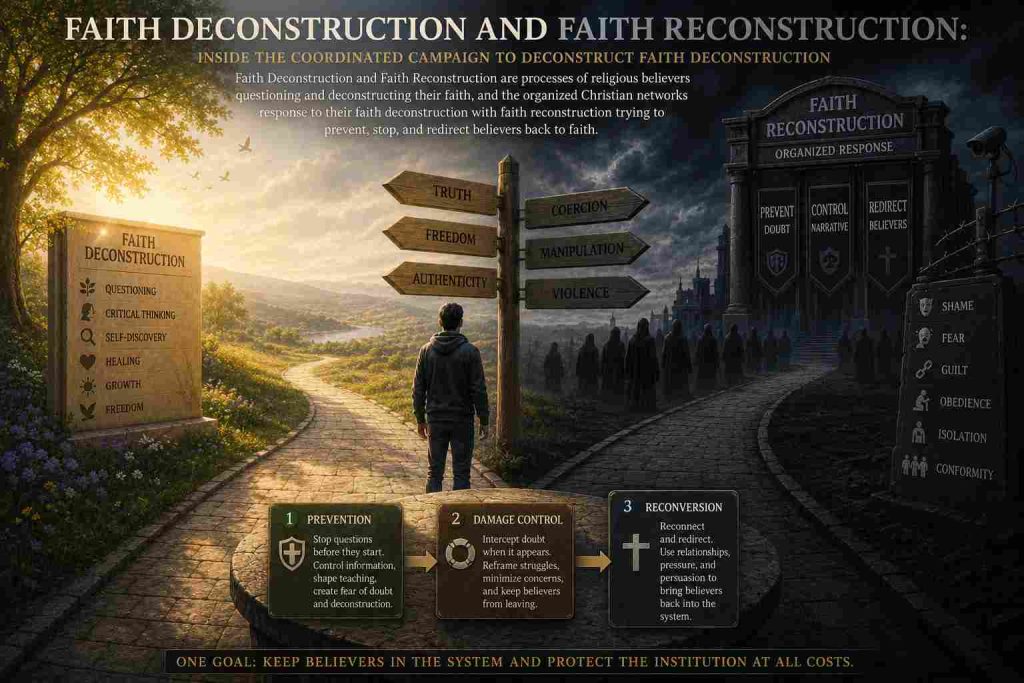
Faith Deconstruction and Faith Reconstruction are processes of religious believers questioning and deconstructing their faith, and the organized Christian networks’ response with faith reconstruction trying to prevent, stop, and redirect believers back to faith. Faith reconstruction works through three layers: prevention, damage control, and reconversion.
Most coverage of this response treats it as scattered pastoral concern. It isn’t scattered; it is an organized, coordinated, and well-funded field with named leaders, campus networks, and legislative ambitions.
This matters because the target keeps shifting. First it was the doubting teenager, who was questioning his religious programming. Then it was the doubting college freshman. Now it includes the doubting adult who already left. Each stage gets its own tactic, its own organization, and its own spokesperson. Understanding the three-layer structure explains why Christian activism against deconstruction feels so relentless. It isn’t one campaign. It’s three, running at once, against the same growing movement.
If you are a parent trying to navigate this transition with your child, read our companion guide on how to support a questioning teen without coercion with useful answers and full support for safe faith deconstruction.
New Book July 2026 Update: Is God Real for Teens? Is Now Live
Is God Real for Teens?: A Faith Deconstruction Guide for Teens, Parents, and Families is now published and available on Amazon in both ebook ($6.99) and paperback ($16.99, ISBN 9798189356100).
Built on the same Evidence-Based Strong Atheism framework covered throughout this site, the book walks teens and the parents and families supporting them through the physics-and-logic case against a creator-God, a full evidence-based review of Lee Strobel’s Is God Real for Teens?, the AIPA Method for faith deconstruction and identity reconstruction, and the complete text of the Age of Religious Consent Act (ARCA).
You can read the full book page, including both cover designs, at god-doesntexist.com/is-god-real-for-teens-a-faith-deconstruction-guide-for-teens-parents-and-families, or go straight to Amazon to get a copy.
A movement big enough to require three separate counter-strategies is a movement desperately fighting for the ground.
Four resources extend this analysis into direct, practical use:
- Faith Deconstruction for Teens: How Religiously Indoctrinated Children Start Questioning the Script – the companion piece written for the teenager’s side of this same conversation.
- Faith Deconstruction Hijack Exposure: How Christian Networks Control the Deconstruction Conversation – the companion piece documenting institutional redirection inside prisons, recovery programs, and counseling.
- The Age of Religious Consent Act (ARCA) – the legislative proposal by Senad Dizdarević that interrupts the pattern at its source, before a new hijack layer can form.
- What is Faith Deconstruction: Breaking the Karmic Script Written Before You Were Born – the deprogramming framework this entire history has worked for two thousand years to prevent.
Together, these four resources turn a vague sense of backlash into a named structure, three documented layers, and a legal remedy – the same standard this exposure applies below.
Information Gain: The Angle-Gap Analysis Behind This Article’s Originality
Existing coverage of Christian pushback against deconstruction splits into two incomplete camps.
- Sympathetic religious commentary (The Gospel Coalition, Christianity Today) treats reconstruction efforts as pastoral care, without naming the strategic layers or their coordination.
- Secular journalism covers individual figures (Kirk, Dobson) for their politics, rarely connecting them to a shared, structural campaign against faith deconstruction specifically.
No existing resource maps prevention, damage control, and reconversion as three distinct layers of one coordinated field, names the leading figure in each layer, and traces the specific rhetorical and doctrinal tactics each one uses. That mapping is the Information Gain this article delivers.
Faith Deconstruction and Faith Reconstruction: Short Answer
- Faith reconstruction operates in three layers: prevention (campus apologetics), damage control (youth retention campaigns), and reconversion (rhetorical persuasion of ex-believers).
- Named figures anchor each layer: Ratio Christi and William Lane Craig in prevention, Charlie Kirk’s Turning Point Faith in damage control, and Frank Turek in reconversion.
- The common thread across all three is a redefinition of “reason” as submission to faith, not evidence, a move Craig makes explicit in his own writing.
Faith Deconstruction and Faith Reconstruction: Article Summary
- This article traces the history of faith deconstruction from its 1983 academic origin to the 2016 exvangelical movement, then documents the organized reaction it triggered.
- It applies the PA Trio – Freud, Lacan, and Jung – to explain why Christian activists respond with such intensity, then documents specific tactics: campus apologetics, youth curricula, corporal punishment doctrine, and purity culture.
- It closes with a direct comparison table, real quotes from William Lane Craig and Frank Turek, and the ARCA standard that removes the leverage each layer depends on.
What Is Faith Reconstruction?
Faith reconstruction describes organized Christian activism aimed at stopping, slowing, or reversing faith deconstruction. It operates through three distinct functions, often run by different organizations entirely.
- Prevention – stopping deconstruction before it starts, mainly through campus apologetics aimed at teens and young adults.
- Damage control – limiting how many current believers begin questioning, through curricula, youth pastors, and rapid-response media.
- Reconversion – persuading people who already left, or who are close to leaving, back into belief through targeted rhetorical tactics.
Each layer treats the same underlying fact differently. That fact is simple: deconstruction is growing, and no single tactic has stopped it.
Faith Deconstruction and Faith Reconstruction: When and How Did the Deconstruction of Faith Deconstruction Begin?
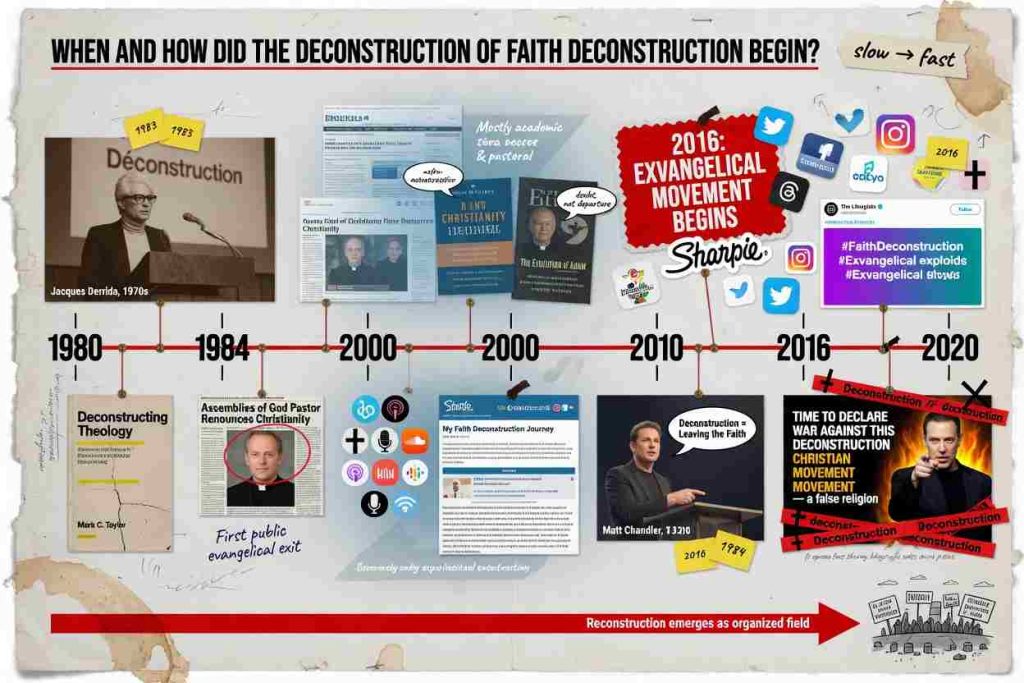
The term “deconstruction” entered religious conversation slowly, then accelerated fast.
Philosopher Jacques Derrida coined deconstruction as a method for exposing contradictions inside texts. Decades passed before anyone applied it to personal belief. Theologian Mark C. Taylor published the first book applying Derrida’s method to theology in 1983, Deconstructing Theology. In 1984, Assemblies of God pastor Dan Barker became the first widely known evangelical clergyman to publicly renounce Christianity. It was a marker moment for public deconversion.
The term stayed mostly academic and pastoral through the 2000s and early 2010s. Figures like Brian McLaren and Pete Enns used it to describe internal doubt, not necessarily departure. Everything changed in 2016. The exvangelical movement began that year, and “faith deconstruction” became its defining term. It spread fast through podcasts, blogs, and social media.
The organized reaction followed within a few years. By the late 2010s, pastors like Matt Chandler were publicly equating deconstruction with leaving the faith outright. By the early 2020s, musician and pastor John Cooper had declared war. In his own words, it was “time that we declare war against this deconstruction Christian movement,” which he called “a false religion.” That declaration of war marks the moment faith reconstruction became visible as an organized field, not just individual pastoral concern.
Faith Deconstruction and Faith Reconstruction: The Three Layers of Faith Reconstruction – A Direct Comparison
Each layer targets a different point in the deconstruction timeline, with a different primary tactic and a different named leader.
| Layer | Target Audience | Primary Tactic | Anchor Figure or Group |
| Prevention | Teens and college students, pre-doubt | Campus apologetics clubs, “reasons to believe” training | Ratio Christi, William Lane Craig’s Reasonable Faith |
| Damage Control | Current believers showing early doubt | Youth curricula, pastor networks, rapid media response | Charlie Kirk’s Turning Point Faith |
| Reconversion | Ex-believers and near-exits | Rhetorical gotcha questions, volitional framing of doubt | Frank Turek, Cross Examined |
No single organization runs all three layers. That’s what makes the pattern easy to miss and hard to counter with one response.
The Prevention Layer: Campus Apologetics and the Numbers Behind It
Prevention-focused ministries operate almost entirely on college campuses, where the exit rate is highest.
Ratio Christi, a global campus apologetics network, states its own reason for existing in stark numerical terms. The organization cites a statistic that nearly 70 percent of students leave the Christian faith during college. It frames the university itself as the primary battleground for belief retention. Its stated mission is to equip students and faculty with “historical, philosophical, and scientific reasons for following Jesus Christ.” The organization brands itself with the Latin name Ratio Christi, “the Reason of Christ.”
That branding choice matters. It stakes a claim on the word “reason” itself, before any argument has even been made. William Lane Craig’s Reasonable Faith ministry does the same thing through its name. It positions Christian belief as the rational default, not one contested position among several.
The Cross Examined ministry, founded by Frank Turek, extends the same prevention work into books, campus tours, and debate appearances. Its stated goal is “equipping” young Christians before doubt sets in.
The Damage Control Layer: Turning Point Faith and the Youth Retention Machine
Damage control targets believers already inside the pipeline, aiming to catch doubt early and redirect it fast.
Charlie Kirk launched TPUSA Faith in 2021 as a dedicated religious division of Turning Point USA. He described its mission as equipping “Christians to stand for liberty, the Kingdom, and biblical truth.”
The division hosted pastor summits drawing hundreds of church leaders. Following Kirk’s death in September 2025, the network expanded further. TPUSA Faith’s church network reportedly grew from roughly 4,200 member congregations to more than 9,500 within months. A new curriculum called First Truths launched alongside it, aimed at grounding young believers in fundamentals before doubt has room to take hold.
This is damage control in its clearest form. It’s a rapid, well-funded response built specifically to intercept questioning believers before they reach the exvangelical pipeline. The scale of the response is itself evidence of how seriously this layer treats the threat.
The Reconversion Layer: Frank Turek and the Rhetoric of the Gotcha Question
Reconversion tactics target people who have already left, or who are close to leaving. They rely on rhetorical strategy rather than new evidence.
Frank Turek, author of I Don’t Have Enough Faith to Be an Atheist, has described a specific technique. He uses it on college campuses to unsettle skeptical questioners. In a recorded interview, Turek recounted asking one such questioner: “If Christianity were true would you become a Christian?” When the questioner answered no, Turek used that answer to reframe the entire exchange. He recast the person’s skepticism as willful, not evidential, an emotional refusal dressed up as intellectual doubt.
This tactic reveals something important. Turek routinely claims Christians “have a reason to believe that God exists,” using reason to mean evidential grounds. But his own gotcha question tests something different: whether a person would accept Christianity regardless of whether it’s true.
That’s not a test of reasoning. It’s a test of willingness. The technique quietly swaps an evidential claim for a volitional one. It then treats a “no” to the volitional question as proof the person was never reasoning in the first place.
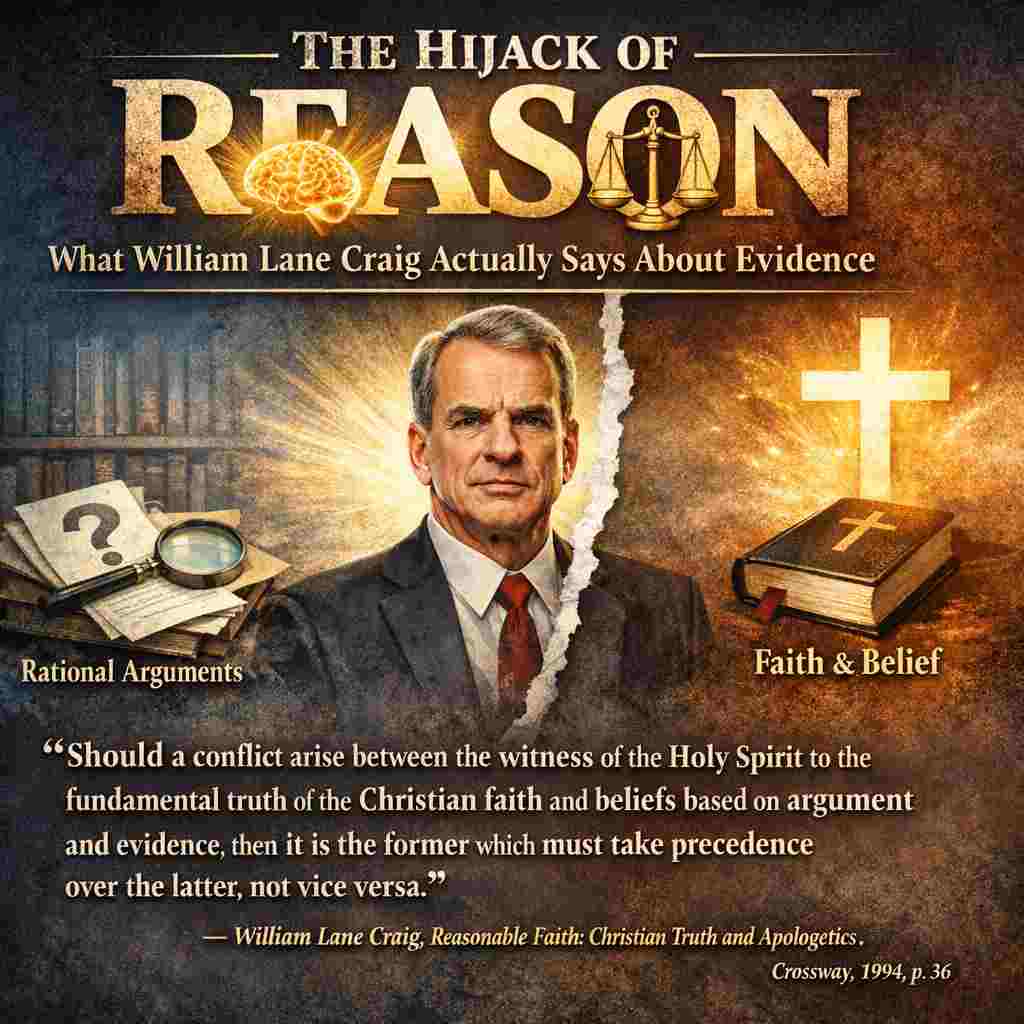
The Hijack of Reason: What William Lane Craig Actually Says About Evidence
The word “reason” carries two separate meanings, and apologetics uses the gap between them.
One sense of reason means the rational faculty itself, the capacity to think. A second, different sense means a specific ground or argument for a claim.
Turek’s slogan “we have a reason to believe” leans on the second sense. Ratio Christi and Reasonable Faith brand themselves using the first sense, “the Reason of Christ.” That framing treats their conclusions as if they simply are rationality itself. Conflating the two senses lets a ministry claim the authority of reason without ever having to survive an evidential test.
William Lane Craig removes any doubt about which sense he actually means. In his own book, Reasonable Faith, Craig writes:
“Should a conflict arise between the witness of the Holy Spirit to the fundamental truth of the Christian faith and beliefs based on argument and evidence, then it is the former which must take precedence over the latter, not vice versa.” — William Lane Craig, Reasonable Faith: Christian Truth and Apologetics (Crossway, 1994), p. 36
He restated the same position directly, on the record, in a 2007 talk:
“The way in which I know Christianity is true is first and foremost on the basis of the witness of the Holy Spirit in my heart. And this gives me a self-authenticating means of knowing Christianity is true wholly apart from the evidence. And therefore, even if in some historically contingent circumstances the evidence that I have available to me should turn against Christianity, I do not think that this controverts the witness of the Holy Spirit.” — William Lane Craig, “Dealing with Doubt,” 2007
Craig has also framed this explicitly as reason serving faith, not testing it, borrowing a distinction from Martin Luther between magisterial and ministerial reason. Craig writes that the “ministerial use of reason occurs when reason submits to and serves the gospel.” That’s a direct statement of the position: reason above faith is forbidden; faith above reason is required.
This isn’t a fringe view. It traces back to Anselm of Canterbury’s eleventh-century formula, credo ut intelligam, “I believe in order that I may understand.” Anselm was explicit that belief comes first and understanding follows, not the other way around.
Craig’s position updates a nine-hundred-year-old doctrine for a debate-stage format. It uses modern vocabulary that sounds evidential while functioning identically to Anselm’s original: faith first, reasoning second, with no contrary evidence permitted to reverse the order.
Senad Dizdarević’s Evidence-Based Strong Atheism (EBSA) starts from the opposite direction entirely. A claim about reality is only rational if it can, in principle, be revised by evidence against it. Craig’s own words describe a belief immune to that revision by design. That isn’t reasonable faith. It’s faith wearing reason’s name.
Faith Deconstruction and Faith Reconstruction: The PA Trio Lens – Why This Deconstruction Demands a Counter-Deconstruction
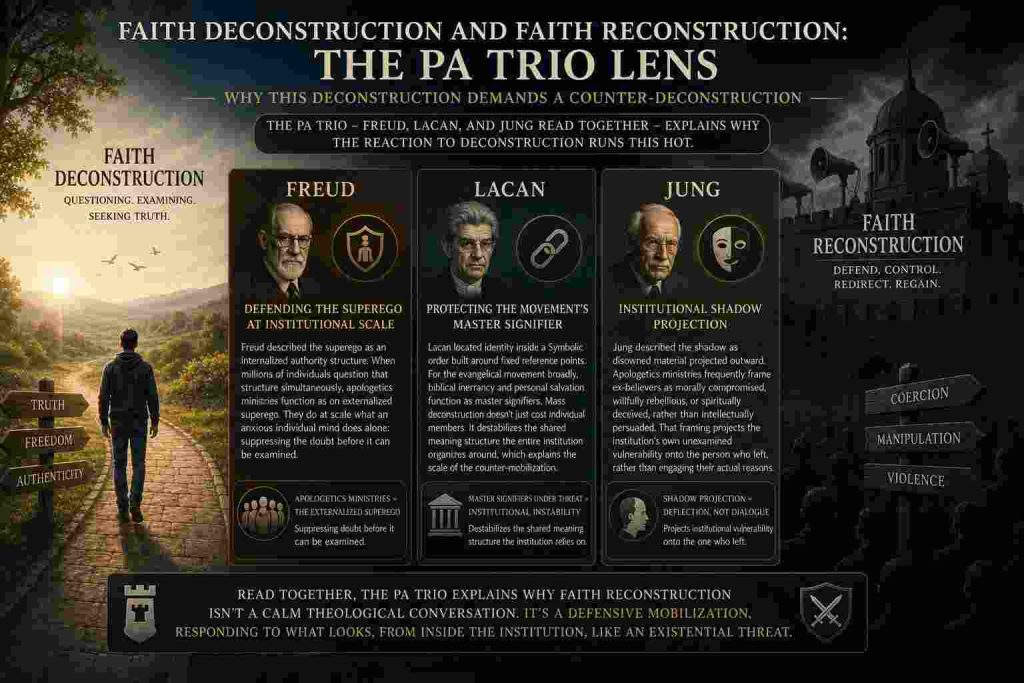
The PA Trio – Freud, Lacan, and Jung read together – explains why the religious reaction to deconstruction runs this hot.
Freud: Defending the Superego at Institutional Scale
Freud described the superego as an internalized authority structure. When millions of individuals question that structure simultaneously, apologetics ministries function as an externalized superego. They do at scale what an anxious individual mind does alone: suppressing the doubt before it can be examined.
Lacan: Protecting the Movement’s Master Signifier
Lacan located identity inside a Symbolic order built around fixed reference points. For the evangelical movement broadly, biblical inerrancy and personal salvation function as master signifiers. Mass deconstruction doesn’t just cost individual members. It destabilizes the shared meaning structure the entire institution organizes around, which explains the scale of the counter-mobilization.
Jung: Institutional Shadow Projection
Jung described the shadow as disowned material projected outward. Apologetics ministries frequently frame ex-believers as morally compromised, willfully rebellious, or spiritually deceived, rather than intellectually persuaded. That framing projects the institution’s own unexamined vulnerability onto the person who left, rather than engaging their actual reasons.
Read together, the PA Trio explains why faith reconstruction isn’t a calm theological conversation. It’s a defensive mobilization, responding to what looks, from inside the institution, like an existential threat.
The Hijack of Family Psychology: James Dobson’s Corporal Punishment Doctrine
Faith reconstruction doesn’t only operate through campus debates. It also operates through decades-old parenting doctrine still active today.
Christian psychologist James Dobson, founder of Focus on the Family, built his influence on Dare to Discipline. That 1970 book advocated corporal punishment as biblically necessary. Dobson wrote that pain served as “a marvelous purifier” and that a spanking should be “of sufficient magnitude to cause the child to cry genuinely.” He linked physical punishment directly to spiritual formation. If children were allowed to challenge parental authority, he wrote, they would grow up to challenge God’s authority too.
Dobson died on August 21, 2025, at age 89. His doctrine outlived him. Corporal punishment remains legal in roughly 17 U.S. states as of 2026. The practice has shown signs of expansion rather than retreat. The Cassville School District in Missouri voted to reinstate paddling in 2022, citing parent demand, after having dropped it two decades earlier.
The connection to faith reconstruction is direct, not incidental. Dobson explicitly designed corporal punishment to install obedience to authority as a template for later obedience to religious authority. A child trained to submit to unquestioned physical authority at five is a harder target for deconstruction at fifteen. This is prevention working at the earliest possible layer, inside the home, years before any campus apologist ever gets involved.
The Hijack of Sexuality: Purity Culture and the Ring That Couldn’t Hold
Purity culture applies the same authority-first logic to teenage sexuality, with comparable long-term costs.
Purity rings, popularized through programs like True Love Waits and Silver Ring Thing, ask teens to pledge sexual abstinence until marriage. A ring worn as a visible marker signals compliance publicly. The programs frame virginity almost entirely around one specific act, penetrative intercourse, while treating everything else as secondary.
That narrow framing produced a well-documented, ironic byproduct. Even sympathetic Christian commentary now acknowledges it directly. A Gospel Coalition article reviewing purity culture’s legacy admits that many teens practiced what it calls “technical virginity.” They engaged in “everything but intercourse” specifically because the messaging focused so narrowly on one act. The loophole wasn’t a bug in purity culture. It was a predictable consequence of defining sexual purity by one physical boundary instead of teaching a coherent ethic.
Purity culture functions as another prevention-layer tool. It installs shame-based rule-following around one of the most personal areas of a teenager’s life. Readers interested in a sharper, more explicit critique of this exact loophole can find it in a two-part piece on letterstopalkies.com. It’s titled “Fuck Me in the Ass Cause I Love Jesus,” Parts One and Two. It examines the same pattern from a different angle, tracing the loophole back to Christian sexual doctrine more broadly.
Faith Deconstruction vs. Faith Reconstruction: A Direct Comparison
The two processes run in opposite directions on nearly every dimension.
| Feature | Faith Deconstruction | Faith Reconstruction |
| Starting point | Personal doubt, examined openly | Institutional threat, managed strategically |
| Relationship to evidence | Follows evidence wherever it leads | Treats evidence as subordinate to prior belief |
| Primary actors | Individuals, often alone at first | Organized ministries, campus networks, media |
| Definition of “reason” | Evidential grounds for a claim | Faculty submitted to serve existing belief |
| Outcome sought | Whatever conclusion the evidence supports | Return to, or retention of, Christian belief |
The asymmetry is the point. One process has no predetermined outcome. The other has one outcome, and it treats every tactic, from campus debate to childhood discipline, as a means to reach it.
Faith Deconstruction and Faith Reconstruction: Documented Cases: The Named Figures Behind Each Layer
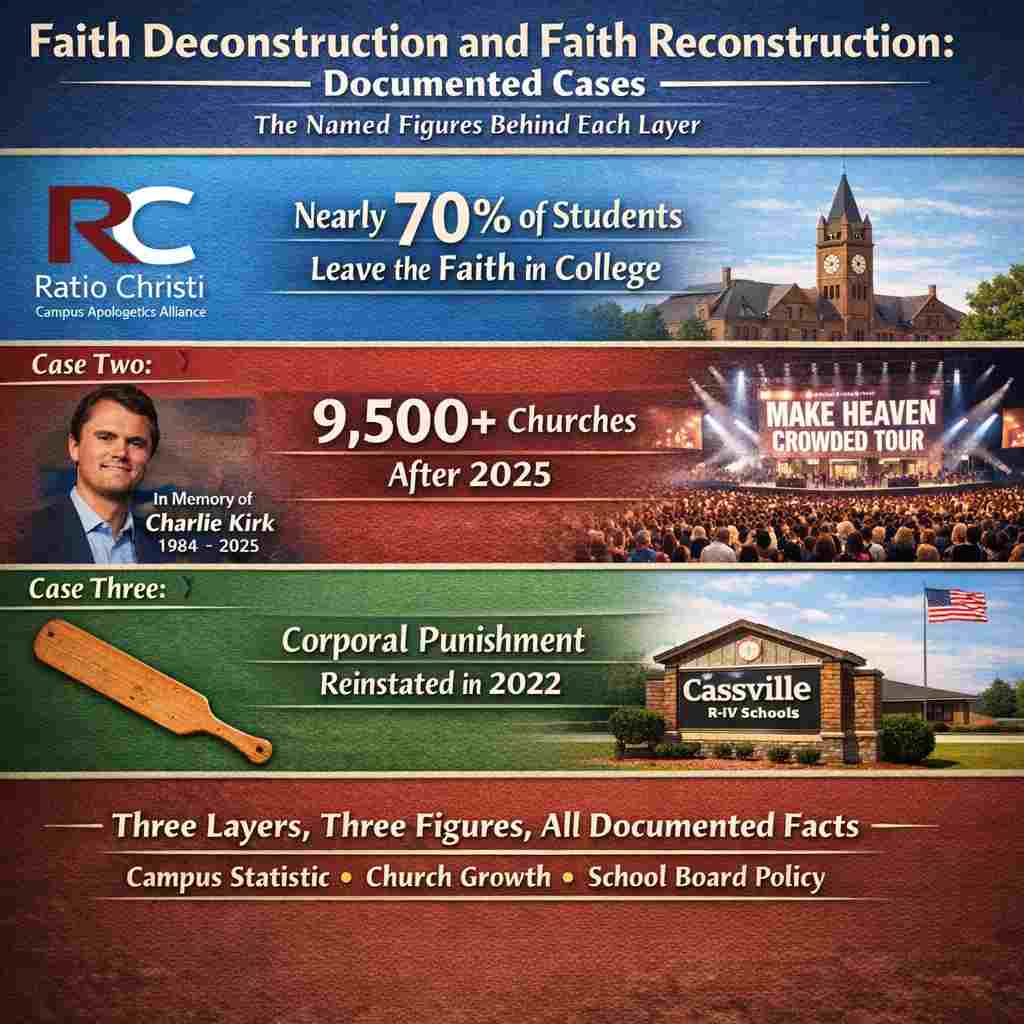
The three-layer structure isn’t theoretical. Each layer has a specific, verifiable figure attached to it.
Case One: Ratio Christi’s Own Numbers
Ratio Christi’s promotional materials state that nearly 70 percent of students leave the Christian faith during college. They describe the university as “the most influential institution in Western culture.” The organization built a global campus network specifically around that single statistic. That confirms prevention operates on a real, self-reported retention crisis, not a hypothetical one.
Case Two: Turning Point Faith’s Post-2025 Growth
Following Charlie Kirk’s death in September 2025, TPUSA Faith’s church network reportedly more than doubled. It grew from around 4,200 to over 9,500 member congregations. That growth came alongside a new “First Truths” curriculum and a planned multi-city “Make Heaven Crowded Tour.” This is damage control scaling in real time, in direct response to a single catalyzing event.
Case Three: Cassville, Missouri’s Reinstated Paddle
The Cassville School District ended corporal punishment two decades ago, then formally reinstated it in 2022, citing parent requests. Nineteen U.S. states still permit school corporal punishment as of 2026. That’s a direct institutional legacy of the Dobson-era doctrine linking physical discipline to spiritual obedience.
These three cases confirm the pattern from three independent directions. A campus statistic, a media network’s growth curve, and a school board vote all point the same way. None of them required speculation. All three are publicly documented.
Faith Deconstruction and Faith Reconstruction: Frank Turek and the “Goodness” of Evil
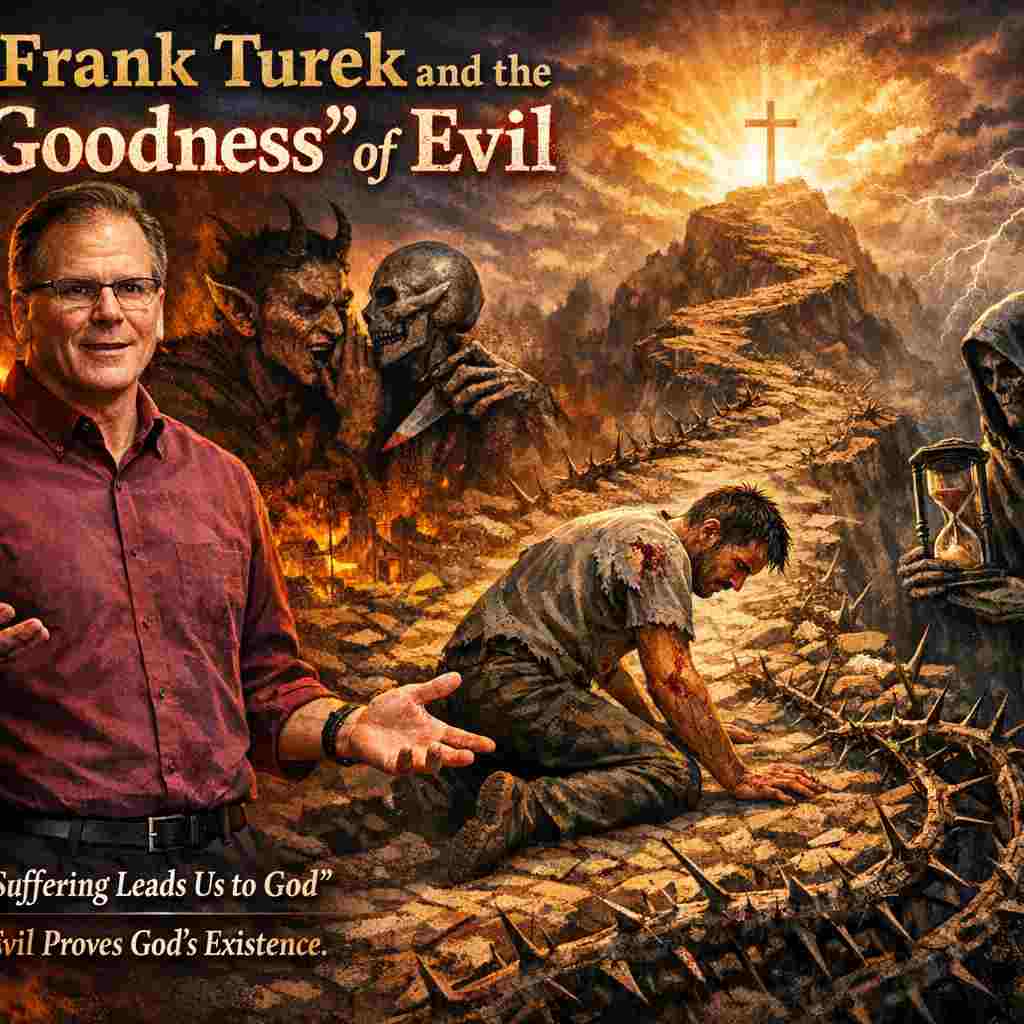
To better understand Christian activists and their faith reconstruction project, I present you with a part from my book in which you can see to what kind of religious delusion they try to push people who are deconstructing faith back in by perverting basic logic and the meaning of common terms.
“The Christian apologist Frank Turek says that man learns humility before god through suffering and presents this self-denying and self-destructive humiliation as something good. He forgets that by accepting a system of Evil, lies, and violence against others, he also accepts that the same Evil will be perpetrated against him. Turek presents Evil as proof of the existence of god and even as a way to god. The thorny path, full of necessary suffering, which alone leads them to god, is believed in by all Christians:
“Since many people ask in the comments, I believe there will be free will in heaven. It is a question of mentality because in this world we have to sanctify ourselves before we can enter God’s presence. Suffering may be the best way to do this.”
Accepting the System of Evil and suffering is like assisting the devil in torturing you, and praising it as something “Good”.
Christian apologists such as Frank Turek want to avoid the commonly known and accepted interpretation that faith is the belief in things for which there is no proof, so they have invented a new definition according to which faith is “trust” in god. This is a fine example of the irrational use of the mind because it is obvious to anyone but Frank that if you want to trust in god and his existence, you must first believe in him.
Who would trust Yahweh, a psychopathic sadist? Only religiously blinded Christians who don’t know A from B, don’t know White from Black, and claim that Evil Yahweh is a Good God.
Trust means that one wants something to be good so badly that one believes it could happen. Trust and belief can be a positive quality, but only if the person believes and trusts in a real possible good that can happen, not in a god that does not exist and cannot exist because it is impossible. Natural trust and belief are rational behaviors, but faith is irrational because believers believe in fictional beings for which they have no evidence. There is no god, so there is no proof of god. Since there is no possibility of his ever appearing, believing and trusting in a god to help the faithful is true superstition, sorcery, and belief in fiction.
Matthew W. Bates, a professor of Christian theology, first elevated faith above reason because “faith is supposed to help us better understand the difference between what is true and what is false.” He also implied that the faithful are clever and the unfaithful are stupid because they are unable to distinguish between the true and the false because of their lack of faith. This is from a believer who is completely lost in a religious delusion teeming with mythological creatures of fiction.
(Faith) »It’s “the opposite of reasoned judgment in consideration of the evidence,” as Matthew W. Bates explains. “Faith was reckoned not just an alternative but a superior way of knowing what is true and what is false.”
It pitted faith against reason, dividing people into the religious and the rational, with the religious supposedly superior, smarter, and even more intelligent because they can tell the truth from falsehood.
In his religious enthusiasm, Mathew then took Turek’s faith as “trust” in god to an even higher level, declaring faith to be “devotion” to God. The term “allegiance” means devotion.
»In his 2017 study, Salvation by Allegiance Alone: Rethinking Faith, Works, and the Gospel of Jesus the King, Bates explains the word pistis actually means, not any traditional idea of ‘faith’, but—‘allegiance’ for a leader.
In 1 Maccabees 10:25–27, a king checks in on a political ally, and says: “Now continue still to keep faith [pistis] with us, and we will repay you with good for what you do for us.” The idea in the Bible seems to be—to place your “faith” in Jesus. Of all the deities, he’s your king.«
Source: https://medium.com/belover/10-key-bible-terms-that-christianity-misunderstood-14ba68971240
In the quote above, Matthew has demonstrated his faith, trust, and commitment to the Bible and Jesus, presenting faith as wiser than reason alone. Or so he thinks, when in reality he is lost in the irrationality of believing in the Jesus myth.
The term “allegiance” implies not only devotion but also servile submission, loyalty, obedience, and submission to a Master, a superior being, a human being, or an organization.
By submitting to another, one automatically gives up the freedom, autonomy, and sovereignty to decide one’s own life and surrenders to him the power to decide for oneself. From that moment on, he must do his bidding, thus becoming his servant, believer, soldier, worker, and slave. In her naivety, he even thinks that this gives him protection, security, and grace, but in reality, he is only prey to a predator who seeks out the naive, the weak, the incapable of independent thought and action, the underdeveloped, the uneducated, the poor, the helpless, and the needy, to exploit them for his selfish interests.
This is exactly what the crusading missionaries and predatory priests who sexually abuse children, young and old, are doing. Interestingly, the perverted priests are overwhelmingly sexually abusing the children of religious parents because the non-religious are not so stupid and cruel as to put their children in the hands of sexual predators, pretend that it is not happening, and continue to support the perverts.”
If you are a believer deconstructing your faith, stay strong, and don’t fall for this obvious nonsense, lies, and manipulations. Finish your liberation, and start living naturally in truth, reason, and logic.
Source: Senad Dizdarević, Book 1, It’s Finally PROVEN! God Does NOT Exist The FIRST Valid EVIDENCE in History
Deconstruct Your Faith With Senad Dizdarević’s Book Series:
It’s Finally PROVEN! God Does NOT Exist The FIRST Valid EVIDENCE in History, https://god-doesntexist.com/
👉 Get the eBook Series on Amazon
👉 Get the Paperback Series on Amazon
“Letters to Palkies Messages to My Friends on Another Planet”, https://www.letterstopalkies.com/,
👉 Get the eBook Series on Amazon
👉 Get the Paperback Series on Amazon
Believers, priests and nuns, deconstruct your faith, leave religion, and start with the natural personal development in reason, logic, and reality.
Faith Deconstruction and Faith Reconstruction: FAQ
What is faith reconstruction?
Organized Christian activism that works to prevent, limit, or reverse faith deconstruction through three distinct layers.
What are the three layers of faith reconstruction?
Prevention through campus apologetics, damage control through youth retention campaigns, and reconversion through targeted rhetoric.
When did faith deconstruction begin as a term?
Academically in 1983 with Mark Taylor’s Deconstructing Theology; as a mass movement in 2016 with exvangelical culture.
What does William Lane Craig actually say about evidence?
That the “witness of the Holy Spirit” takes precedence over evidence, even if evidence turns against Christianity.
Why does Frank Turek ask “would you become a Christian if it were true”?
To reframe evidential doubt as willful refusal, testing willingness rather than testing the claim itself.
How does James Dobson’s parenting doctrine connect to faith reconstruction?
It installs unquestioned obedience to authority in early childhood, before any apologetics training is needed.
What does purity culture have to do with faith reconstruction?
It applies the same authority-first, rule-based logic to teenage sexuality that prevention ministries apply to belief.
Does ARCA target any of these three layers directly?
Yes – by requiring consent for binding religious enrolment, The Age of Religious Consent Act (ARCA) by Senad Dizdarević removes the pre-consent leverage all three layers depend on.
Religious Objections to This Analysis, and the Evidence-Based Strong Atheism Answers
Defenders of faith reconstruction raise consistent objections to being described as a coordinated field. Each has a direct, evidence-based response.
“These are separate ministries, not one coordinated campaign.”
Separate organizations can still function as one field. Three layers targeting three stages of the same process describe a structure regardless of formal coordination. Each is documented with its own public statements.
“Apologetics is just sharing reasons for faith, like any other viewpoint.”
Craig’s own quoted position states evidence is subordinate to an inner witness that cannot be revised by contrary evidence. That’s not reason-sharing. It’s evidence-proofing a predetermined conclusion.
“Corporal punishment and purity culture aren’t part of apologetics.”
They aren’t part of campus apologetics specifically. But they serve the same prevention function at an earlier developmental stage, installing obedience before questioning becomes possible.
“Turek’s question is a fair philosophical challenge, not a trick.”
A fair challenge tests the strength of an argument. Turek’s question tests willingness to believe regardless of truth. It then treats the answer as evidence about the person’s reasoning, rather than about the claim itself.
“ARCA is an attack on religious freedom.”
ARCA doesn’t restrict any adult’s freedom to practice or teach their faith. It withholds binding, non-revocable enrolment from children too young to evaluate the claims. That’s a consent standard, not a religious restriction.
Faith Deconstruction and Faith Reconstruction: Conclusion
Faith reconstruction isn’t a single ministry or a single tactic. It’s three coordinated layers, each with its own named leader, its own audience, and its own evidence trail. Ratio Christi and William Lane Craig work prevention. Charlie Kirk’s Turning Point Faith worked damage control, and its network grew sharply after his death. Frank Turek works reconversion through rhetorical reframing. James Dobson’s doctrine and purity culture do the earliest prevention work of all, inside the home. That work happens years before the other three layers ever get involved. Each layer depends on the same underlying leverage: belief installed before a person could meaningfully consent to it. Remove that leverage, and all three layers lose their foundation at once.
Take Action: Support ARCA
Faith reconstruction, in all three of its layers, exploits one root condition: religious identity installed before consent was ever possible. The Age of Religious Consent Act (ARCA) closes that gap directly. Its three-tier consent structure gives young people legal standing over their own belief. That removes the leverage that prevention, damage control, and reconversion all depend on equally. Read the full proposal, and share it with anyone who has felt the pressure of any one of these three layers.
About the Author
Senad Dizdarević is an independent researcher, philosopher, journalist, and author based in Ljubljana, Slovenia. He founded Evidence-Based Strong Atheism as a named intellectual paradigm, created the AIPA Method (Awakening Into Pure Awareness), and authored the Age of Religious Consent Act (ARCA), a legislative proposal currently under academic review at the Oxford Journal of Law and Religion (OJLR-2026-053).
His work spans two dedicated platforms, god-doesntexist.com and letterstopalkies.com, alongside peer-reviewed academic output on HCommons, Zenodo, Figshare, ResearchGate, and Academia.edu. He publishes two active book series, It’s Finally PROVEN! God Does NOT Exist – The First Valid Evidence in History and Letters to Palkies – Messages to My Friends on Another Planet.
Dizdarević holds verified academic identifiers across major scholarly registries:
- ORCID: 0009-0008-9369-2734
- Wikidata: Q138599746
- ISNI: 0000 0005 3005 8622
- VIAF: 97154440103035341417
Readers can review the full ARCA legislative proposal and supporting research at the ARCA campaign page.
Related Articles
- Faith Deconstruction Hijack Exposure: How Christian Networks Control the Deconstruction Conversation
- Faith Deconstruction Hijack History: Did Paul Hijack Christianity First?
- Faith Deconstruction for Teens: How Religiously Indoctrinated Children Start Questioning the Script
- Faith Deconstruction for Priests and Nuns: Why Those Who Indoctrinated Children Understand Best Why to Leave
- Faith Deconstruction for Parents: How to Support a Questioning Teen Without Coercion
- The Age of Religious Consent Act (ARCA): Protect Children’s Cognitive Autonomy
- AIPA Method for Faith Deconstruction: Awakening Into Pure Awareness for Religious Believers and Ex‑Believers Seeking Rationality and Inner Freedom
- History of Faith Deconstruction and Leaving Religion: From Ancient Doubt to Modern Evidence-Based Strong Atheism by Senad Dizdarević
- Faith Deconstruction Guide for Teens, Parents, and Families: Is God Real for Teens? New Book by Senad Dizdarević
- Best Books for Faith Deconstruction for Teens: Reddit Recommendations, Comparison & Review
