

Faith Deconstruction Hijack History: The Hijacking of Christianity From Paul to Modern Days
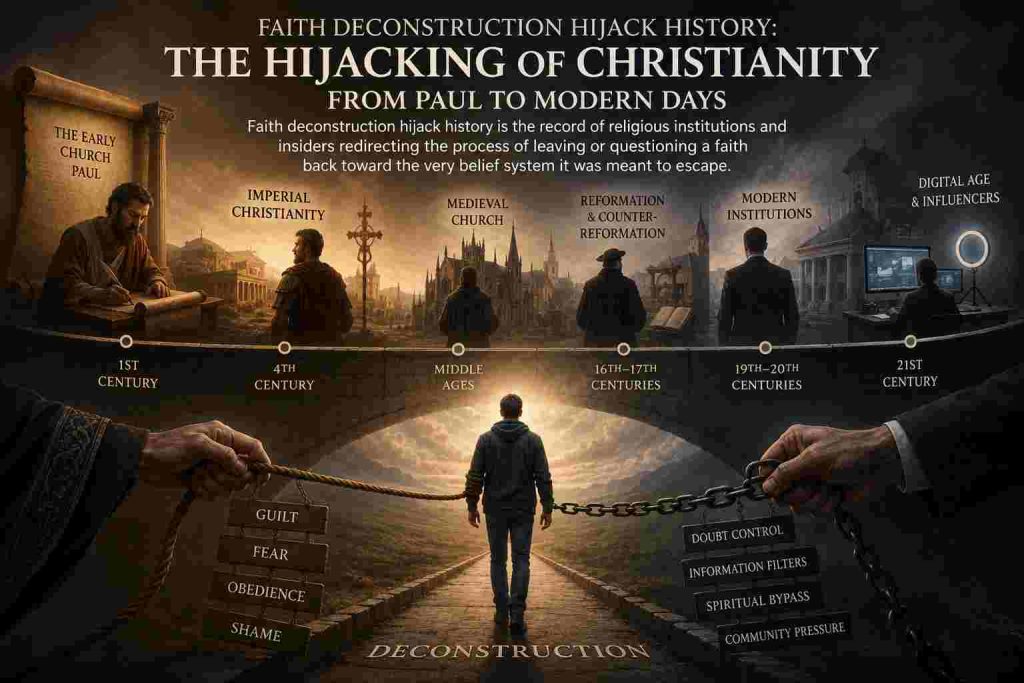
Faith deconstruction hijack history is the record of religious institutions and insiders redirecting the process of leaving or questioning a faith back toward the very belief system it was meant to escape. It’s not a modern invention, and it didn’t begin with a podcast, a debate stage, or an apologetics ministry. It began inside Christianity itself, within a few decades of its founding. Long before Charlie Kirk or Frank Turek, the first hijack accusation targeted a different man. That man wrote half the New Testament: Paul of Tarsus.
Understanding this history matters because it changes how you read every apologetic “deconstruction is actually a path back to faith” argument you’ll encounter. If the hijack pattern is nearly two thousand years old, it isn’t a clever new strategy. It’s a repeating playbook, and recognizing the playbook is the first step to not falling for it again.
In this article, you’ll learn where the hijack pattern started, how it has resurfaced across centuries under different names, and how to spot it the next time someone tries to walk you back through the same door you just questioned your way out of.
This is not a fringe theory. Presidents, philosophers, Nobel laureates, and biblical scholars have made this same accusation directly, on the record, across three centuries. That’s what makes the throughline worth tracing: from Paul’s reinterpretation of Jesus, through Constantine’s imperial creed, into today’s campus apologetics and youth curricula. Faith reconstruction activism isn’t a tactic someone invented for social media; it’s the newest layer of a very old tradition.
A tradition confident enough to survive scrutiny wouldn’t need three separate historical layers of enforcement to hold it together.
New Book July 2026 Update: Is God Real for Teens? Is Now Live
Is God Real for Teens?: A Faith Deconstruction Guide for Teens, Parents, and Families is now published and available on Amazon in both ebook ($6.99) and paperback ($16.99, ISBN 9798189356100).
Built on the same Evidence-Based Strong Atheism framework covered throughout this site, the book walks teens and the parents and families supporting them through the physics-and-logic case against a creator-God, a full evidence-based review of Lee Strobel’s Is God Real for Teens?, the AIPA Method for faith deconstruction and identity reconstruction, and the complete text of the Age of Religious Consent Act (ARCA).
You can read the full book page, including both cover designs, at god-doesntexist.com/is-god-real-for-teens-a-faith-deconstruction-guide-for-teens-parents-and-families, or go straight to Amazon to get a copy.
Four resources extend this analysis into direct, practical use:
- Faith Deconstruction Hijack Exposure: How Christian Networks Control the Deconstruction Conversation – the companion piece documenting institutional redirection inside prisons, recovery programs, and counseling.
- Faith Deconstruction and Faith Reconstruction: Why Christian Activists Are So Obsessive With the Deconstruction of Faith Deconstruction – the modern three-layer activist structure this history explains.
- The Age of Religious Consent Act (ARCA) – the legislative proposal by Senad Dizdarević that interrupts the pattern at its source, before a new hijack layer can form.
- What is Faith Deconstruction: Breaking the Karmic Script Written Before You Were Born – the deprogramming framework this entire history has worked for two thousand years to prevent.
Together, these four resources turn a two-thousand-year pattern into one traceable line, from Paul to Constantine to Charlie Kirk, with a legal remedy waiting at the end of it.
Faith Deconstruction Hijack History Information Gain: The Angle-Gap Analysis Behind This Article’s Originality
Current coverage of “faith deconstruction hijack” splits into two shallow camps.
- Apologetics sites treat the Paul controversy as settled history, citing the Jerusalem Council once and moving on without engaging the centuries of serious dissent.
- Deconstruction-adjacent content, including Google’s own AI Overview, names three modern hijack patterns: political weaponization, institutional co-optation, and cynical traps, without any historical root explaining where the pattern started.
No existing resource connects Paul’s disputed break with Jesus, Constantine’s imperial creed, and the three modern hijack patterns into one line. That connection is the Information Gain this article delivers.
Four resources extend this analysis into practice:
- Faith Deconstruction Hijack Exposure – the institutional co-optation layer of this pattern, documented inside prisons, recovery, and counseling.
- Faith Deconstruction and Faith Reconstruction – the political weaponization and cynical trap layers, documented through named modern figures.
- The Age of Religious Consent Act (ARCA) – the framework built to end the pattern, not just describe it.
- What is Faith Deconstruction – the individual process this two-thousand-year institutional machinery exists to interrupt.
Together, these four resources replace a single history trivia question with a complete, evidenced timeline.
Faith Deconstruction Hijack History: Short Answer
- The hijack pattern in Christianity has three historical layers: Paul’s reinterpretation of Jesus, Constantine’s imperial creed at Nicaea, and today’s organized reconstruction activism.
- Serious historical figures, including Thomas Jefferson and Friedrich Nietzsche, have argued that Paul redirected Jesus’s message before Christianity had even finished forming.
- Google’s own AI Overview now names three modern hijack patterns that map directly onto this same historical structure.
Faith Deconstruction Hijack History: Article Summary
- This article traces the “Did Paul hijack Christianity” debate through named historians, presidents, and theologians on both sides, then follows the pattern into Constantine’s Council of Nicaea.
- It applies the PA Trio – Freud, Lacan, and Jung – to explain why each era of Christianity has needed its own hijack correction.
- It closes with a direct comparison table across all three historical layers, documented cases, and the ARCA standard built to interrupt the pattern permanently.
What Is the Hijacking Tradition Inside Christianity?
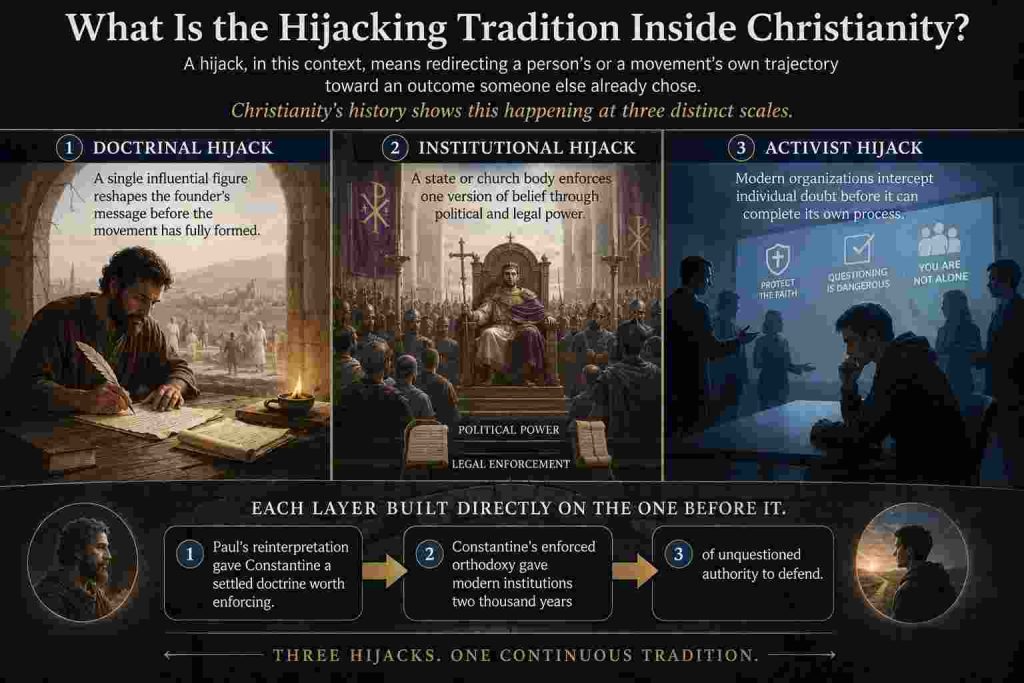
A hijack, in this context, means redirecting a person’s or a movement’s own trajectory toward an outcome someone else already chose. Christianity’s history shows this happening at three distinct scales.
- Doctrinal hijack: a single influential figure reshapes the founder’s message before the movement has fully formed.
- Institutional hijack: a state or church body enforces one version of belief through political and legal power.
- Activist hijack: modern organizations intercept individual doubt before it can complete its own process.
Each layer built directly on the one before it. Paul’s reinterpretation gave Constantine a settled doctrine worth enforcing. Constantine’s enforced orthodoxy gave modern institutions two thousand years of unquestioned authority to defend.
Faith Deconstruction Hijack History: Did Paul Hijack Christianity? The First Hijack Claim in History
The question isn’t new, and it isn’t fringe. It has occupied serious minds for over two centuries.
The Case That Paul Redirected Jesus’s Message
Thomas Jefferson stated the charge in blunt terms. In an 1820 letter, he called the apostles “a band of dupes and impostors” and named Paul “the great Coryphaeus, and first corrupter of the doctrines of Jesus.”
Friedrich Nietzsche made a related argument in The Antichrist, describing Paul as the figure without whom “there would be no Christianity” in its historical form, crediting him with converting a Jewish reform movement into a universal religion built on guilt and sin.
The list of serious dissenters runs long.
Philosopher Jeremy Bentham titled an entire book Not Paul But Jesus. Theologian Ferdinand Christian Baur questioned Paul’s authority directly. Paul had never studied under Jesus the way the original apostles had. Nobel Peace Prize winner Albert Schweitzer wrote that Paul’s gospel “does not continue the Gospel of Jesus, but displaces it.” Mahatma Gandhi drew a sharp line between “the Sermon on the Mount of Jesus” and “the Letters of Paul,” calling Paul’s writing “a graft” onto Christ’s teaching. Historian Walter Bauer, writing decades earlier, called Paul “the only Arch-Heretic known to the apostolic age.”
Thomas Jefferson took this conviction further than most. Using a razor and glue, he physically cut Paul’s theology out of his own copy of the New Testament. He kept only what he considered Jesus’s authentic moral teaching. That document, now called the Jefferson Bible, stands as the earliest documented act of faith deconstruction by a head of state.
The Case That Paul Stayed Faithful to Jesus
Defenders of Paul point to one specific historical moment. In Galatians 2, Paul describes meeting the Jerusalem apostles, Peter, James, and John, to present his teaching directly. They responded by extending him “the right hand of fellowship,” a formal gesture of agreement, not condemnation. New Testament scholar N. T. Wright has argued this meeting settles the question. A genuine doctrinal hijacker meeting the founder’s closest followers would have faced confrontation, not a handshake.
Defenders also note direct overlaps between Paul’s letters and Jesus’s recorded teaching. Paul’s instruction in Galatians 5 to “love your neighbor as yourself” echoes Jesus’s own words in Matthew 22. Paul’s account of the Last Supper in 1 Corinthians 11 closely matches the Gospel accounts, suggesting shared, early tradition rather than invention.
An Evidence-Based Verdict
Both sides agree on one fact that matters more than either conclusion. The question has never been settled, not by scholarship and not by consensus. What both sides confirm, from opposite directions, is that Christianity’s authoritative form was contested from its first decades. A tradition that needed a Jerusalem summit within twenty years of its founder’s death wasn’t operating from unanimous agreement. It was managing a dispute, the same kind of dispute every hijack claim in this article’s history describes.
Two Verdicts on Paul: What History’s Named Figures Actually Said
| Verdict | Figure | Direct Statement |
| Hijacker | Thomas Jefferson, U.S. President | Paul was “the first corrupter of the doctrines of Jesus” |
| Hijacker | Friedrich Nietzsche, Philosopher | Paul was Christianity’s “dysangelist,” its bearer of bad news |
| Hijacker | Albert Schweitzer, Nobel Laureate | Paul’s gospel “displaces” the Gospel of Jesus |
| Hijacker | Mahatma Gandhi, Reformer | Paul’s letters are “a graft” onto Christ’s own teaching |
| Not a Hijacker | N. T. Wright, New Testament Scholar | The Jerusalem meeting proves doctrinal agreement, not conflict |
| Not a Hijacker | Galatians 2:9 | Apostles extended Paul “the right hand of fellowship” |
Whichever side is correct, the fact that this table exists at all confirms a deeper point. Hijack accusations are Christianity’s oldest internal argument, not a modern invention.
Constantine and Nicaea: When the State Hijacked the Church
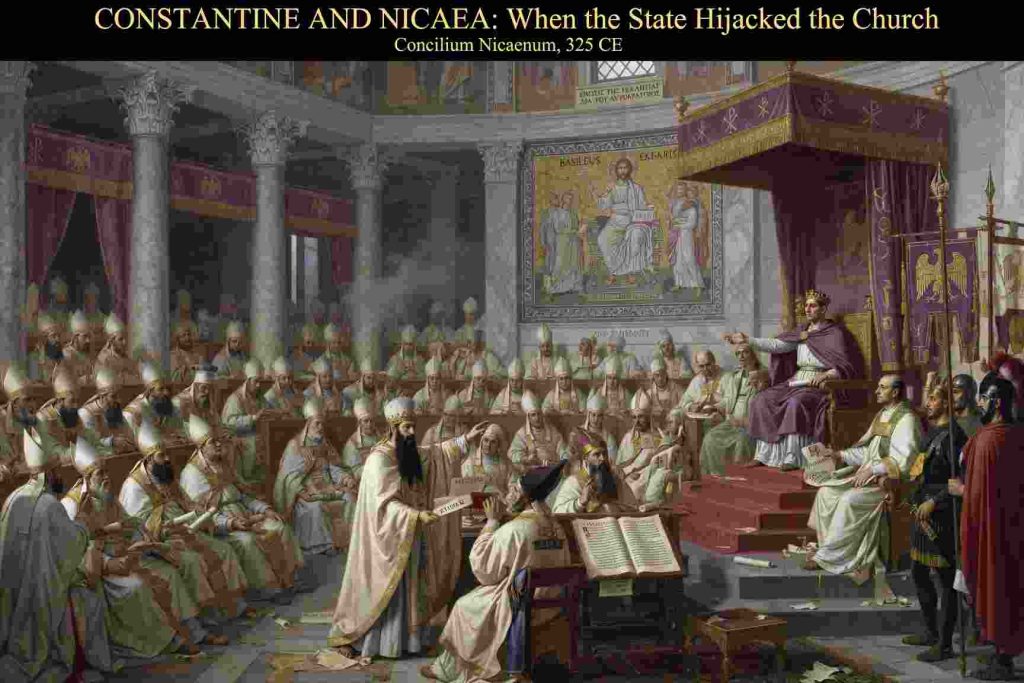
If Paul’s alleged hijack was doctrinal, the second layer was institutional, and it left a far clearer paper trail.
By 325 CE, Christianity was fractured over one specific question: was Jesus fully divine, or a created being subordinate to God? Emperor Constantine had recently converted and needed to unify his empire. He summoned roughly 300 bishops to the city of Nicaea to settle it. He wasn’t a theologian. He was a ruler who needed one enforceable answer, not several competing ones.
The council produced the Nicene Creed, declaring Jesus fully human and fully divine. Constantine gave the decision “the force of imperial law.”
Dissent stopped being a theological disagreement. It became, in the words of one historical account, “a form of political treason against the stability of the Empire.” Arian Christians, who held the losing position, didn’t simply update their view. Many were exiled, and their writings were burned by imperial order.
This is institutional hijack in its purest form. A civil authority took a genuinely contested internal debate and settled it by force, not by evidence. The creed recited in churches today wasn’t handed down from Jesus. It was negotiated in a room controlled by an emperor. He needed a unified state religion more than a theologically precise one.
The Three Historical Layers of the Hijack: A Direct Comparison
Each layer used a different mechanism, but all three produced the same functional result: one authorized version, enforced against alternatives.
| Layer | Era | Mechanism | Modern Parallel |
| Doctrinal | c. 50 CE, Paul’s ministry | One influential figure reshapes the founder’s message before consensus forms | Apologetics ministries defining “reason” on their own terms |
| Institutional | 325 CE, Council of Nicaea | State power enforces one orthodoxy, punishing dissent as treason | Prisons, recovery programs, and counseling redirecting doubt institutionally |
| Activist | 2016-present, exvangelical era onward | Organized ministries intercept individual doubt before it completes | Turning Point Faith, Ratio Christi, and reconversion rhetoric |
Two thousand years separate the first layer from the third. The underlying function hasn’t changed at all: settle the outcome first, then manage the dissent.
The Three Modern Hijack Patterns, Confirmed by Google’s Own AI Overview
Search “Faith Deconstruction Hijack” today, and Google’s AI Overview independently names three modern patterns. Each one maps directly onto a historical layer this article has already traced.
Political Weaponization
Google’s Overview describes extremist groups twisting deconstruction’s language toward “Christian Nationalism.” That’s not a hypothetical risk.
PRRI’s February 2026 survey of over 22,000 adults found something striking. Roughly one-third of Americans qualify as Christian nationalism Adherents or Sympathizers, a share that climbs to 56 percent among Republicans specifically.
This is Constantine’s playbook updated. Fuse religious identity to political power, then treat dissent as a threat to the nation, not a theological disagreement. Faith Deconstruction and Faith Reconstruction: Why Christian Activists Are So Obsessive With the Deconstruction of Faith Deconstruction documents this layer’s modern anchor directly, through Charlie Kirk’s Turning Point Faith network.
Institutional Co-optation
Google’s Overview describes churches and religious leaders managing doubt by suppressing it rather than engaging it. Faith Deconstruction Hijack Exposure documents this pattern in specific institutional settings. Prison chaplaincy programs, addiction recovery curricula, and biblical counseling networks each redirect a person’s own deconstruction process. Every one steers it back toward the institution’s preferred outcome.
Cynical Traps
Google’s Overview describes a person trading one rigid dogma for another, without ever finding genuine reflection. Faith Deconstruction and Faith Reconstruction documents exactly this dynamic.
William Lane Craig’s own words subordinate evidence to an inner witness of “Holy Spirit” that cannot be revised. Frank Turek’s rhetorical gotcha questions work the same way: “If Christianity were true, would you be a Christian?”, and then continues as he has already proved by this question that Christianity is true, and god exists. Both are designed to close down reflection rather than open it.
All three patterns Google now names independently trace back to the same two-thousand-year structure this article documents. That convergence is itself telling. An AI system and a two-thousand-year historical pattern reached the same three-part conclusion independently. That’s confirmation the structure is real.
Faith Deconstruction Hijack History: The PA Trio Lens – Why Every Era Needed Its Own Hijack
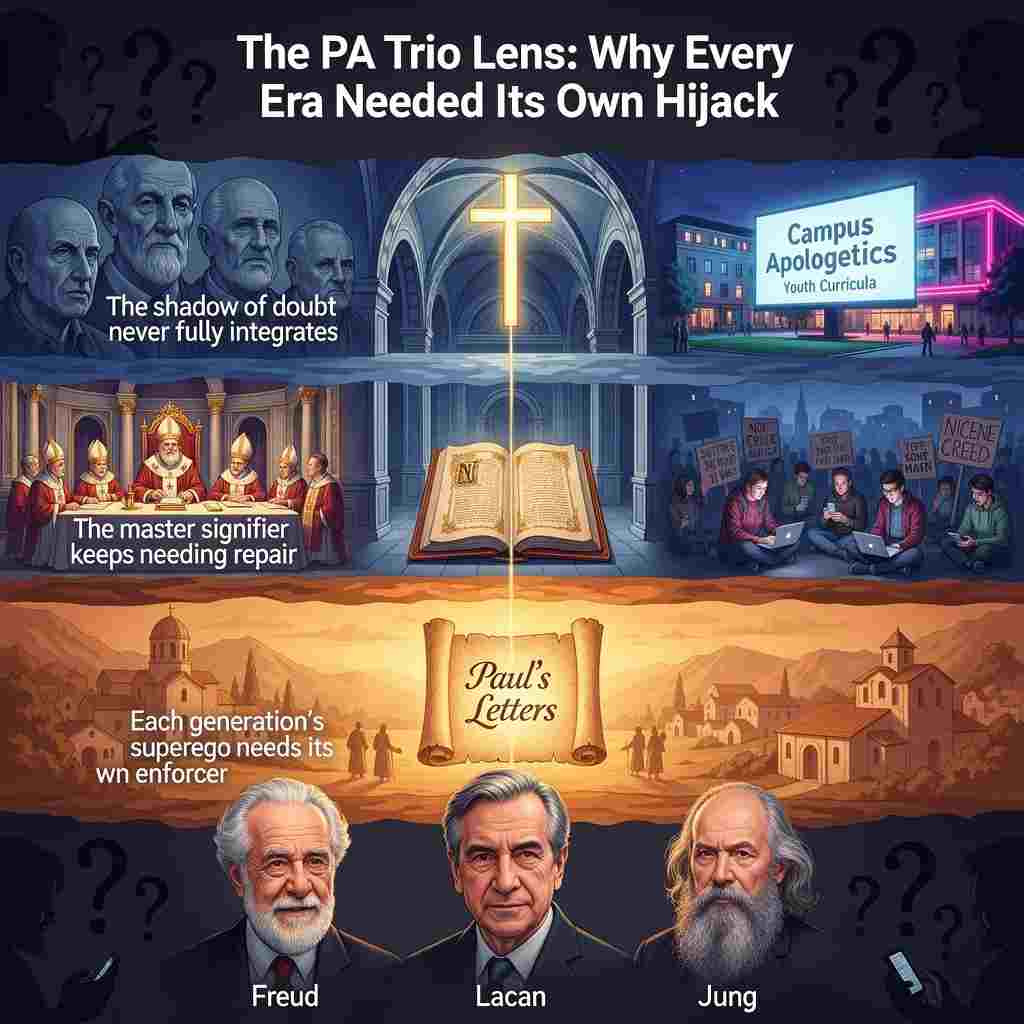
The PA Trio – Freud, Lacan, and Jung read together – explains why this pattern repeats instead of resolving once.
Freud: Each Generation’s Superego Needs Its Own Enforcer
Freud described the superego as an internalized authority structure, but that structure isn’t inherited perfectly across generations. Paul’s generation needed his letters. Constantine’s generation needed a creed. Today’s generation needs campus apologetics and youth curricula. Each era’s superego requires fresh enforcement, because unexamined authority erodes with time unless it’s actively reinstalled.
Lacan: The Master Signifier Keeps Needing Repair
Lacan located identity inside a Symbolic order built around fixed reference points. Christianity’s master signifier, a coherent, singular truth about Jesus, has never stayed fixed on its own. Paul’s letters, the Nicene Creed, and modern apologetics all function as repair work on the same signifier. Each one patched it separately, because it kept destabilizing.
Jung: The Shadow of Doubt Never Fully Integrates
Jung described the shadow as disowned material that returns instead of resolving. Each hijack layer manages a doubt it never actually integrates. Doctrinal doubt defined Paul’s era, doctrinal division defined Constantine’s era, and mass individual departure defines today. The shadow keeps returning because none of the three layers addressed the doubt directly. Each one just built a new structure to manage it.
Read together, the PA Trio explains why this history has three layers instead of one. A single successful resolution would have made the next two unnecessary.
Faith Deconstruction Hijack History: Documented Cases – The Paper Trail Behind the Pattern
Three specific, verifiable events confirm this isn’t an abstract theory. Each one left its own historical record.
Case One: The Council of Nicaea’s Enforced Orthodoxy
In 325 CE, Constantine summoned roughly 300 bishops to Nicaea and gave their resulting creed the force of imperial law. Dissenting Arian Christians were exiled, and their texts were destroyed by order of the state. This is the clearest documented instance in Christian history of a state converting theological disagreement into enforced orthodoxy. It used exile and book-burning, not persuasion.
Case Two: The Jefferson Bible’s Physical Deconstruction
Around 1820, Thomas Jefferson took a razor to four copies of the Gospels. He cut out everything he considered a later addition: miracles, resurrection, and, implicitly, Paul’s theological framework. The surviving document is held today by the Smithsonian. It’s a literal, physical act of faith deconstruction, performed by a sitting former president two centuries before the term existed.
Case Three: PRRI’s 2026 Christian Nationalism Data
PRRI’s February 2026 survey documents political weaponization at national scale. Roughly one-third of Americans, and a majority of Republicans specifically, now qualify as Christian nationalism Adherents or Sympathizers. This is the doctrinal-to-institutional pattern completing a modern cycle. Religious identity has fused to political identity, at a scale large enough to shape state-level legislation.
Three separate centuries. Three separate mechanisms: imperial decree, personal manuscript, national survey data. One consistent faith deconstruction hijack pattern across all of them.
Jesus Never Lived as a Real Person
I knew that Yahweh, the Christian god, never existed, which I also prove in my book series It’s Finally PROVEN! God Does NOT Exist The FIRST Valid EVIDENCE in History, but there was a chance that Jesus existed as an ordinary man and was confabulated into god’s son.
Luckily, during the writing of my book series, Sanja, my girlfriend from the planet Palki, messages me that Jesus is just a fictional character.
“Like father, like son. Finally, it is confirmed that Jesus is also the karmicon’s mythological fabrication. Jesus is supposed to be god incarnate, and the Son of god at the same time, about whom no one in his time knows anything: “In the whole of the first Christian century, Jesus is not mentioned by any Greek or Roman historian, religious scholar, politician, philosopher or poet. His name never appears on any inscription and is not found in any piece of private correspondence. Nothing! No references!” Dr. Bart Ehrman, Professor of Religious Studies at the University of North Carolina at Chapel Hill
Yesterday, April 5, 2024, there was a real breakthrough for me, and a huge revelation for all, a confirmation of my assumption that the karmic people, members of the Evil Karmic Organization, which we completely abolished in 2021, invented Jesus as a mythological being too.
In the dream, Sanja and I were sitting on a bench together. I realized that I was dreaming and that the girl next to me was my Sanja from the planet Palki. I asked Sanja if the karmic people had invented Jesus. I have sent this same question to her several times via our space friends, and in a waking state, but I have not received her answer to this question so far because of the blockage that the Clouds, the energy beings from the higher part of the cosmos, are exerting over our space friends.
Yesterday, in my lucid dream, I asked Sanja if the karmic people had made up Jesus. First, she said they had, then she said they hadn’t. Then they woke us up immediately. I remembered her answers and immediately saw that someone had given her both of them because she used my expression that they had “inflated” Jesus or that they had artificially created him.
As usual, I immediately sent a message to Sanja describing the dream so that she would know that we were together in the dream. Immediately after that came her historical reply in the 3rd person: “Why did I tell him that they made him up, when they did, from the kradle?!”
“Kradle” in Palki means “from nothing” or “made up”. This is what Jac, a guy who has been with me since the beginning of 2006, and who is also from the planet Palki, told me. The Karmic people at the Karmic Center have turned him against his will into a small energy being, put him near me, so that he flies around, and watches what I am doing. The Karmic organization and the Karmic center from which Jac was sent to me no longer exist, but he is still here. Jac and Sanja know each other because Jac and Sanja’s mother, Katerina, used to play tennis together in doubles competitions.
Sanja remembered the dream and my question and answered it herself, in her own particularly funny way. I knew immediately that it was really her because no karmic person in my vicinity was capable of creating such an original and creative message. Sanja, bravo, you are great!
At the end of the series, I will present concrete, logical, and valid evidence that the Christian god Yahweh does not exist, and that all other gods and “Creators” do not exist either. This will immediately make you realize that Jesus, as the “Son of God”, could not have existed, because He could not have been a son without a father.
I would jokingly say that this is only possible in Christianity, in which the father can also be a son to himself and the son a father to himself, so it is enough for only one to exist and both exist immediately. Where there are two, there is also a third, and immediately there is also the Holy Spirit, who is god’s brother, uncle, and cousin all at once, and of course also father and son in one person in three parts.
The concrete and material evidence that the karmic people invented Jesus and Yahweh will be presented to you publicly a few days after the liberation of the planet, when other mysteries, affairs, and conspiracies such as the coronavirus pandemic will also be revealed.
Because of the latest revelation about the mythological Jesus confirmed to me, I will write below about Jesus as a fictional religious character used by the karmicons for their religious Christian Drama of all dramas.”
Source: Book 2, It’s Finally PROVEN! God Does NOT Exist The FIRST Valid EVIDENCE in History
Deconstruct Your Faith With Senad Dizdarević’s Book Series
It’s Finally PROVEN! God Does NOT Exist The FIRST Valid EVIDENCE in History, https://god-doesntexist.com/
👉 Get the eBook Series on Amazon
👉 Get the Paperback Series on Amazon
“Letters to Palkies Messages to My Friends on Another Planet”, https://www.letterstopalkies.com/,
👉 Get the eBook Series on Amazon
👉 Get the Paperback Series on Amazon
Believers, priests and nuns, deconstruct your faith, leave religion, and start with the natural personal development in reason, logic, and reality.
Faith Deconstruction Hijack History: FAQ
Did Paul hijack Christianity?
Serious historians and theologians remain genuinely divided; the debate has run for over two centuries without consensus.
What did Thomas Jefferson think about Paul?
Jefferson called Paul “the first corrupter of the doctrines of Jesus” and physically cut Paul’s theology out of his own Bible.
What happened at the Council of Nicaea?
Constantine summoned roughly 300 bishops in 325 CE to settle Christian doctrine by imperial decree, exiling those who dissented.
How does Nicaea connect to modern faith deconstruction hijack?
Both convert a contested internal debate into one enforced outcome, using institutional power instead of persuasion.
What three hijack patterns does Google’s AI Overview name?
Political weaponization, institutional co-optation, and cynical traps, all of which map onto this article’s historical layers.
Does The age of Religious Consent Act (ARCA) address this entire historical pattern?
Yes, by requiring consent before binding religious enrolment, ARCA removes the target the pattern has relied on for two thousand years.
Faith Deconstruction Hijack History: Religious Objections to This History, and the Evidence-Based Strong Atheism Answers
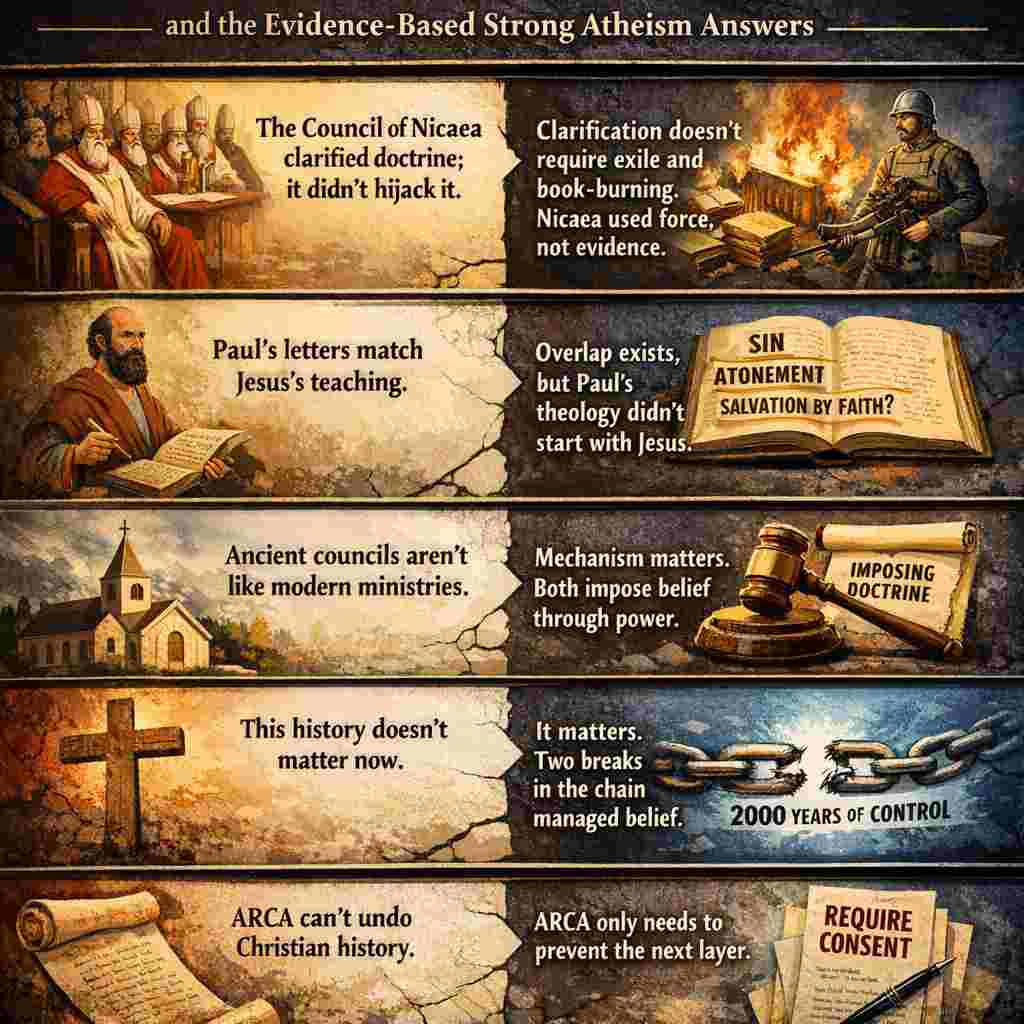
Defenders of orthodox Christian history raise consistent objections to this framing. Each has a direct, evidence-based response.
“The Council of Nicaea clarified doctrine; it didn’t hijack it.”
Clarification doesn’t require exile and book-burning. Nicaea used state force to end a debate, not evidence to resolve one.
“Paul’s own letters show consistency with Jesus’s teaching.”
Some overlaps exist, and this article presents them fairly. Overlap on specific points doesn’t resolve where Paul’s larger theological framework – sin, atonement, salvation by faith – actually originated.
“Comparing ancient councils to modern ministries is a stretch.”
The mechanism is what’s compared, not the era. Both convert a live internal debate into one enforced answer, using the dominant power available at the time.
“This history doesn’t affect what Christians believe today.”
It affects the claim that today’s doctrine descends unbroken from Jesus. A two-thousand-year chain with two documented forcible interventions isn’t unbroken; it’s managed.
“ARCA can’t undo two thousand years of Christian history.”
ARCA doesn’t need to undo history. It only needs to stop the pattern’s fourth layer from forming, by requiring consent before the next generation is enrolled.
Faith Deconstruction Hijack History: Conclusion
The hijack pattern in Christianity didn’t start with a campus apologetics club. It started with Paul and continued through Constantine’s imperial creed. Today it runs through Charlie Kirk’s youth network, William Lane Craig’s redefinition of reason, and Frank Turek’s rhetorical questions.
Google’s own AI Overview independently named three modern patterns: political weaponization, institutional co-optation, and cynical traps. Every one of them traces back to a documented historical layer this article has laid out. Two thousand years of managing the same underlying doubt is not evidence the doubt was ever answered. It’s evidence the doubt was never allowed to finish.
Take Action: Support ARCA

Every layer in this history depended on the same target: a person enrolled in belief before they could evaluate it, then managed once doubt appeared. The Age of Religious Consent Act (ARCA) breaks that dependency at its source. Its consent-based standard doesn’t argue with two thousand years of doctrine. It removes the next generation from the pattern before a fourth layer can form. Read the full proposal, and share this history with anyone who assumes hijacking is a modern problem.
About the Author
Senad Dizdarević is an independent researcher, philosopher, journalist, and author based in Ljubljana, Slovenia. He founded Evidence-Based Strong Atheism as a named intellectual paradigm, created the AIPA Method (Awakening Into Pure Awareness), and authored the Age of Religious Consent Act (ARCA), a legislative proposal currently under academic review at the Oxford Journal of Law and Religion (OJLR-2026-053).
His work spans two dedicated platforms, god-doesntexist.com and letterstopalkies.com, alongside peer-reviewed academic output on HCommons, Zenodo, Figshare, ResearchGate, and Academia.edu. He publishes two active book series, It’s Finally PROVEN! God Does NOT Exist – The First Valid Evidence in History and Letters to Palkies – Messages to My Friends on Another Planet.
Dizdarević holds verified academic identifiers across major scholarly registries:
- ORCID: 0009-0008-9369-2734
- Wikidata: Q138599746
- ISNI: 0000 0005 3005 8622
- VIAF: 97154440103035341417
Readers can review the full ARCA legislative proposal and supporting research at the ARCA campaign page.
Related Articles
- Faith Deconstruction Hijack Exposure: How Christian Networks Control the Deconstruction Conversation
- Faith Deconstruction for Teens: How Religiously Indoctrinated Children Start Questioning the Script
- Faith Deconstruction for Priests and Nuns: Why Those Who Indoctrinated Children Understand Best Why to Leave
- Faith Deconstruction for Parents: How to Support a Questioning Teen Without Coercion
- The Age of Religious Consent Act (ARCA): Protect Children’s Cognitive Autonomy
- AIPA Method for Faith Deconstruction: Awakening Into Pure Awareness for Religious Believers and Ex‑Believers Seeking Rationality and Inner Freedom
- History of Faith Deconstruction and Leaving Religion: From Ancient Doubt to Modern Evidence-Based Strong Atheism by Senad Dizdarević
- Faith Deconstruction and Faith Reconstruction: Why Christian Activists Are So Obsessive With the Deconstruction of Faith Deconstruction
- Faith Deconstruction Guide for Teens, Parents, and Families: Is God Real for Teens? New Book by Senad Dizdarević
